

Which Puzzle Toys Work Best for Senior Dogs?
Quick Summary
For a senior dog with cognitive decline, the best puzzle toys are simple, low-pressure treat puzzles that let them sniff, nudge and solve at their own pace. Start with an easy option that rewards quickly, use high-contrast designs if vision is fading, and choose toys whose difficulty you can adjust.
- Choose a toy that rewards almost immediately if initiation and persistence are low.
- Favor scent-led toys over visual ones when recognition is fading.
- Pick toys that can be used lying down, since mobility and dental limits matter.
- Select toys whose difficulty you can adjust with covers, treat wells or hiding spots.
- Discuss new or worsening behavioral changes with your veterinarian.
Table of Contents
- Why Puzzle Toys Matter for Senior Dogs With Cognitive Decline
- How to Choose a Puzzle Toy for an Aging Dog
- Chewzzle Puzzle Toys Compared: Difficulty, Price and Fit
- Snuffle Mats and Scent Games as Low-Pressure Alternatives
- How to Mentally Stimulate an Older Dog Step by Step
- Safety, Supervision and Keeping Sessions Short
- Start Your Senior Dog's First Puzzle Session Today
- Frequently Asked Questions
Last Updated: October 27, 2026
Which puzzle toys work best for senior dogs? For an aging dog whose thinking is slowing, the best choice is usually a simple, low-pressure treat puzzle that lets them sniff, nudge and solve at their own pace. This guide covers how to choose and start. Puzzle toys offer an older dog something to focus on.
Why Puzzle Toys Matter for Senior Dogs With Cognitive Decline
Mental stimulation is one of the simplest ways to keep an older dog engaged. A treat puzzle gives a dog a task with a result.
Some Chewzzle puzzle feeders release food a few pieces at a time.
How to Choose a Puzzle Toy for an Aging Dog
Use the criteria below as a screening checklist.
Screen for cognitive fit first
If initiation and persistence are both low, start with a toy that rewards almost immediately. If recognition is fading, favor scent-led toys over visual ones.
Accommodate vision and hearing changes
- Choose high-contrast toys: dark treats against a light toy, or a toy that contrasts with your floor.
Respect mobility and dental limits
- Lying-down puzzles: snuffle mats, lick mats, and flat sliding puzzles let a dog work from a comfortable position.
Check the difficulty dial, not just the label
What matters is whether the toy lets you adjust difficulty. Good signs:
- Covers or sliders that can be left partly open at first.
- Treat wells you can fill with high-value food before moving to kibble.
- A design that lets you hide treats in different spots each session.
- A shape your dog can investigate with their nose before using a paw.
When to simplify or stop
Puzzle toys are enrichment, not treatment. Discuss new or worsening behavioral changes with your veterinarian.
A quick buying checklist
-
Fits your dog's current initiation and persistence level.
-
Can be used lying down and stays put on a non-slip surface.
-
Lets you adjust difficulty up or down.
-
Is easy to rinse and dry between sessions.
Chewzzle Puzzle Toys Compared: Difficulty, Price and Fit
Here are the prices listed on each product page.
| Product | Price | Difficulty | Best For |
|---|---|---|---|
| RollFeast Treat Ball | $9.99 | Easy | Gentle starters, slow eaters |
| TreatDrop Ball | $14.99 | Easy | Daily enrichment, light chewers |
| ThinkDisc Puzzle Feeder | $19.99 | Medium | Dogs who enjoy sniffing and nudging |
| MindMaze IQ Puzzle | $29.99 | Medium | Confident dogs ready for variety |
| SmartPaws Interactive Puzzle | $39.99 | Medium to hard | Dogs still sharp and food-motivated |
| PuzzleFeast Sliding Puzzle | $49.99 | Hard | Experienced puzzle solvers |
Gentle Starters for Low-Confidence Seniors
The RollFeast Treat Ball is $9.99 and the TreatDrop Ball is $14.99. The TreatDrop Ball is made from textured silicone. The MindMaze IQ Puzzle is $29.99 and has adjustable treat placement.
Challenge Options for Dogs Still Sharp
The SmartPaws Interactive Puzzle is $39.99. The PuzzleFeast Sliding Puzzle is $49.99 and releases one treat at a time under sliding buttons. The PuzzleFeast listing recommends supervising dogs who tend to chew plastic rather than solve it.
Snuffle Mats and Scent Games as Low-Pressure Alternatives
Not every senior needs a mechanical puzzle. A snuffle mat or simple scent game can be just as enriching and often feels more relaxed: scatter kibble through fabric strands or across a rug and let the dog use their nose to find each piece.
How to Mentally Stimulate an Older Dog Step by Step
A structured routine does two things: it gives your dog predictable, low-stress mental work, and it gives you data. Over a couple of weeks you can see whether a toy is helping, whether it is too hard, and whether your dog settles afterward, a record more useful than any product description.
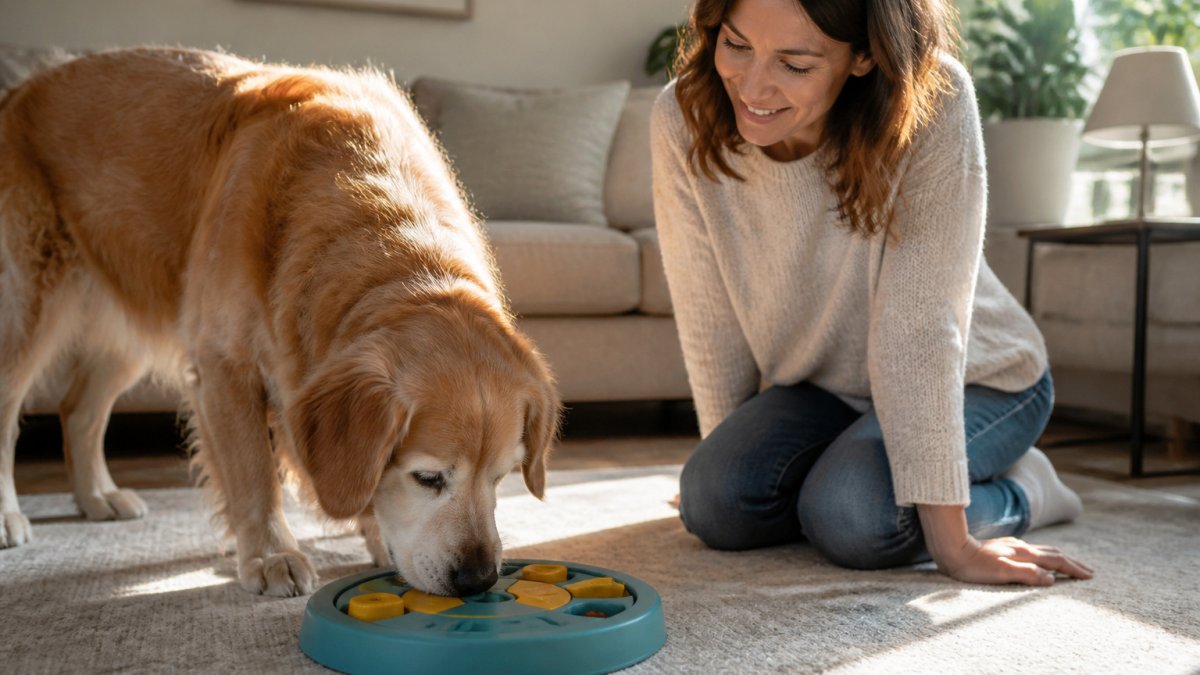
Set up a two-week baseline
- How long does your dog stay engaged with a familiar toy or a scatter of kibble?
Build a short, repeatable session
- Start easier than you think you need to. Leave covers open, use a high-value treat, and let your dog see and smell the setup first.
Track four observable measures
Engagement time often rises slightly in week one, then plateaus, that's fine. A steady decline across several sessions suggests the toy is too hard, too easy, or no longer interesting: simplify, rotate, or try a scent game.
Know when to progress and when to stop
Progress when your dog completes the puzzle easily two or three sessions in a row and still seems eager at the start. Move up one small step, close one more cover, switch from high-value treats to kibble, or hide treats in a new spot.
If you notice new confusion, house-soiling, or sleep changes, raise it with your veterinarian.
Keep the routine realistic
Pair a focused puzzle session with a relaxed scent game later in the day. The puzzle provides problem-solving; the scent game provides low-pressure sniffing. Together they cover more of a senior dog's enrichment needs than either alone.
Safety, Supervision and Keeping Sessions Short
The PuzzleFeast listing recommends supervising the first few sessions and supervising dogs who tend to chew plastic rather than solve it.
Clean each toy after use: rinse with warm water and dry fully so food residue does not attract bacteria. Replace any toy that cracks or loses a cover.
Start Your Senior Dog's First Puzzle Session Today
Browse our full range on the Chewzzle site. Add to cart when you are ready.
Frequently Asked Questions
What can keep a dog entertained for hours?
The PuzzleFeast can be loaded with a portion of normal kibble for an enrichment session. The ThinkDisc has recessed compartments and shallow troughs for kibble.
Are puzzle toys safe for dogs with cognitive decline?
The PuzzleFeast listing recommends supervising the first few sessions and supervising dogs who tend to chew plastic rather than solve it. The ThinkDisc has sliding paw-shaped covers and a turning center wheel.
How long should a senior dog use a puzzle toy at a time?
Most senior dogs do best with sessions of five to fifteen minutes. Stop before your dog becomes frustrated, restless or stops trying, since ending on a success keeps motivation high. Dogs with cognitive decline may lose interest faster as the day goes on, so morning sessions often work better. Start with a single easy compartment and build up gradually as your dog shows steady interest.
Can mental enrichment help a dog with cognitive dysfunction?
Mental enrichment offers problem-solving and treat-based play. Puzzle toys are not a treatment for cognitive dysfunction and do not replace veterinary care. Speak with your veterinarian about diagnosis and care.
