

Are Puzzle Toys Worth It for Dogs?
Table of Contents
- What Are Dog Puzzle Toys and Why They Matter
- The Real Benefits of Dog Enrichment Toys
- Interactive Dog Toys for Mental Stimulation
- How to Choose a Dog Puzzle Toy for Your Pet
- Cost-Benefit Analysis: DIY vs. Commercial Puzzle Toys
- The Verdict: Are Puzzle Toys Worth the Investment?
- Frequently Asked Questions
Last Updated: September 18, 2026
What Are Dog Puzzle Toys and Why They Matter
Dog puzzle toys are interactive games that hide treats or kibble inside compartments, sliding mechanisms, or rotating wheels that your dog must manipulate to access the reward. Unlike a standard toy, puzzle toys require active problem-solving, your dog has to use their nose, paws, and brain to unlock each hidden piece of food.
The core idea is simple: turn mealtime or treat time into mental work. Instead of dumping kibble into a bowl where your dog inhales it in seconds, you're forcing them to think, sniff, nudge, and figure things out one compartment at a time. This mimics how dogs forage in nature, where finding food requires effort and strategy.
A puzzle toy does exactly that. It's not a gimmick. It's a deliberate shift in how your dog interacts with food.
The Real Benefits of Dog Enrichment Toys
Mental Stimulation and Cognitive Development
Mental enrichment is where puzzle toys genuinely shine. Your dog's brain needs work just like their body needs exercise. A 30-minute puzzle session can tire a dog mentally in ways a walk sometimes can't.
When your dog solves a puzzle, they're engaging problem-solving skills. They're learning cause and effect, push this, that opens. They're building focus and persistence. Over time, dogs that regularly work with puzzles show improved ability to concentrate and adapt to new challenges.
The cognitive benefits extend beyond the toy itself. Dogs that receive consistent mental stimulation tend to be calmer overall, more responsive to training, and less prone to anxiety-driven behaviors. They've learned that their brain can solve things, which builds confidence.
Reducing Destructive Behavior and Anxiety
Destructive behavior often stems from boredom or anxiety. A dog with nothing to do and too much energy will find ways to occupy themselves, usually by chewing your couch, digging holes, or destroying toys. Puzzle toys redirect that energy into productive mental work.
For anxious dogs, particularly rescues, puzzle toys serve as a grounding activity. The focused work required to solve a puzzle can interrupt anxiety spirals and give your dog something concrete to concentrate on. It's not a cure for separation anxiety, but it's a valuable tool in managing it.
Introducing a puzzle toy during stressful times, like when you're leaving for work, can give your dog a positive association with that moment. Instead of panic, the dog thinks: "Oh, puzzle time."
Slowing Fast Eaters and Improving Digestion
Fast eating is more than a behavioral quirk. Dogs who gulp their food without chewing risk bloating, which can be serious. Puzzle toys force your dog to eat slowly by design. Each treat or kibble comes out one piece at a time, stretched over several minutes instead of seconds.
This slower pace allows better digestion. Your dog's stomach has time to signal fullness, reducing the risk of overeating. For dogs prone to bloating or those with sensitive digestion, this alone can be worth the investment.
Interactive Dog Toys for Mental Stimulation
Treat-Dispensing Puzzles vs. Sliding Mechanisms
The two main categories of puzzle toys work differently, and which one suits your dog depends on their problem-solving style and motivation level.
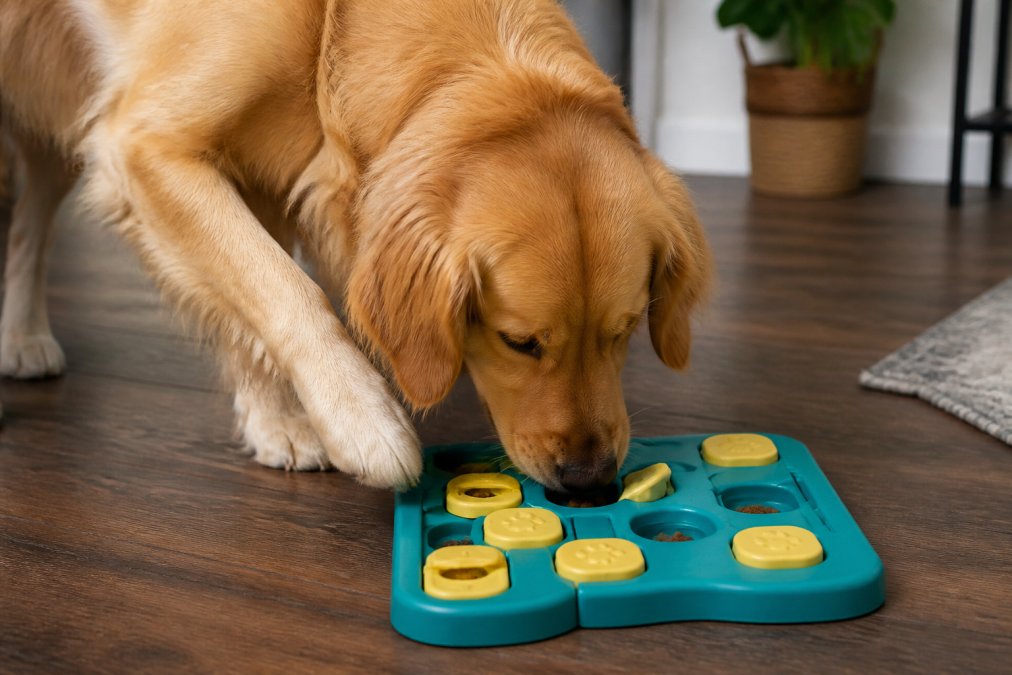
Treat-dispensing puzzles typically have compartments or hidden pockets where you load treats. Your dog has to figure out how to access each one, sometimes by lifting a flap, sometimes by rolling the toy, sometimes by nudging a cover aside. These work well for dogs who are highly food-motivated and enjoy the hunt.
Sliding mechanism puzzles use buttons or covers that your dog pushes or slides to reveal a treat underneath. The Chewzzle PuzzleFeast Sliding Puzzle, for example, lets your dog nose or paw a button aside to reach one treat at a time. This type is excellent for pacing fast eaters because the mechanism inherently slows consumption, only one treat is accessible at once.
The real difference comes down to engagement style. Some dogs love the variety of a multi-compartment puzzle. Others prefer the repetitive, meditative work of sliding the same mechanism over and over. Watching your dog's natural play style will tell you which direction to go.
Difficulty Levels and Breed-Specific Challenges
Not all puzzle toys are created equal in terms of difficulty. A toy that challenges a Border Collie might frustrate a more laid-back breed, while a toy too simple for a smart dog becomes boring within minutes.
Difficulty typically breaks down into three levels. Beginner puzzles have obvious compartments or mechanisms with minimal steps, your dog figures them out within minutes and can repeat the behavior consistently. Intermediate puzzles require multiple steps or hide treats more thoroughly, keeping a moderately clever dog engaged for 10-15 minutes. Advanced puzzles demand serious problem-solving, with hidden compartments, multiple mechanisms, and treats that require sustained effort to access.
Chewzzle SmartPaws Interactive Puzzle →
The Chewzzle SmartPaws Interactive Puzzle offers scalable difficulty, you can adjust where treats are placed and how accessible they are, which means one toy can grow with your dog's skills. This matters because a puzzle that's too easy becomes invisible, and one that's too hard becomes frustrating.

Breed tendencies matter too. Retrievers and Spaniels tend to excel at sniffing-based puzzles. Terriers often prefer paw-work and digging-style mechanisms. Sighthounds may lose interest if the puzzle doesn't have enough visual movement. Knowing your dog's breed instincts helps you pick a toy they'll actually engage with rather than ignore.
How to Choose a Dog Puzzle Toy for Your Pet
Assessing Your Dog's Skill Level and Motivation
Before buying any puzzle toy, honestly assess what motivates your dog. Is your dog highly food-driven, or do they lose interest in treats quickly? Are they a problem-solver who enjoys figuring things out, or do they prefer simpler, more direct play?
Start with a beginner puzzle if your dog has never worked with one before, regardless of age or breed. Success builds momentum. A dog that solves their first puzzle feels accomplished and wants to do it again. A dog that can't figure out an advanced puzzle on day one gets frustrated and ignores it forever.
Also consider your dog's energy level. A high-energy dog needs a puzzle that provides sustained engagement, something that takes 15-20 minutes to complete. A lower-energy dog might be satisfied with a simpler toy that takes 5-10 minutes. Match the toy's difficulty and duration to your dog's actual needs, not to what you think they should need.
Safety, Durability, and Material Quality
This is where many owners cut corners and regret it. A puzzle toy that falls apart after two weeks isn't a bargain, it's waste.
Non-toxic materials matter. Your dog will spend extended time with this toy, potentially chewing or gnawing on it. The Chewzzle product line uses non-toxic, chemical-free plastic for the SmartPaws Interactive Puzzle and BPA-free plastic for the MindMaze IQ Puzzle. Cheap plastics can leach chemicals or break into sharp pieces.
Durability depends on construction quality and your dog's chewing style. Some dogs treat puzzle toys gently, focused on solving them. Others gnaw aggressively. If your dog is a heavy chewer, you need a toy built to withstand that pressure. Look for reinforced seams, thick-walled construction, and materials that resist puncture rather than shatter.
A non-slip base matters more than it sounds. A puzzle that slides across your floor as your dog pushes at it becomes frustrating, the toy moves instead of opening.
Cleaning and Maintenance Expectations
This is the question most guides skip, but it's critical for long-term use. Puzzle toys trap food particles, especially if you're using wet treats or kibble that breaks apart. That food can mold or attract bacteria if not cleaned properly.
Cost-Benefit Analysis: DIY vs. Commercial Puzzle Toys
Many owners ask whether they can make their own puzzle toys instead of buying commercial ones. The answer is: you can, but there are real trade-offs.
The Verdict: Are Puzzle Toys Worth the Investment?
Puzzle toys work. They provide genuine mental stimulation, they slow fast eaters, they reduce destructive behavior, and they give anxious dogs a productive outlet. The question isn't whether they work, it's whether the benefit justifies the cost and effort for your specific dog.
Frequently Asked Questions
Do puzzle toys actually help dogs with separation anxiety and stress?
Yes, puzzle toys can help reduce anxiety by redirecting focus and providing mental engagement during stressful times. They work best as part of a broader enrichment routine. Dogs that are food-motivated tend to respond well, as the problem-solving activity creates a calming effect. However, puzzle toys alone won't resolve severe anxiety, they're most effective when combined with training and consistent routines. Start with shorter sessions and gradually increase difficulty to build your dog's confidence.
Will puzzle toys hold up to aggressive chewers and puppies?
Durability depends on the toy's material and your dog's chewing style. High-quality puzzle toys made from non-toxic, BPA-free plastic can withstand heavy use, but dogs that chew and destroy plastic rather than solve it may not be a good fit. Puppies and aggressive chewers need supervision during play. If your dog tends to shred toys, look for toys designed to be puzzle-solved rather than chewed, and always supervise initial sessions to gauge whether your dog will engage with the puzzle or attempt to destroy it.
How often should I clean puzzle toys, and how much work is it?
Most puzzle toys can be rinsed clean with water and dried between uses, typically taking just a few minutes. For deeper cleaning, hand wash with mild soap and warm water, then air dry completely. If you use kibble instead of treats, cleaning is even simpler since kibble doesn't leave sticky residue. Regular cleaning prevents bacteria buildup and keeps the toy fresh. The cleanup routine is quick enough to use puzzle toys daily without significant extra effort.
Are puzzle toys worth buying if my dog seems happy without them?
Even content dogs benefit from mental enrichment. Puzzle toys provide cognitive stimulation that regular feeding and play don't offer, helping prevent boredom-related destructive behaviors down the road. They're especially valuable for high-energy breeds, puppies during training, and dogs spending time alone. If your dog shows no interest in food-based puzzles, you might try different styles or types. However, if your dog genuinely ignores puzzle toys, they may not be the right fit for your pet's personality, and that's okay, not every enrichment tool works for every dog.