

Benefits of Scent Work for Anxious Dogs and How to Start
Last Updated: November 5, 2026
Quick Summary
Scent work gives an anxious dog a structured search game that uses its strongest sense, sniffing, which tends to slow breathing and focus attention on a solvable task. Start with a treat-scented target in plain sight, then build gradually while keeping sessions short and low-pressure.
- Sniffing engages the smell system and can shift attention away from whatever is causing worry.
- Keep early sessions to 2 to 3 minutes and end while the dog is still interested.
- Stage 1 pairs the scent with a reward, with five to ten repetitions per session over days 1 to 3.
- Change only one variable at a time, such as a new container or a new room.
- Pause or back off if the dog scans for exits, pants heavily, or refuses the reward.
Table of Contents
- What Scent Work Is and Why Dogs Find It Calming
- How Scent Work Supports Anxious and Fearful Dogs
- Mental Stimulation for Anxious Dogs: Focus, Confidence and Relaxation
- Beginner Scent Work for Dogs: A Gradual Introduction Plan
- Scent Training for Dogs at Home: Session Structure and Progress Markers
- When Scent Work Is Not Enough and Who to Call
- Start Your Dog's First Search This Week
- Frequently Asked Questions
Scent work gives an anxious dog a job that uses its nose, and that is often the calmest thing it can do all day. New owners often reach for puzzle toys and slow feeders to keep their dogs busy, and scent work is a natural next step: it turns sniffing into a structured game with a clear start and finish. Searching for hidden food is one of the most natural behaviors a dog has, so the activity tends to feel familiar rather than stressful.
What Scent Work Is and Why Dogs Find It Calming
Scent work, sometimes called nose work, is a game where a dog searches for a hidden scent or treat. The dog learns to find a target, then works through rooms, boxes or containers until it locates the reward.
Dogs process the world largely through smell, so a search uses their strongest sense. A focused sniff tends to slow breathing and shift attention away from whatever is causing worry.
How Scent Work Supports Anxious and Fearful Dogs
Anxious dogs often feel better when they have a predictable, low-stakes task. Scent work provides that structure. The dog knows what to do, the reward comes steadily, and no one asks it to face a scary situation head on. But the reason it works is more specific than "it keeps the dog busy," and understanding the mechanism helps you use it well.
The mechanism: why a searching dog settles
A dog in a search is doing what its nervous system is built for. Sniffing engages the olfactory system and the parts of the brain that process smell, and a focused sniff tends to slow breathing and pull attention onto a single, solvable problem.
There is also a confidence mechanism. Every successful find is a small piece of evidence that the dog can solve a problem on its own.
Match the game to the trigger
Not every anxious dog is anxious about the same thing, and the setup should reflect that. A few common patterns and how to adapt:
- Fear of people or strangers. Run searches with only the handler present, in a room the dog already knows. Keep the dog on a long line if you are working in an open space so it cannot be cornered by an approaching person. Do not invite helpers to "proof" the search until the dog is reliably relaxed alone with you.
- Noise sensitivity. Choose a quiet room away from street noise, appliances, and doorbells. For a gentle first game that rewards each return, try the Launch & Learn Puppy Trainer. Close windows and turn off the TV. If the dog startles at a sound mid-search, pause, let it reset, and restart with an easier hide rather than pushing through.
- Separation-related anxiety. Use scent work as part of a departure routine: a short search before you leave gives the dog a job and a positive association with the moment you go. Keep the hide easy so the dog succeeds without you hovering.
- Outdoor or environmental fear. Start indoors and only move outside once the dog is consistently relaxed inside. When you do go out, pick a familiar, low-traffic spot and keep sessions short. A dog that is worried about the environment cannot also learn a search game.
A common mistake is treating the game as a cure. Scent work may support relaxation, but it does not replace a plan for the specific fears a dog has. Think of it as one tool alongside patient, consistent handling, and if the dog's anxiety is severe, worsening, or paired with aggression or self-injury, pair the game with veterinary and behavior-professional support rather than relying on it alone.

Mental Stimulation for Anxious Dogs: Focus, Confidence and Relaxation
- Short sessions of 5 to 10 minutes work well for most dogs
- Successful finds should come often early on
- End the session while the dog is still interested
Beginner Scent Work for Dogs: A Gradual Introduction Plan
The goal of the first few weeks is not a polished search dog. It is a dog that learns "this game is safe, I can win, and nothing bad happens here." That means building in stages and knowing when to pause rather than push.
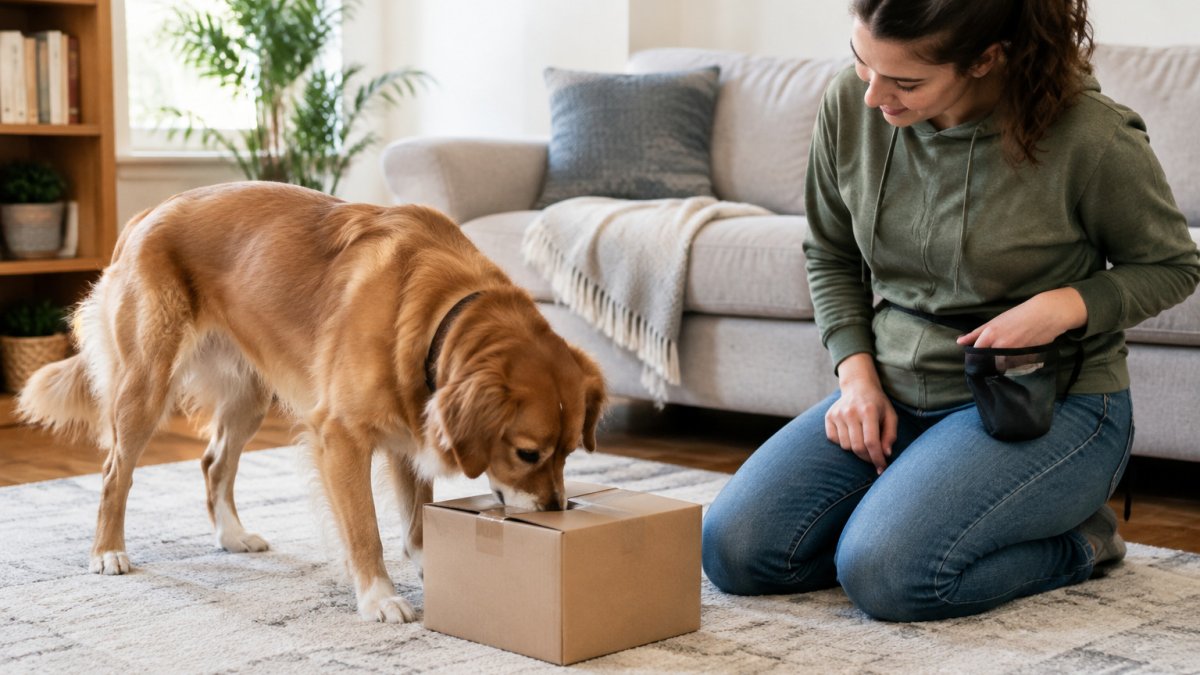
Stage 1: Pair the scent with the reward (days 1-3)
Start with a treat the dog loves and a target container, a small box or a dedicated scent tin. Show the dog the target, let it sniff, and pay immediately. Once the basics are down, a multi-step puzzle that builds focus and treat-finding skills can carry the same idea into daily play at home. Repeat five to ten times in a session. For no-cost ideas to practice with, see these simple DIY scent games for puppies at home.

Stage 2: First easy hides (days 3-7)
Place the target in plain sight on the floor, a foot or two from the dog. Let the dog walk to it and eat the reward. Then move the target to a spot the dog can reach with a quick sniff, under a chair leg, beside a table leg, in an open box. Build distance and slight concealment only after the dog is reliably finding the target in plain sight. Three to five successful finds per session is plenty.
Stage 3: Add containers and rooms (weeks 2-3)
Once the dog is confidently finding the target in the open, introduce a few identical boxes with the target in one. This teaches the dog to search rather than simply follow a visible cue. Then move to a second room. Change one variable at a time: new container, or new room, not both in the same session.
Stage 4: Build difficulty without overwhelming (weeks 3-6)
Increase difficulty along one axis at a time: height (target on a low shelf), distance (target across the room), or distraction (a second person quietly present). If the dog fails twice in a row, drop back to the last easy level and rebuild. A bad day does not mean the plan has failed.
When to pause or back off
Watch out: if the dog stops searching, starts scanning the room for exits, pants heavily, or refuses the reward, that is a sign the session has crossed from challenge into stress. End the session, note what was different, and return to an easier level next time. Pausing is not failure, it is how you keep the game associated with safety.
Setting up a safe, low-pressure space
- Pick a quiet room with few distractions and no loud noises nearby.
- Keep the first searches on the floor, where the dog feels grounded.
- Keep other pets and children out during sessions.
- Let the dog leave the search area at any point. To understand how gradual exposure keeps a space low-pressure, read whether desensitization training is effective for anxious dogs.
- Avoid crowding or hovering over the dog while it searches.
- Check for food and scent sensitivities before using treats or scented targets; if the dog has known allergies or dietary restrictions, confirm the reward with your veterinarian.
- Avoid hiding food where another pet can guard it, and pick up the target after each session to prevent resource guarding.
How to measure progress
Do not rely on a vague sense that the dog "seems better." Track observable markers across sessions:
- Recovery time: how quickly the dog returns to a relaxed baseline after a startle or a missed find.
- Willingness to explore: whether the dog moves into the search area on its own rather than waiting to be led.
- Engagement: how quickly the dog starts searching after you set up the hide.
- Relaxation after the session: whether the dog settles, yawns, or rests afterward rather than pacing or scanning.
A simple log, date, stage, number of finds, and one note on recovery time, gives you a real trend line over several weeks. Progress is not always linear, so look at the trend, not a single session.
The article lays out four stages for the first few weeks, so here is a quick summary of how the plan builds.
| Stage | What to do | Timing |
|---|---|---|
| 1. Pair scent with reward | Show target, let dog sniff, pay immediately | Days 1-3, 5-10 reps |
| 2. First easy hides | Place target in plain sight, then reachable spots | Days 3-7, 3-5 finds |
| 3. Add containers and rooms | Identical boxes, then a second room | Weeks 2-3 |
| 4. Build difficulty | Raise height, distance or distraction one at a time | Weeks 3-6 |
Scent Training for Dogs at Home: Session Structure and Progress Markers
Keep a simple routine. Begin with a warm-up find, run two or three searches, then end on a success. Over several weeks, watch for signs of progress: the dog starts searches faster, looks less tense, and recovers quickly after a mistake.
Progress is not always linear. A bad day does not mean the plan has failed, so drop back to an easier level and rebuild.
When Scent Work Is Not Enough and Who to Call
Scent work is best used alongside, not in place of, professional care. If a dog shows severe fear, aggression, self-injury, or panic that does not ease with time, talk with your veterinarian or a certified behavior professional. A medical check can rule out pain or illness that may be driving the behavior.
Start Your Dog's First Search This Week
Pick one easy hiding spot, use a treat your dog loves, and keep the first session short. The goal is a quick, happy win. You can pair that routine with enrichment tools from Chewzzle, such as the SmartPaws Interactive Puzzle, which offers mental stimulation between scent sessions.
Frequently Asked Questions
What scents calm dogs' anxiety?
No scent has been proven to calm every dog, so treat this as a trial rather than a rule. Many owners use familiar, low-intensity smells such as a worn piece of their own clothing, which carries their scent and reassures the dog. Lavender and chamomile are popular, but some dogs find strong essential oils irritating, and essential oils can be harmful to dogs in concentrated form. In scent work, the goal is not to soothe with a particular smell but to give the dog a focused task. Start with a single familiar scent and watch for relaxed body language.
Why is scent work good for dogs?
A dog's sense of smell is far more sensitive than ours, so searching for a hidden scent engages a part of the brain that is naturally active in dogs. The task is absorbing: the dog must sniff, decide, and commit to a location. That focus gives the dog a concrete task to work on. Some dogs finish a session settled, though results vary. Results vary by dog, so watch how your dog responds rather than expecting an immediate change.
How do I start scent work with an anxious dog at home?
Begin with the easiest possible search. Place a cotton ball with a drop of a familiar scent in an open room, let your dog find it, and reward it right away with a treat. Keep sessions to three to five minutes and end before your dog loses interest. Gradually hide the scent in harder spots, but only when your dog is comfortable. If your dog shows stress signals such as lip licking, yawning, tucked tail, or freezing, make the next search easier. A gradual plan protects confidence and keeps the activity positive.
Can scent work help reactive dogs?
Scent work can support reactive dogs by giving them a calm outlet for energy and a task that competes with the urge to lunge or bark. It is not a cure, and it does not replace training with a qualified professional. Some reactive dogs become overaroused during a search, so keep sessions short, use low-distraction spaces at first, and watch for signs of rising stress. If reactivity involves biting or is getting worse, consult a certified professional trainer or veterinary behaviorist.
