

Best Puzzle Feeders for Large Dogs: 7 Top Picks for 2026
Table of Contents
- Quick Comparison: Best Puzzle Feeders for Large Dogs
- How to Stop Dog Eating Too Fast with the Right Puzzle Feeder
- Preventing Bloat in Large Dogs: Why Slow Feeding Matters
- Durable Puzzle Toys for Aggressive Chewers: What to Look For
-
Top 7 Puzzle Feeders for Large Dogs: Reviews and Picks
- 1. Chewzzle PuzzleFeast Sliding Puzzle: Best Overall for Big Brains
- 2. Chewzzle SmartPaws Interactive Puzzle: Best for Training and Energy Burn
- 3. Chewzzle MindMaze IQ Puzzle: Best Adjustable Difficulty
- 4. Chewzzle SnuffleSphere Foraging Ball: Best for Anxiety and Foraging
- 5. Chewzzle ThinkDisc Puzzle Feeder: Best Budget Slow Feeder
- 6. Chewzzle TreatDrop Ball: Best for Gentle Chewers and Dental Health
- 7. Chewzzle RollFeast Treat Ball: Best Value Entry Point
- How to Choose the Right Size and Difficulty for Large Breeds
- Cleaning, Safety, and Maintenance Tips for Puzzle Feeders
- Frequently Asked Questions
Last Updated: September 24, 2026
Quick Comparison: Best Puzzle Feeders for Large Dogs
Finding the best puzzle feeders for large dogs comes down to durability, capacity, and difficulty that actually slows a fast eater. This guide compares seven options.
Here is the quick version before the detail:
| Product | Price | Best For | Difficulty |
|---|---|---|---|
| PuzzleFeast Sliding Puzzle | $49.99 | Best overall for big brains | Moderate |
| SmartPaws Interactive Puzzle | $39.99 | Training and energy burn | Adjustable |
| MindMaze IQ Puzzle | $29.99 | Adjustable difficulty | Beginner to advanced |
| SnuffleSphere Foraging Ball | $29.99 | Anxiety and foraging | Gentle |
| ThinkDisc Puzzle Feeder | $19.99 | Budget slow feeder | Moderate |
| TreatDrop Ball | $14.99 | Gentle chewers, dental health | Easy |
| RollFeast Treat Ball | $9.99 | Best value entry point | Easy |
How to Stop Dog Eating Too Fast with the Right Puzzle Feeder
The most effective way to stop dog eating too fast is to make food physically harder to reach. A puzzle feeder forces your dog to nose, paw, and think between bites, stretching a meal into minutes of work.


Preventing Bloat in Large Dogs: Why Slow Feeding Matters
Preventing bloat in large dogs starts with meal pacing, because deep-chested breeds are most at risk. When a dog swallows food whole, they also swallow air, a known contributor to gastric issues. The clinical concern is gastric dilatation-volvulus (GDV), where the stomach fills with gas and can twist on its axis, an emergency that progresses in hours, not days.
Which large dogs carry the highest risk
Risk is not evenly distributed across big breeds. Veterinarians describe a combination of:
- Deep, narrow chests. Great Danes, Weimaraners, Standard Poodles, Irish Setters, and German Shepherds are the classic body types.
- A first-degree relative with a history of bloat. Genetics appear to play a role.
- One large meal per day rather than two or more smaller meals.
- Vigorous activity or heavy drinking immediately around mealtime.
- Eating very fast, which is the factor a puzzle feeder can actually influence.
How much slower should a meal actually be?
A useful benchmark: a large dog that normally eats quickly should take several minutes from a puzzle feeder. Two minutes means the feeder isn't doing much work; past 15 minutes with a frustrated dog means it's too hard and the dog may quit.
Meal-pacing habits that pair with a puzzle feeder
- Split the daily ration into at least two meals.
- Load the puzzle feeder with the dog's regular kibble, not extra treats.
- Avoid a big drink of water right before or right after a puzzle session.
- Keep the dog calm for 30 to 60 minutes after eating rather than immediately going for a hard run.
If your dog shows signs of distress after eating, retching without producing anything, a distended abdomen, pacing, or drooling, call your vet immediately. For everyday prevention, the American Kennel Club's guidance on canine bloat is a useful starting point for understanding risk factors in large breeds.
Durable Puzzle Toys for Aggressive Chewers: What to Look For
Durable puzzle toys for aggressive chewers share a few traits: thick walls, no small removable parts, and materials rated for the job. The biggest cause of a destroyed puzzle toy is a dog that treats it as a chew toy instead of a puzzle. Here's a toughness framework you can apply to any feeder before buying.
A toughness rating you can apply in the store
- Wall thickness (1-5). Thin, flexible plastic that flexes under thumb pressure scores 1. Rigid plastic that does not flex at all scores 5.
- Seam construction (1-5). Snap-fit seams that pop apart score 1. Sonic-welded or single-mold bodies score 5.
- Removable part count (1-5). Five or more loose pieces score 1. Zero removable pieces scores 5.
- Material hardness (1-5). Soft silicone scores 1. Firm natural rubber or high-density, BPA-free plastic scores 5.
- Base stability (1-5). A feeder that slides across the floor scores 1. A weighted or suction-based base scores 5.
Material cheat sheet
- High-density polyethylene (HDPE) and polypropylene (PP). Common in puzzle boards. Look for "BPA-free" and "non-toxic" on the label. Rigid and crack-resistant when thick, but thin versions split at seams.
- Firm natural rubber. Best for treat balls and chew-and-dispense toys. Bounces, resists punctures, and does not shatter.
- TPR (thermoplastic rubber). Softer than natural rubber. Fine for foraging toys, not for power chewers.
- Silicone. Great for dental and lick-style feeders, but a determined chewer can bite through it. Not a durability material.
The supervision rule that matters most
If your dog chews rather than solves, supervise every session, a cracked piece can be swallowed, turning an enrichment toy into a veterinary emergency. Rotate two or three feeders instead of leaving one out all day to reduce wear and keep the puzzle novel.
When to retire a feeder
Pull a puzzle feeder from rotation the moment you see any of these:
- A crack that runs through a wall, not just a surface scratch.
- A sliding or rotating part that no longer seats flush.
- A piece that can be pried loose with light finger pressure.
- Any missing piece you cannot account for.
Top 7 Puzzle Feeders for Large Dogs: Reviews and Picks
Each pick below is judged on how well it handles a large, food-motivated dog. Match the feeder to your dog's chewing style first.
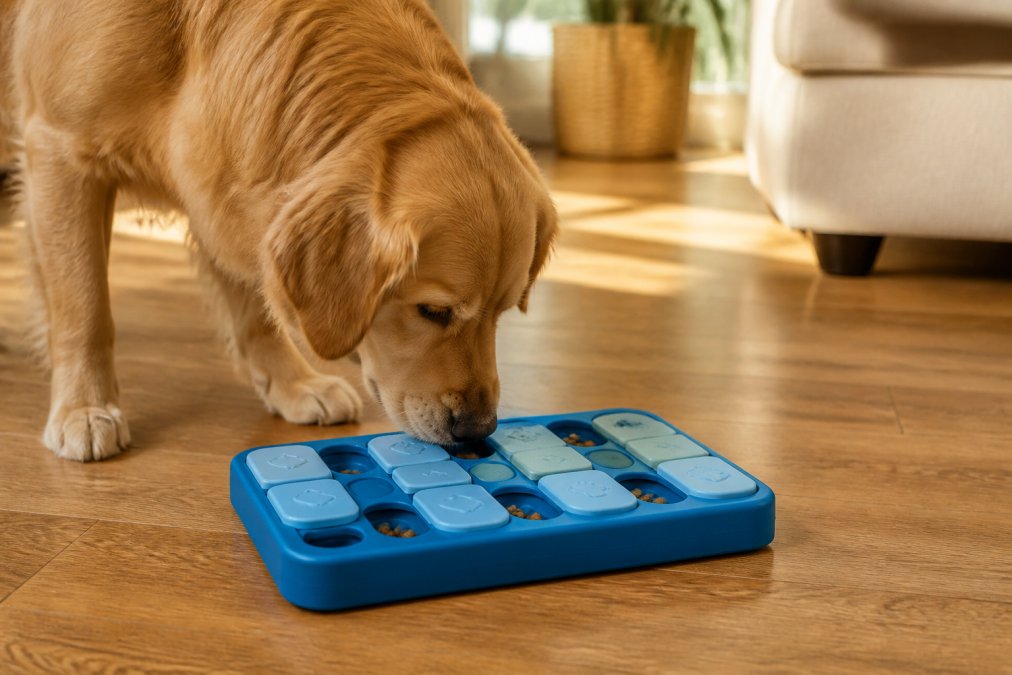
1. Chewzzle PuzzleFeast Sliding Puzzle: Best Overall for Big Brains
The PuzzleFeast is a great pick because it delivers real mental work, not just a slower bowl. Each button slides aside to reveal one hidden treat, so your dog works across the board one reward at a time.
2. Chewzzle SmartPaws Interactive Puzzle: Best for Training and Energy Burn
SmartPaws can be used as a training tool. Scalable difficulty keeps a large breed engaged, and the reward-driven format works for obedience sessions and redirecting chewing toward a positive outlet.
3. Chewzzle MindMaze IQ Puzzle: Best Adjustable Difficulty
MindMaze is a great option if you want one toy that grows with your dog. Vary treat placement to keep the challenge fresh for beginners and clever pups alike.
Chewzzle ThinkDisc Puzzle Feeder →
4. Chewzzle SnuffleSphere Foraging Ball: Best for Anxiety and Foraging
For anxious rescues, sniffing is calming work. The SnuffleSphere mimics the instinct to search and explore, supporting cognitive enrichment and reducing anxiety or boredom through engaging snuffle activity.
Price: $29.99. Best for: anxious dogs and gentle foragers.
5. Chewzzle ThinkDisc Puzzle Feeder: Best Budget Slow Feeder
ThinkDisc is a great value slow feeder. Kibble goes into recessed compartments and rim troughs, then sliding paw-shaped covers and a turning center wheel hide it away.
6. Chewzzle TreatDrop Ball: Best for Gentle Chewers and Dental Health
TreatDrop combines slow feeding with a chew-and-clean design. Textured silicone helps reduce plaque buildup while satisfying natural chewing instincts, and treats leak out gradually as your dog plays.
7. Chewzzle RollFeast Treat Ball: Best Value Entry Point
RollFeast is an affordable way to test whether your dog takes to puzzle feeding. It dispenses treats as your dog rolls or nudges it, pacing delivery during play.
How to Choose the Right Size and Difficulty for Large Breeds
Size and difficulty should match your dog's weight and problem-solving speed, not just breed. Too small frustrates a large dog; too easy gets solved and ignored.
Use this decision framework:
- Under 30 lbs: entry-level treat balls and smaller compartments
- 30-60 lbs: adjustable-difficulty boards like MindMaze
- 60-90 lbs: sliding puzzles with a non-slip base, like PuzzleFeast
- 90+ lbs or heavy chewer: supervise closely and choose thick-walled designs
Cleaning, Safety, and Maintenance Tips for Puzzle Feeders
Most plastic puzzle feeders rinse clean in warm water, and many are dishwasher safe on the top rack. The bigger job is inspection, not washing.
Run this routine between uses:
- Rinse compartments after every meal to prevent residue buildup
- Check seams and sliding parts weekly for cracks
- Rotate food placement so the puzzle doesn't become routine
- Retire any toy with a loose or missing piece immediately
Frequently Asked Questions
What are the best puzzle games for large dogs?
The best puzzle games for large dogs combine durability, adjustable difficulty, and food motivation. Chewzzle's PuzzleFeast Sliding Puzzle ($49.99) and SmartPaws Interactive Puzzle ($39.99) are top picks because they withstand pawing and nudging from big breeds. Look for non-slip bases, BPA-free plastic, and compartments that release kibble slowly. These features turn mealtime into a mentally stimulating activity that can reduce boredom and destructive behavior.
What are the differences between a slow feeder and a puzzle feeder for dogs?
A slow feeder typically has a static maze or ridges that force a dog to navigate around obstacles to reach food, which directly slows eating. A puzzle feeder requires problem-solving, such as sliding covers or turning wheels, to access kibble. Many Chewzzle toys combine both functions. For example, the ThinkDisc Puzzle Feeder ($19.99) has sliding paw-shaped covers and a turning center wheel that slow eating while providing mental enrichment.
Are puzzle feeders worth it for large breeds?
Yes, puzzle feeders offer significant value for large breeds. They can help slow rapid eating, which may reduce the risk of bloat, a serious condition in big dogs. They also provide mental stimulation that tires a dog out more effectively than physical exercise alone. Durable options like the Chewzzle PuzzleFeast ($49.99) are built to handle enthusiastic pawing. The investment can pay off by reducing boredom-related destruction and supporting healthier digestion.
How can I make homemade puzzle feeders for my dog?
You can make simple homemade puzzle feeders using muffin tins, tennis balls, and treats. Place kibble in muffin cups and cover with balls so your dog has to remove them. Another option is a cardboard box with crumpled paper and treats scattered inside. However, homemade versions may not hold up to aggressive chewers. Commercial options like Chewzzle's MindMaze IQ Puzzle ($29.99) offer adjustable difficulty and non-toxic materials that are safer for unsupervised use.
Do puzzle feeders help with dog anxiety?
Puzzle feeders can help reduce anxiety by giving dogs a constructive activity that redirects nervous energy. The SnuffleSphere Foraging Ball ($29.99) mimics natural foraging, which can be calming for anxious dogs. Chewzzle's SmartPaws Interactive Puzzle ($39.99) also channels excess energy into problem-solving. While not a cure for severe separation anxiety, these toys can be part of a broader enrichment routine that supports emotional wellbeing.