

5 Ways to Verify Your Dog Toy Is BPA Free
Last Updated: October 24, 2026
Quick Summary
To verify a dog toy BPA free, check for BPA-free labeling backed by third-party certifications like ASTM or NSF, examine the recycling number on the plastic, review the material composition details, contact the manufacturer directly with safety questions, and look for independent testing certifications on the packaging or company website.
- Recycling numbers 3 (PVC) and 7 (Other) should be avoided as they often contain phthalates or BPA
- Legitimate BPA-free claims include specific testing documentation or certification names, not just the words BPA-free alone
- Natural vulcanized rubber, food-grade silicone, and polypropylene are among the safest material options for dog toys
- Reputable manufacturers will answer direct questions about BPA content and provide testing documentation when asked
- Inspect toys weekly for cracks, splits, or wear that exposes the interior, and replace damaged toys immediately
Table of Contents
- Why BPA and Phthalates Matter in Dog Toys
- How to Check Dog Toy Materials Before You Buy
- Reading Dog Toy Safety Labels and Manufacturer Claims
- Safe Materials for Dog Toys: What to Look For
- 5 Steps to Tell If a Dog Toy Is BPA Free
- What to Do If a Dog Eats a Plastic Toy
- Monitoring and Replacing Your Dog's Toys
- Choosing Your Next Safe Toy for Your Dog
- Frequently Asked Questions
Why BPA and Phthalates Matter in Dog Toys
Neither chemical is good for your dog, and both can accumulate with repeated exposure.
This is why learning to identify whether a dog toy BPA free matters. Many owners assume all dog toys are safe; they're not.
At Chewzzle, we prioritize non-toxic materials in every product for exactly this reason. Our puzzle toys and slow feeders are crafted from durable, non-toxic materials designed to keep your dog safe during extended play sessions.
How to Check Dog Toy Materials Before You Buy
Start your inspection before you bring a toy home. Most of what you need is on the packaging or product listing.
Look for these red flags first:
- No material composition listed
- Vague descriptions like "plastic" or "rubber" without specifics
- No mention of safety certifications
- Manufacturing country not listed
- Extremely cheap pricing for a toy that seems durable
Check product photos carefully: does the material look like solid rubber or plastic, or cheap filling that might tear out?
Read the product description word by word, manufacturers often bury important details in small text. Mentions of safety testing, certifications, or non-toxic claims are a good sign.
Reading Dog Toy Safety Labels and Manufacturer Claims
Safety labels on dog toys vary widely. Some are meaningful. Others are marketing language with no real backing.
Look for these legitimate claims:
- "BPA-free" paired with a certification name (like ASTM or ISO standards)
- "Phthalate-free" with specific testing documentation
- "Non-toxic materials" from a manufacturer with a strong reputation
- "Tested for safety" with a third-party certifier named
Be skeptical of these vague claims:
- "Safe for pets" without any supporting evidence
- "Natural ingredients" (irrelevant for toys)
- "Eco-friendly" (doesn't address chemical safety)
- "Vet approved" without naming the veterinarian or organization
The phrase "BPA-free" is only meaningful if backed by actual testing. A real claim includes how the product was tested or which third party verified it.
Read the fine print: legitimate manufacturers include testing methods and certifications.
When claims seem too good to be true, they usually are. Proper testing costs money, and that cost gets passed to consumers.
Safe Materials for Dog Toys: What to Look For
Not all materials are created equal. Some are inherently safer than others for dogs that chew intensely.
Rubber toys, Natural rubber is generally safer than synthetic: it breaks down more slowly and doesn't leach chemicals the way some plastics do.
Cotton and rope toys, Among the safest options, since cotton is a natural fiber with minimal chemical risk.
Wood toys, Untreated wood is safe; painted or stained wood carries risk because paints and stains can contain lead or other toxins.
Avoid these materials:
- PVC (vinyl), Contains phthalates
- Polycarbonate plastics, Often contain BPA
- Toys with visible paint or dyes that might flake off
- Foam toys that break apart easily
- Toys with plastic beads or pellets inside
The material composition label should clearly list the primary material.
5 Steps to Tell If a Dog Toy Is BPA Free
Here's the practical process to verify whether a specific toy is actually BPA free before you buy it.
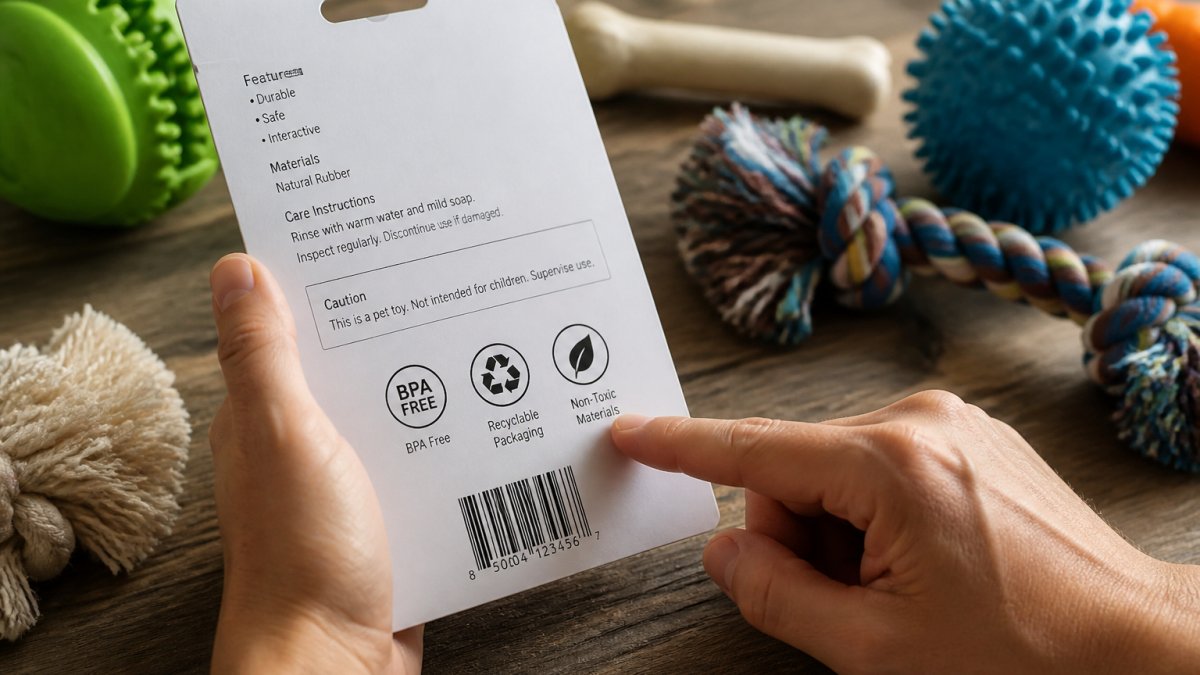
Step 1: Look for BPA-Free Labeling on Packaging
Start with what's printed on the box or product listing. Legitimate manufacturers put this information front and center because it's a selling point.
The label should clearly say "BPA-free," but the label alone isn't proof, anyone can print those words. What matters is what backs it up.
Look for certification marks or testing standards next to the claim, like ASTM, ISO, or NSF, which indicate third-party testing. If the label says "BPA-free" and nothing else, dig deeper before buying.
Step 2: Check the Recycling Number and Plastic Type
Every plastic toy has a recycling number on the bottom or back, your first clue about what kind of plastic it is.
Look for a small triangle with a number inside (usually 1-7). Here's what each number means:
- #1 (PET), Generally safer, but can still contain BPA
- #2 (HDPE), Safer option, lower chemical risk
- #3 (PVC), AVOID. Contains phthalates
- #4 (LDPE), Generally safer
- #5 (PP), Safe option
- #6 (PS), Lower risk but can contain BPA
- #7 (Other), AVOID. Often contains BPA
Recycling numbers alone don't guarantee safety, a #2 toy might still contain harmful chemicals if poorly manufactured, but #3 and #7 are red flags to avoid.
If you can't find a recycling number, that's suspicious. Reputable manufacturers include this information.
Step 3: Examine Material Composition Details
Go beyond the recycling number and look for a full material composition list specifying exactly what the toy is made of.
Good examples of clear labeling:
- "100% natural vulcanized rubber"
- "Food-grade silicone with no fillers"
- "Polypropylene (PP) with no BPA or phthalates"
Vague labeling:
- "Plastic"
- "Rubber material"
- "Safe plastic blend"
The more specific the description, the more likely the manufacturer has actually tested their materials; companies that hide their composition usually have something to hide.
Check for additives or fillers: toys with plastic pellets or foam inside increase chemical exposure because your dog chews directly on them. Solid toys with no fillings are safer.
Step 4: Contact the Manufacturer Directly
If the packaging doesn't clearly state that a dog toy is BPA free, reach out to the company. Most legitimate manufacturers respond to safety questions.
Ask specific questions:
- "Is this toy BPA-free? Do you have testing documentation?"
- "What is the exact material composition?"
- "Has this toy been tested by a third party for chemical safety?"
- "Which chemicals have been tested for and which were found to be absent?"
A company that's transparent about safety will answer these questions directly. They might even send you their testing reports. A company that dodges the question or gives vague answers is not worth trusting.
Document their response. If you ever need it, you'll have proof of what they claimed.
Step 5: Inspect for Third-Party Certifications
Third-party testing is the gold standard. Look for certifications from organizations that actually test products.
Common certifications to look for:
- ASTM International, Tests toys for safety standards
- NSF International, Certifies products for safety and sustainability
- ISO standards, International safety and quality standards
- Underwriters Laboratories (UL), Tests for hazards
These organizations test toys for BPA, phthalates, lead, and other harmful chemicals. If a toy carries one of these certifications, that's strong evidence it's actually safe.
Be careful: some manufacturers claim certifications they don't have. Verify certifications by checking the certifier's website. Most legitimate certifications are listed in a public database.
If a toy has no third-party certification, that doesn't automatically mean it's unsafe. But it means the manufacturer hasn't paid for independent testing.
Here's what each recycling number means and which ones to avoid:
| Recycling Number | Plastic Type | Safety Level |
|---|---|---|
| #1 | PET | Generally safer, but can still contain BPA |
| #2 | HDPE | Safer option, lower chemical risk |
| #3 | PVC | AVOID, contains phthalates |
| #4 | LDPE | Generally safer |
| #5 | PP | Safe option |
| #6 | PS | Lower risk but can contain BPA |
| #7 | Other | AVOID, often contains BPA |
What to Do If a Dog Eats a Plastic Toy
Dogs sometimes swallow pieces of toys. It happens. Knowing what to do next matters.
First, stay calm. Small plastic pieces often pass through a dog's system without causing problems. But some situations need immediate attention.
Contact your veterinarian if:
- Your dog swallowed a large piece of plastic
- Your dog is showing signs of distress (vomiting, loss of appetite, letharness, abdominal pain)
- It's been more than a few hours and your dog seems uncomfortable
- The toy contained paint, dyes, or other obvious chemicals
Your vet might recommend watching your dog for 24-48 hours. They'll look for signs of blockage or toxicity.
Plastic pieces that pass through typically exit within a few days. Most dogs have no lasting effects.
Knowing what your dog ate is important. Check our guide on signs of dental damage from hard chew toys to understand what toy wear looks like before it becomes a swallowing risk.
Monitoring and Replacing Your Dog's Toys
Safe toys don't stay safe forever. Regular inspection and replacement are part of responsible toy ownership.
Inspect toys weekly. Look for:
- Cracks or splits in the material
- Pieces starting to break off
- Visible wear that exposes the interior
- Discoloration or staining that might indicate chemical breakdown
- Loose seams or threads
A toy that's starting to fall apart should be removed immediately.
Replace toys that show damage. Explore our durable toys for teething puppies to find safe, long-lasting options designed to withstand aggressive chewing. Don't wait until a toy completely falls apart.
Rotate toys to extend their life. If you have multiple toys, rotate them.
Wash toys regularly. Most toys can be wiped down with warm water and mild soap.
Track toy age. Write the purchase date on new toys with a permanent marker.
When you need replacements, use what you've learned. Check material composition, look for certifications, and verify BPA-free claims before buying.
Choosing Your Next Safe Toy for Your Dog
When shopping for your next toy, use everything you've learned to make the best choice.
Start by identifying what your dog needs. Is this a toy for mental stimulation? Slow feeding? Gentle play?
Mental stimulation toys benefit from durable materials.
Slow feeder toys need to be food-safe.
For puppies, prioritize durability and safety above all else. Puppies chew more aggressively and are more likely to swallow pieces.
Check non-toxic dog toys for puppies for specific recommendations that meet safety standards. You'll also find guidance on puzzle toys and safety considerations if you're deciding between toy types.
Chewzzle offers interactive puzzle toys and slow feeders made from durable, non-toxic materials.
The investment in a high-quality, verified safe toy pays off.
Frequently Asked Questions
How can you tell if a dog toy is BPA-free?
Check the packaging for explicit BPA-free labeling, examine the recycling number (avoid #3 and #7 plastics), review the material composition listed on the label, and contact the manufacturer if details are unclear. Third-party certifications from organizations that test for chemical safety provide additional assurance. Many manufacturers now provide detailed material information online or via customer service.
What does the recycling number tell you about BPA in dog toys?
Recycling numbers indicate plastic type. Number 3 (polyvinyl chloride) and #7 (polycarbonate and other plastics) are more likely to contain BPA or phthalates. Numbers 1, 2, 4, and 5 generally carry lower risk, though BPA-free labeling is still the best confirmation. However, recycling numbers alone don't guarantee safety; always pair this check with manufacturer claims and material details.
What happens if a dog chews or swallows plastic from a toy?
Small plastic fragments may pass through your dog's digestive system without harm, but larger pieces can cause choking, intestinal blockage, or internal injury. If your dog ingests significant plastic, contact your veterinarian immediately. Watch for vomiting, lethargy, loss of appetite, or abdominal pain. Prevent ingestion by inspecting toys regularly for cracks, wear, and damage, and removing toys that are breaking apart.
Are natural materials like rubber and cotton rope safer than plastic dog toys?
Natural materials such as rubber, cotton rope, and sustainably sourced wood are generally safer alternatives to plastic because they don't contain BPA or phthalates. However, durability varies; rope toys can fray and pose choking hazards, while rubber toys may still wear down. The safest approach combines material choice with regular inspection and supervised play, regardless of whether you choose plastic, rubber, or natural options.
Choosing a safe dog toy means understanding what's in it and why it matters. By checking labels, verifying certifications, and knowing what materials to look for, you can confidently select toys that keep your dog healthy and happy. Take time to inspect new toys before they reach your dog, and replace them as soon as wear appears. Your dog's safety depends on the choices you make today.
