

Are Puzzle Toys Safe for Puppies? A Complete Guide
Table of Contents
- Are Puzzle Toys Safe for Puppies?
- Benefits of Mental Stimulation for Puppies
- Safety Considerations and Material Standards
- How to Stop Puppy From Chewing Furniture With Enrichment
- How to Introduce Food Puzzles to Dogs
- Supervision and Age-Appropriate Selection
- Maintenance, Wear, and When to Replace
- Troubleshooting Common Frustration and Behavioral Issues
- Frequently Asked Questions
Last Updated: September 21, 2026
Are Puzzle Toys Safe for Puppies?
When you ask are puzzle toys safe for puppies, the answer is yes, when chosen correctly and used with proper supervision. The key is selecting the right toy for your puppy's age, size, and chewing intensity, then monitoring play closely. At Chewzzle, we design interactive puzzle toys to meet safety standards while delivering the mental stimulation puppies need to develop healthy behaviors.

The main concerns are choking hazards and material toxicity, both manageable with informed choices. Real risk emerges when owners skip supervision, ignore wear and tear, or select adult-dog toys for puppies with developing teeth.
Benefits of Mental Stimulation for Puppies
Mental enrichment through puzzle toys is a developmental necessity. Puppies' brains develop rapidly during their first six months, and puzzle toys accelerate cognitive development by presenting problems they must solve to access rewards.
Puzzle toys reduce destructive chewing by channeling energy into problem-solving. A bored puppy chews furniture, baseboards, and shoes; a puppy engaged with a treat-dispensing puzzle learns focus, patience, and delayed gratification. This builds neural pathways supporting obedience training and impulse control.
Puzzle toys mimic natural foraging behaviors. Wild dogs spend hours searching for food; indoor puppies get meals in seconds. Puzzle toys restore that rhythm, satisfying innate drives and reducing anxiety-related behaviors.
Puppies who engage regularly with mental challenges show improved focus during training, fewer destructive episodes when alone, and better behavioral health. Problem-solving builds confidence in rescue puppies and anxious dogs.
Safety Considerations and Material Standards
Material quality determines safety most. Puzzle toys should be made from non-toxic, durable plastic that won't splinter, crack, or leach chemicals during extended chewing.
Look for toys explicitly labeled BPA-free. BPA (Bisphenol A) can leach into saliva during aggressive chewing. Non-toxic materials ensure the toy won't cause harm even with extended chewing.
Durable construction prevents fractures that become ingestion risks. Quality puzzle toys use reinforced plastic that withstands sustained pressure without splintering. The Chewzzle SmartPaws Interactive Puzzle and Chewzzle MindMaze IQ Puzzle are engineered with durable, non-toxic plastic designed to handle aggressive chewing.

Inspect seams and joints regularly. Toys with glued seams can separate; molded construction with fewer seams is safer. Check joints during the first week to ensure they withstand your puppy's chewing style.
Choking Hazards and Ingestion Risks
Choking hazards include the toy itself and its contents. A toy that fits entirely in your puppy's mouth can be swallowed. Use the "fist test": if the toy fits inside your closed fist, it's too small. Larger toys requiring both paws are safer.
Removable parts pose risk. Puppies with aggressive chewing can disassemble toys designed for gentler play. Supervision during initial sessions is mandatory, you'll see whether your puppy tries to destroy the toy or works it for treats.
Treat size matters. Kibble-sized treats are low-risk; larger treats can lodge in mechanisms and break off. Use smaller kibble for puppies 8-12 weeks, standard kibble for puppies 12+ weeks.
Watch for ingestion stress: difficulty swallowing, excessive drooling, vomiting, or loss of appetite. Seek immediate veterinary attention. Most incidents occur with unsupervised toys, so supervise all initial play sessions.
Non-Toxic and BPA-Free Standards
Non-toxic means chemicals used are food-safe and won't cause harm if ingested. BPA-free guarantees absence of Bisphenol A, linked to hormonal disruption.
Check product descriptions for explicit BPA-free claims. Reputable manufacturers like Chewzzle list this clearly. If a product doesn't mention BPA-free or non-toxic materials, the manufacturer hasn't prioritized material safety.
Some plastics leach chemicals when warm. Avoid leaving toys in direct sunlight or hot cars. Store in cool, dry places and rinse thoroughly if exposed to heat.
How to Stop Puppy From Chewing Furniture With Enrichment
Destructive chewing is a symptom, not a behavior problem. Puppies chew furniture when bored, anxious, or teething. Puzzle toys address the root cause by providing appropriate outlets.
Redirect to puzzle toys instead of punishing. Fill them with high-value treats your puppy doesn't get elsewhere. Over time, your puppy learns puzzle toys deliver rewards and furniture doesn't.
Puzzle toys work well during teething (weeks 8-16). Cold puzzle toys (refrigerate 30 minutes) soothe discomfort and distract from pain.
For puppies with separation anxiety, puzzle toys create positive associations with alone time. Your puppy learns departure means puzzle time, reducing anxiety-related destructive chewing.
Chewzzle Launch & Learn Puppy Trainer →
Rotate puzzle toys to maintain engagement. If your puppy solves one quickly, they lose interest. The Chewzzle Launch & Learn Puppy Trainer and Chewzzle ThinkDisc Puzzle Feeder offer different challenge levels, start simple and progress as skills develop.

How to Introduce Food Puzzles to Dogs
Introduction matters more than the toy itself. Poor introduction frustrates puppies; good introduction makes it a favorite activity.
Start with empty puzzles. Let your puppy explore without pressure, sniffing and pawing at their own pace. This removes pressure to solve and lets curiosity drive exploration.
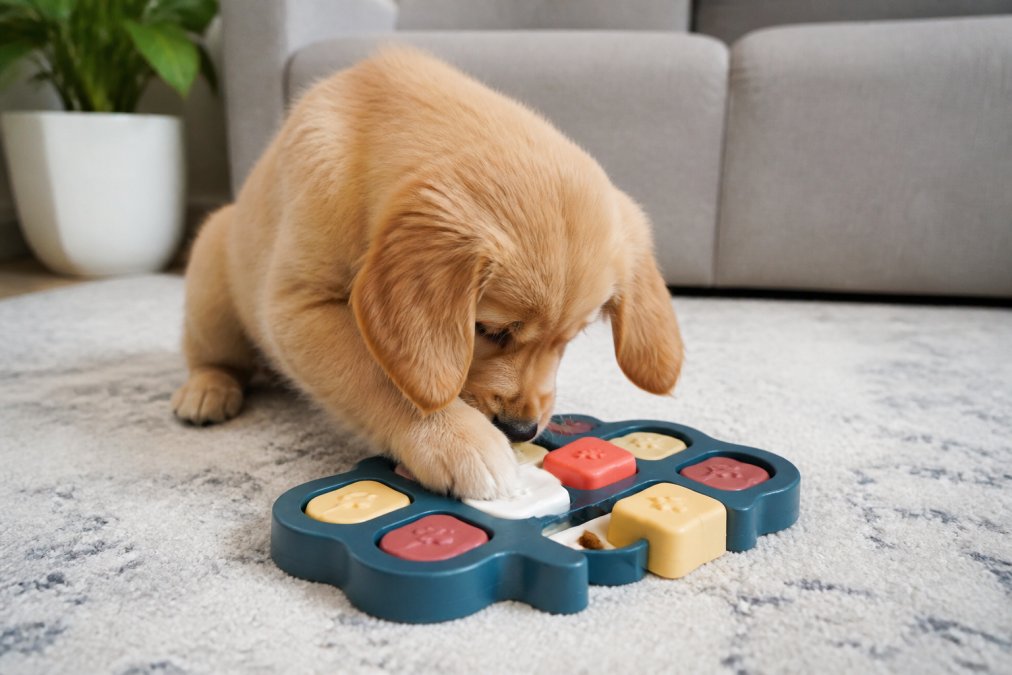
Once your puppy shows interest, add a single treat to the easiest compartment. Make first attempts so easy they solve in seconds. Quick wins build confidence.
Gradually increase difficulty. Move treats to harder compartments and introduce sliding covers or rotating wheels only after mastering simpler designs.
Watch for frustration: whining, abandoning the toy, or aggressive pawing. If frustrated, simplify or return to the previous level. Frustration teaches that puzzles are pointless.
Feed meals through puzzle toys when possible. Use a puzzle feeder for breakfast and dinner to integrate enrichment into daily routine and reduce gulping. The Chewzzle ThinkDisc Puzzle Feeder slows fast eaters while providing mental stimulation.
Keep sessions short: 5-10 minutes for puppies under 16 weeks, 10-15 minutes for older puppies. Multiple short sessions maintain engagement better than one long session.
Supervision and Age-Appropriate Selection
Supervision isn't optional, it's mandatory during the first week of any new toy. You need to see how your specific puppy interacts with it: Do they try to destroy it? Do they get frustrated? Do they swallow pieces of kibble safely or try to gulp whole sections?
Age-appropriate selection means matching toy complexity and size to your puppy's developmental stage:
| Puppy Age | Toy Type | Best Features | Supervision Level |
|---|---|---|---|
| 8-12 weeks | Simple treat dispensers | Large, soft, easy-to-solve | Constant |
| 12-16 weeks | Beginner puzzles | Medium difficulty, treat compartments | Close monitoring |
| 16-26 weeks | Intermediate puzzles | Sliding covers, rotating wheels | Periodic checks |
| 26+ weeks | Advanced puzzles | Complex mechanisms, multiple steps | Routine monitoring |
Puppies under 12 weeks have developing teeth and limited problem-solving skills. Choose toys with simple mechanisms and larger sizes. Avoid small toys, toys with removable parts, and puzzles requiring complex manipulation.
Puppies 12-16 weeks can handle slightly more complex puzzles but still need close supervision. Their teeth are developing rapidly, and they're more likely to try destroying toys. Watch for signs of wear during this phase.
Puppies 16-26 weeks can engage with intermediate puzzles. Their teeth are nearly adult-sized, and their problem-solving abilities have improved significantly. Supervision can become less constant, but check the toy for damage after each session.
Multi-pet households require special supervision.
Maintenance, Wear, and When to Replace
Puzzle toys accumulate bacteria from saliva, food, and environment. Clean them regularly, at minimum weekly, more often if used daily for feeding.
Replace toys immediately if you find:
- Cracks or fractures in the plastic
- Loose or detachable parts
- Sharp edges or splintering
- Persistent discoloration despite cleaning
- Visible wear in high-stress areas (where your puppy chews most)
Troubleshooting Common Frustration and Behavioral Issues
Not every puppy engages with puzzle toys immediately. Some get frustrated, others ignore them entirely. Understanding why helps you troubleshoot and build a positive relationship with enrichment.
Frequently Asked Questions
Can puppies use puzzle toys safely?
Yes, puzzle toys are safe for puppies when chosen correctly and supervised properly. Select toys made from non-toxic, BPA-free plastic and appropriate for your puppy's size and age. Always supervise play sessions, especially with young puppies under 12 weeks old. Remove the toy if your puppy shows signs of frustration or tries to swallow pieces. The key is matching the toy's difficulty to your puppy's developmental stage and monitoring for wear and tear regularly.
What are the main benefits of mental stimulation for puppies?
Mental stimulation reduces boredom-related destructive behaviors like chewing furniture and excessive barking. Puzzle toys encourage problem-solving, which strengthens cognitive development and focus. They also help channel a puppy's natural foraging instincts into positive outlets. Mentally engaged puppies experience less anxiety and separation stress, sleep better, and are easier to train. Interactive play builds confidence and creates a foundation for good behavioral habits throughout your dog's life.
How do I introduce a food puzzle to my puppy?
Start with an easy, treat-dispensing puzzle to build confidence. Fill it with your puppy's regular kibble or soft treats they already enjoy. Show your puppy how the puzzle works by gently moving the pieces to reveal food. Let them explore and solve it at their own pace without pressure. Keep initial sessions short (5-10 minutes) and supervise closely. Once your puppy understands the basic concept, gradually increase difficulty. Practice during calm times, not when your puppy is overstimulated or hungry.
What should I watch for to keep puzzle toys safe?
Inspect toys regularly for cracks, loose pieces, or sharp edges that could become choking hazards. Watch for signs of frustration, such as excessive chewing, whining, or abandonment of the toy. Remove the toy if your puppy tries to swallow pieces or shows obsessive behavior. Avoid toys with small detachable parts for puppies under 6 months. Always use toys made from durable, non-toxic materials with no BPA. Never leave your puppy unsupervised with a puzzle toy, especially during the first few weeks of use.