

How to Keep Puppy Entertained Indoors
Table of Contents
- Why Indoor Enrichment Matters for Puppies
- Mental Stimulation for Puppies: Training and Brain Games
- Best Puzzle Toys for Puppies: Interactive Solutions
- How to Stop Puppy from Chewing Furniture: Redirection and Prevention
- DIY Indoor Games and Scent Work Activities
- Rotating Toys and Maintaining Interest
- Creating a Puppy-Proof Space for Safe Indoor Play
- Frequently Asked Questions
Last Updated: September 20, 2026
Why Indoor Enrichment Matters for Puppies
To keep puppy entertained indoors is essential, bored puppies become destructive. Without mental stimulation and physical activity, they chew furniture, dig carpets, and create chaos. Strategic enrichment keeps their minds engaged and energy directed toward positive outlets.
Indoor enrichment prevents destructive behavior, builds confidence and problem-solving skills during critical development, and strengthens your bond through interactive play and training.
Puppies receiving consistent mental stimulation are calmer, less anxious, and more receptive to training. This supports cognitive development and overall wellbeing during their first year.
Rotate activities and match enrichment to your puppy's age and energy level. A 12-week-old has different needs than a 6-month-old. Simple adjustments keep challenges fresh and maintain interest.
Mental Stimulation for Puppies: Training and Brain Games
Mental enrichment is as important as physical exercise. Brain-challenging activities create neural pathways that support learning and focus throughout life.
Brain games require no fancy equipment. Use short training bursts (5-10 minutes, 2-3 times daily) with positive reinforcement: treats, praise, and play.
Try these proven mental stimulation techniques:
- Hide and seek with treats: Hide small treats around a room and let your puppy search for them using their nose
- Name recognition games: Teach your puppy to recognize the names of specific toys, then ask them to fetch by name
- Impulse control exercises: Practice "wait" or "leave it" commands before meals or playtime
- Scent tracking: Create simple scent trails using treats to encourage natural foraging instincts
- Trick training: Teach new commands weekly, sit, down, shake, spin, to keep their brain active
Brain games reduce boredom-related anxiety and destructive behavior while tiring puppies mentally, leading to deeper rest and less need for supervision.
Best Puzzle Toys for Puppies: Interactive Solutions
Puzzle toys are highly effective for keeping puppies entertained indoors. They require problem-solving to access hidden treats, engage cognitive abilities, slow eating pace, and provide independent entertainment.
Choose puzzle toys with adjustable difficulty and durable, non-toxic materials that withstand chewing and repeated use.
How Puzzle Toys Support Puppy Development
Puzzle toys do more than entertain. They build specific cognitive and behavioral skills during critical developmental windows.
Problem-solving and persistence: Puppies learn that effort leads to rewards, developing patience and frustration tolerance that transfer to obedience training and impulse control.
Impulse control and delayed gratification: Puzzle toys require waiting and working before eating, training self-control.
Introducing Puzzle Toys by Age and Skill Level
Timing matters. Introduce puzzle toys too early and your puppy becomes frustrated; too late and you miss a critical window for building problem-solving confidence.
Interactive Puzzle Challenges for Problem-Solving
When selecting a puzzle toy, look for these features:
- Adjustable difficulty: Compartments or sections that can be made easier or harder as your puppy progresses
- Durable construction: Materials that withstand repeated manipulation and light chewing without breaking or splintering
- Non-toxic materials: Rubber, plastic, or silicone that won't harm your puppy if chewed
- Appropriate size: Large enough that your puppy can't swallow it, but sized for their mouth
- Easy to clean: Dishwasher-safe or easily washable to prevent bacterial growth from stored treats
- Varied compartment types: Some toys with sliding lids, some with flipping covers, some with rolling balls, variety prevents boredom
Show your puppy how the toy works with treats in obvious spots. Once they understand, hide treats in harder-to-reach compartments. This progression maintains motivation and prevents frustration.
Chewzzle SmartPaws Interactive Puzzle →
Treat-Dispensing Toys and Slow Feeders
Use slow feeders for regular meals 2-3 times weekly. They slow eating, improve digestion, reduce bloating, and provide engagement. Fill with regular kibble; monitor weight and adjust if needed.
Automatic Rolling Toys for Active Play
Automatic rolling toys provide unpredictable movement that triggers hunting instincts without active throwing. Use for puppies 12+ weeks, supervising to prevent chasing into hazards. Ideal for work calls or meal prep.
How to Stop Puppy from Chewing Furniture: Redirection and Prevention
Puppy chewing is a developmental stage. Puppies explore through their mouths, chew to relieve teething pain, and burn energy. Redirect chewing toward appropriate toys, not furniture.
DIY Indoor Games and Scent Work Activities
Simple games using household items provide hours of engagement at minimal cost, but safety must come first. Many items pose choking or toxicity risks.
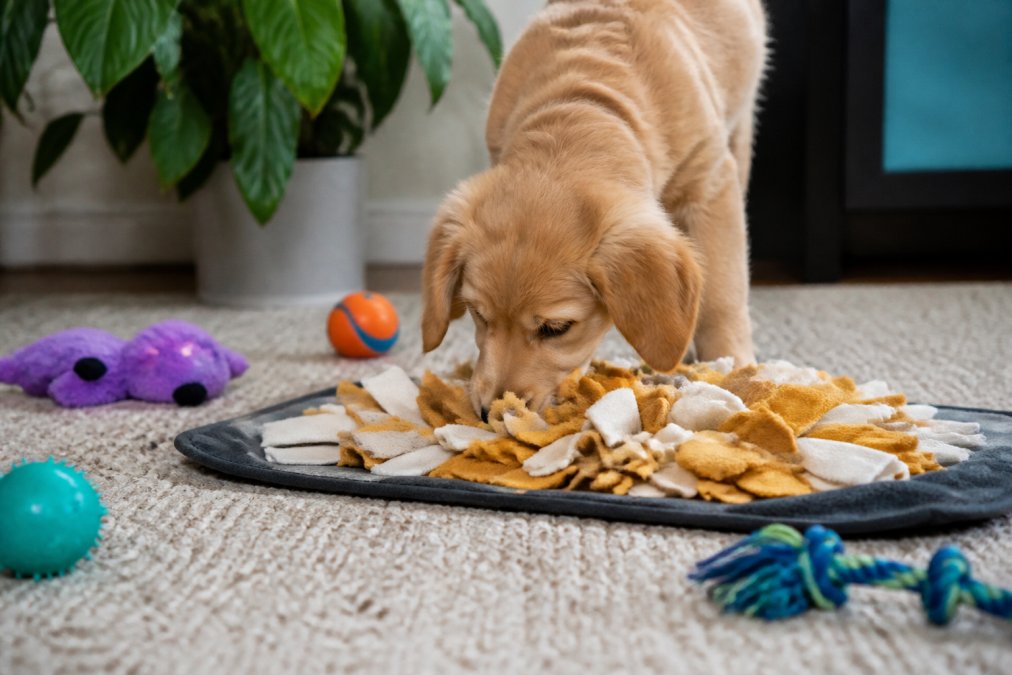
Safe DIY Game Setup: Materials to Use and Avoid
Evaluate DIY materials for choking hazards, toxicity, and durability under chewing.
Safe materials for DIY games:
- Clean, food-safe towels and blankets (no loose threads or fraying edges)
- Muffin tins and baking pans (supervise to prevent metal ingestion)
- Tennis balls (only if your puppy doesn't shred them; remove immediately if torn)
- Cardboard boxes without staples, tape, or ink printing
- Paper bags (brown kraft paper only; remove if puppy tears into pieces)
- Rope toys you've inspected for loose fibers
Materials to avoid entirely:
- Plastic bags, plastic wrap, or plastic containers (choking and intestinal blockage risk)
- Rubber bands, hair ties, or string (can cause fatal intestinal obstruction)
- Foam padding or foam toys (puppies swallow pieces; can cause blockages)
- Anything with small parts, buttons, or decorations that can detach
- Treated or painted wood
- Anything with strong chemical odors (pesticides, solvents, adhesives)
- Houseplants or plant materials (many are toxic; see ASPCA Poison Control for specifics)
- Cooked bones or anything with sharp edges
Age-Appropriate DIY Games by Developmental Stage
DIY enrichment safety depends heavily on your puppy's age and chewing intensity. Younger puppies (8-14 weeks) have weaker jaws but explore more indiscriminately. Older puppies (4-6 months) have stronger jaws and are more likely to destroy toys and ingest pieces.
8-14 weeks (early socialization phase):
- Hide and seek with kibble: Scatter meals across a clean floor. Supervise to prevent swallowing non-food items.
- Soft towel games: Hide treats in clean towel folds. Remove immediately after play.
- Cardboard box exploration: Provide plain boxes filled with crumpled paper. Supervise and remove pieces they attempt to swallow.
4-6 months (teething and stronger chewing):
- Towel roll game: Roll treats in clean towels, starting loose and progressing to tighter rolls. Remove immediately after play.
- Muffin tin puzzle: Cover treats in muffin tin cups with tennis balls. Inspect balls and remove if tearing.
- Snuffle mat alternative: Hide treats in bunched blankets with no loose seams. Supervise.
- Scent tracking: Create simple scent trails with treats, progressing from straight lines to turns. Use only food-based scents.
Supervision and Post-Play Inspection
Supervise all DIY games under 16 weeks. From 16 weeks to 6 months, supervise soft material games; step away only for durable items. After each session, inspect mouth and gums for debris and check stool for ingestion signs.
Rotating Toys and Maintaining Interest
Keep 4-6 toys in rotation, swapping every few days. When toys reappear after a week, they feel "new." Rotate based on developmental stage: rubber toys for teething, puzzles for impulse control. Match toy types to situations (puzzles for meals, rolling toys for active play, rope toys for bonding). Variety prevents boredom and destructive behavior.
Creating a Puppy-Proof Space for Safe Indoor Play
- Electrical cords and outlets
- Cleaning supplies and chemicals
- Small objects (coins, buttons, rubber bands)
- Houseplants (many are toxic to puppies)
- Medications and supplements
- Plastic bags and packaging
- Furniture with sharp edges or unstable legs
Supervise play sessions to keep puppy entertained indoors, especially with new puppies or new toys. Watch for signs of overstimulation, excessive excitement, difficulty settling, or aggressive play. End sessions before your puppy reaches that point.
Frequently Asked Questions
How much mental stimulation does a puppy need daily?
Puppies need 15-30 minutes of focused mental stimulation several times throughout the day, depending on age and breed. Younger puppies tire more quickly from cognitive work than physical exercise. Short, frequent training sessions and puzzle toy engagement work better than one long activity. Mental stimulation should be mixed with physical play, rest periods, and supervised socialization to support healthy development.
Can puzzle toys really help stop puppy from chewing furniture?
Yes. Puzzle toys redirect chewing energy toward appropriate outlets and provide the mental engagement puppies crave when bored. Interactive toys like the Chewzzle SmartPaws and MindMaze keep your puppy focused on problem-solving rather than destructive chewing. Combined with consistent redirection, positive reinforcement, and removing access to furniture during unsupervised time, puzzle toys significantly reduce furniture damage.
What's the best way to keep a puppy entertained when you're busy?
Use treat-dispensing toys, slow feeders, and automatic rolling toys that keep puppies engaged independently. The Chewzzle SmartBounce rolling ball and SnuffleSphere foraging toy are ideal for solo play. Rotate toys every few days to maintain novelty. Set up a safe play area with appropriate chew toys, and use puzzle toys during your work hours to channel energy productively.
How do I know if my puppy is getting enough enrichment?
A well-enriched puppy shows calm behavior, reduced destructive chewing, and better focus during training. Signs of under-stimulation include excessive barking, furniture chewing, restlessness, and separation anxiety. If your puppy seems bored or destructive, increase mental stimulation through training games, puzzle toys, and scent work activities. Most puppies thrive with varied, rotating enrichment throughout the day.