

How to Teach Your Dog to Stay on a Mat in 5 Steps
Quick Summary
To teach your dog to stay on a mat, first lure them onto it with a treat and reward them, then add a cue word such as place. Gradually build the time they stay, rewarding each success in short sessions of two to three minutes.
- Lure your dog onto the mat with a treat and reward right away.
- Add a cue word like place just before your dog steps on.
- Keep each training session to two to three minutes.
- Lengthen the wait time slowly, from one second up to ten.
- Never use the mat as a punishment spot.
Table of Contents
- What Mat Training Teaches and Why It Helps
- Choosing the Best Mat for Dog Training
- Step-by-Step: Teach Your Dog to Go to Place and Stay
- Building a Calm Settle Routine on the Mat
- Adding Distractions to Your Mat Training
- Common Mistakes and What to Do When Your Dog Leaves the Mat
- Start Your First Mat Session Today
- Frequently Asked Questions
How to Teach Your Dog to Stay on a Mat in 5 Steps
Last Updated: October 30, 2026
What Mat Training Teaches and Why It Helps
Teaching your dog to stay on a mat is one of the most useful skills you can build.
Mat training works because dogs learn best through repetition and rewards. Each time your dog goes to the mat and stays, they learn that the spot means good things happen.
Here is what mat training teaches your dog:
- Impulse control: Waiting before jumping up or running off
- Settling: Lying down and relaxing on cue
- Boundaries: Knowing where to be during busy moments
- Focus: Paying attention to you even with things going on around them
Watch out: Do not use the mat as a punishment spot. If your dog learns that the mat means being sent away, they will avoid it.
Choosing the Best Mat for Dog Training
The right mat makes training easier.
Choose a mat that stays in place on the floor. Non-slip backing matters because a sliding mat teaches your dog that the spot is unstable.
Many owners use a simple bed or rug. Others prefer a dedicated training mat with a firm surface.
For a more interactive approach, the Chewzzle Launch & Learn Puppy Trainer ($69.99) is a reward-based ball launcher that encourages focus and self-play.
Step-by-Step: Teach Your Dog to Go to Place and Stay
Teaching your dog to go to place and stay takes a few short sessions each day. Keep each session under five minutes so your dog stays motivated and successful. The key is to treat this like a staged plan with clear pass/fail criteria, not a vague instruction to "go slowly." Below is a session-by-session progression you can actually measure.
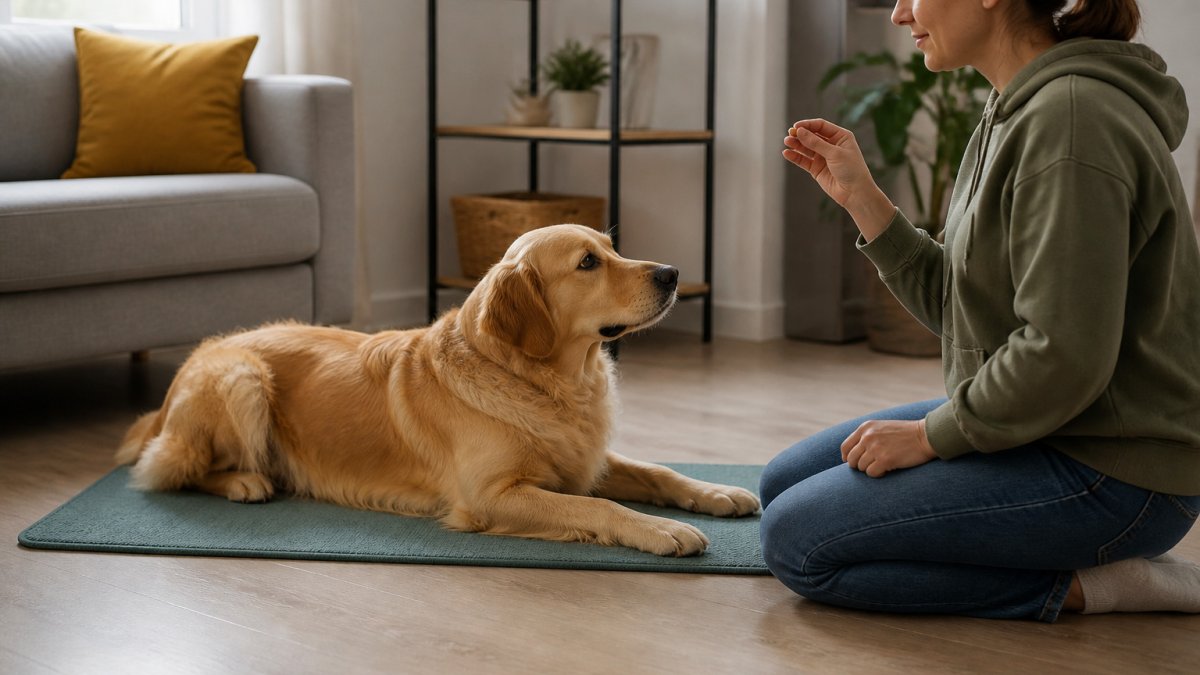
Step 1: Lure and Reward Onto the Mat
Start by showing your dog the mat with a treat in your hand. Let them step onto it, then reward right away.
Once your dog reliably steps onto the mat, add a cue word like "place" or "mat" just before they step on.
Then guide your dog into a down position on the mat. Lure with a treat held near the floor, moving it slowly toward the mat.
Progression criterion for Step 1: Move on only when your dog steps onto the mat and lies down within 3 seconds of the cue in 8 out of 10 repetitions across two consecutive sessions. If they need more than 3 seconds or miss the cue more than twice, repeat the session at the same level.
Step 2: Add Duration With Short Sessions
After your dog lies down on the mat, wait just one second before rewarding. Then reward again and release them with an "okay" cue.
Keep sessions short, around two to three minutes each. Practice several times a day rather than one long session. This helps your dog learn without getting bored or restless.
A measurable progression plan. Rather than guessing when to add time, use this staged ladder. Each stage has a target duration and a pass criterion.
| Stage | Target duration on mat | Pass criterion (per session) |
|---|---|---|
| 1 | 1-3 seconds | 8 of 10 reps stay until release cue |
| 2 | 5 seconds | 8 of 10 reps stay until release cue |
| 3 | 10 seconds | 8 of 10 reps stay until release cue |
| 4 | 20 seconds | 7 of 10 reps stay until release cue |
| 5 | 30 seconds | 7 of 10 reps stay until release cue |
| 6 | 60 seconds | 6 of 10 reps stay until release cue |
When to step back. If your dog gets up before the release cue in more than 3 of 10 reps at any stage, drop back one stage for the next session. If they fail the same stage twice in a row, cut the target duration in half and rebuild. A common pattern is to jump from 10 seconds to 60 seconds too quickly; the ladder above prevents that.
Session structure that works. Run 8-10 repetitions per session, with a 10-15 second break between reps. End every session on a successful rep, even if that means finishing at a shorter duration than you planned. Three short sessions per day beats one long session, and most practitioners find that two sessions per day is enough once your dog is past Stage 3.
What to watch for during duration work.
- Your dog stays calm for the full wait time: pass the rep and continue.
- Your dog gets up before the release cue: mark the miss calmly, guide them back, and count it as a failed rep.
- Your dog seems distracted or stressed: end the session early and note the trigger (noise, movement, time of day) so you can lower the difficulty next time.
If your dog gets up early, calmly guide them back to the mat and try a shorter wait next time.
Building a Calm Settle Routine on the Mat
A calm settle routine helps your dog relax on the mat during everyday life.
Keep your energy low when your dog is on the mat. Speak softly, avoid rough play, and reward calm behavior.
For anxious or newly adopted dogs, the mat can serve as a safe space. Rescue dogs often need time to adjust.
For more guidance on helping an anxious dog feel secure, read our guide on how to calm an anxious rescue dog.
Adding Distractions to Your Mat Training
Once your dog can stay on the mat in a quiet room, add small distractions. Try an interactive puzzle toy to keep your dog engaged and working on the mat during these sessions.

Slowly increase the difficulty. Try a doorbell sound, a family member moving around, or a toy placed nearby. If your dog breaks the stay, go back to an easier level.
The Chewzzle SmartPaws Interactive Puzzle ($39.99) is a treat-based puzzle designed to challenge dogs mentally and help redirect chewing behavior.
Common Mistakes and What to Do When Your Dog Leaves the Mat
Most mat training problems come from a few common mistakes. Knowing them helps you fix problems quickly, but the more important skill is diagnosing why your dog leaves the mat, because the fix depends on the cause.
The Four Common Training Mistakes
- Moving too fast: Increasing wait time or distraction too quickly can overwhelm your dog. Go back a step if your dog struggles. Use the staged ladder in Step 2 rather than guessing.
- Long sessions: Dogs lose focus in long sessions. Keep practice to 2-3 minutes and 8-10 reps.
- Inconsistent rewards: If you reward sometimes and forget other times, your dog gets confused. Reward reliably in the early stages, then move to a variable schedule only after Stage 4.
- Using the mat only for correction: Keep the mat a positive place. Never send your dog to the mat as punishment.
Diagnose Why Your Dog Leaves the Mat
A dog who leaves the mat is telling you something. Before you change the training plan, figure out which of these four patterns fits:
- Boredom or restlessness. Your dog leaves after a few seconds, sniffs around, or looks for a toy. Fix: add exercise before training and use a food-stuffed enrichment toy on the mat during duration work.
- Mat-specific fear. Your dog avoids the mat itself, approaches and backs away, or only steps on it when lured. This often happens if the mat was once used for restraint or punishment. Fix: restart Step 1 with a different mat and pair it only with high-value treats.
- Confinement sensitivity. Your dog settles on the mat but panics when you step away or add a barrier. This is about being restricted, not about being alone. Fix: practice release-and-return at very short distances before adding duration.
- Separation-related distress. Your dog is fine on the mat while you are visible but shows distress when you leave the room, pacing, whining, scratching at the mat or door, drooling. This is not a mat-training problem; it is a separation issue. Fix: pause mat duration work and address departures separately, starting with absences of a few seconds.
A common pattern is for owners to treat all four as "stubbornness" and push harder. That backfires. Match the training plan to the cause: boredom needs more enrichment, fear needs a slower restart, confinement sensitivity needs distance work, and separation distress needs a departure plan.
Safety and Urgent Distress Signs
Stop the session immediately and do not resume that day if you see any of the following:
- Escape attempts: digging at the mat, bolting, or trying to climb over a barrier
- Self-injury: damaged teeth or nails, scraped paws, or broken skin
- Heavy panting, trembling, drooling, or wide eyes that do not settle within a minute of removing the pressure
- Overheating: excessive panting, bright red gums, or weakness, move your dog to a cool area and offer water
If your dog injures themselves, shows these signs repeatedly, or the distress does not improve after two weeks of consistent, slowed-down training, contact your veterinarian. A veterinarian can rule out pain or medical causes and, if needed, refer you to a qualified behavior professional.
When to Use an Alternative to the Mat
Mat training is not the right tool for every dog at every stage. Consider a gated room or an exercise pen instead if:
- Your dog shows distress the moment they are on the mat, even with high-value treats
- Your dog has injured themselves trying to leave the mat
- Your dog settles better in a small, familiar room than on an open mat
A gated room or pen gives your dog space to move while still setting a boundary, and you can transition back to the mat later once the distress has faded.
Watch out: If your dog shows signs of distress, such as panting, trembling, or trying to escape, stop the session. Continued pressure can make anxiety worse.
If your dog keeps leaving the mat, they may be bored or restless. For help with restless behavior, read our guide on how to stop boredom barking.
Start Your First Mat Session Today
Mat training takes patience, but the results are worth it. Start with five minutes today: lure your dog onto the mat, reward, and end on a positive note. Repeat a few times a day, and you will see steady progress.
Your dog learns best when training feels like a game, and enrichment toys can help keep sessions fun and engaging.
Frequently Asked Questions
How do you teach a dog to stay on a mat?
Start by luring your dog onto the mat with a treat, marking the moment it lands with a word like 'yes' and rewarding it. Repeat until your dog steps on the mat readily, then ask for a brief stay of one to two seconds before releasing. Build duration and distance slowly over several short sessions, and always end on a success so your dog keeps its confidence and enthusiasm for the mat.
How long does it take to teach a dog to settle on a mat?
Most dogs learn the basic idea within a few days of short daily sessions, but a reliable settle that holds for several minutes usually takes two to four weeks. Puppies and high-energy breeds often need more time than calm adult dogs. Progress depends on consistency, session length, and how gradually you add distractions and duration.
What should you do if your dog keeps leaving the mat?
Don't scold or pull your dog back. Calmly guide it back to the mat with a treat, reward it for staying, and make the mat more rewarding than the exit. If your dog leaves repeatedly, shorten the stay, lower the level of distraction, and go back to an easier step. Repeated leaving often means the training moved faster than your dog's current skill level.
Can mat training help an anxious dog settle?
Mat training can give an anxious dog a predictable, safe spot to rest, which many dogs find reassuring. Keep sessions calm and low-pressure, and reward quiet behavior. If your dog shows signs of distress such as panting, pacing, whining, or trembling, stop the session and consult your veterinarian or a qualified trainer, especially if the anxiety is severe or involves separation.
