

How to Calm an Anxious Rescue Dog: A Step-by-Step Guide
Table of Contents
- Step 1: Set Up a Safe Space Before Your Rescue Dog Comes Home
- Step 2: Learn the Signs of Dog Anxiety and Stress Signals
- Step 3: Follow the 3-3-3 Rule for Rescue Dogs During Decompression
- Step 4: Build Trust With a Predictable Routine and Gentle Handling
- Step 5: Use the Best Puzzle Toys for Anxious Dogs to Redirect Nervous Energy
- Step 6: Manage Walks, Triggers, and Multi-Pet Households
- Step 7: Know When to Ask a Vet About Medication for an Anxious Rescue Dog
- Conclusion: Patience Is the Real Treatment Plan
- Frequently Asked Questions
Last Updated: September 15, 2026
Step 1: Set Up a Safe Space Before Your Rescue Dog Comes Home
The first step in learning how to calm an anxious rescue dog happens before your new dog walks through the door. An anxious rescue dog needs a quiet, low-traffic area where they can decompress without being overwhelmed by the whole household at once.
Set up a corner with a crate or bed, a water bowl, and a few quiet chew items. Keep the space away from the front door, kitchen traffic, and any rooms where kids or other pets constantly pass through.
A safe space is not a punishment zone. It is a sanctuary the dog chooses to return to when the world gets loud. Leave the door open so your dog can retreat on their own terms, and resist the urge to follow them in for cuddles during the first few days.
Step 2: Learn the Signs of Dog Anxiety and Stress Signals
Recognizing the signs of dog anxiety early is what separates a smooth transition from a stressful one. Rescue dogs rarely growl or snap first; they whisper with their bodies long before they shout.
Watch for these stress signals:
- Lip licking and repeated yawning when no food is present
- Whale eye (showing the whites of the eyes while turning the head away)
- Tucked tail, flattened ears, or a lowered body posture
- Pacing, panting without exercise, or refusing to settle
- Sudden avoidance of food, toys, or people they previously approached
Calming signals like turning away, sniffing the ground, or slow blinking are your dog's way of saying "I need space." Respect them. A common mistake is interpreting a wagging tail as happiness when the rest of the body says otherwise.
Step 3: Follow the 3-3-3 Rule for Rescue Dogs During Decompression
The 3-3-3 rule for rescue dogs breaks the transition into three phases: three days to decompress, three weeks to settle into routine, and three months to feel fully at home. Most guides name the rule and move on. The value is in knowing what each phase actually looks like, what to do, and what to deliberately not do, so you can stop panicking when your dog hides for the first 72 hours.
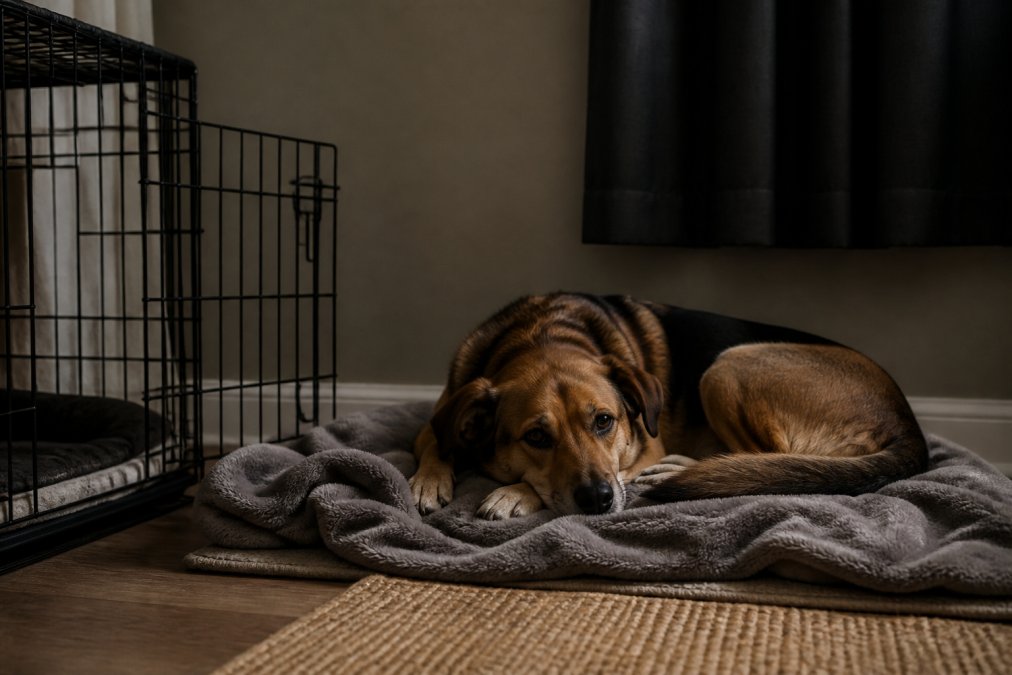
Days 1-3: Decompression
Your dog is not being difficult. They are coming down from a stretch of chronic stress that may include transport, shelter noise, and the loss of everyone they knew. Expect some combination of not eating, pacing at night, hiding, avoiding eye contact, and a loose stool from stress alone.
What to do:
- Keep the dog in the safe space or a single quiet room, not the full house
- Limit visitors to zero for the first few days
- Offer food and water on a fixed schedule and pick up what is not eaten
- Speak softly, move slowly, and skip the welcome party
- Let the dog come to you; do not corner them for affection
What not to do: do not take your new dog to a pet store, a dog park, or a family gathering in the first 72 hours. Every one of those is a stressor stacked on an already overloaded system.
Weeks 1-3: Settling Into Routine
This is where the first real tail wags usually show up. Your dog starts learning the household rhythm: when food comes, when the door opens, who is safe. Appetite typically returns. Sleep normalizes. Some dogs begin to seek contact on their own.
What to do:
- Lock in the daily anchors: same wake time, same feeding times, same walk route
- Introduce one new person or one new room at a time, not both in the same day
- Start short, low-traffic walks and keep them boring on purpose
- Begin hand-feeding a portion of each meal to build the association between your hands and good things
- Watch for the first signs of a personality emerging and follow the dog's lead on pace
A common pattern is a "honeymoon" calm in week one followed by a testing phase around weeks two and three, when the dog feels safe enough to push boundaries. That shift is progress, not regression.
Months 1-3: Feeling at Home
By the three-month mark, most dogs show their real personality. The dog who flinched at the leash may now bring it to you. The dog who would not leave the crate may start napping in the middle of the living room floor.
What to do:
- Gradually widen access to the full home if the dog is handling it well
- Add new environments, new people, and new dogs one variable at a time
- Keep the routine anchors in place even as freedom expands
- Reassess any lingering anxiety with your veterinarian if the dog is still not eating, sleeping, or settling
According to the American Kennel Club's rescue dog guidance, decompression is a biological need, not a luxury, and it cannot be rushed with extra affection. Track your dog's progress against the phase you are actually in, not the phase you wish you were in.
Step 4: Build Trust With a Predictable Routine and Gentle Handling
Trust building with an anxious rescue dog runs on consistency. A predictable routine tells your dog what happens next, and predictability is the fastest route to a nervous system that can finally relax.
Build your day around fixed anchors:
- Same wake-up time, same feeding time, same walk route
- Same words for the same actions ("outside," "bed," "good")
- Same calm energy from every family member
Gentle handling matters just as much. Skip the head pats and full-body hugs at first. Instead, offer a hand low and let your dog approach you. Sit on the floor at their level. When they lean in, that is consent. When they pull back, that is a no.
Consistency beats intensity every time. Ten calm, predictable days do more for an anxious rescue dog than one big adventure.
Step 5: Use the Best Puzzle Toys for Anxious Dogs to Redirect Nervous Energy
The best puzzle toys for anxious dogs work because they give a nervous brain a job to do. Anxiety feeds on idle energy, and enrichment redirects that energy into sniffing, problem-solving, and foraging, all of which are naturally calming behaviors for dogs.
This is where Chewzzle fits into a decompression plan. Our interactive puzzle toys and slow feeders turn mealtime into a low-pressure activity your dog can do alone in their safe space. The Chewzzle SnuffleSphere Foraging Ball mimics natural foraging, which taps into the sniff-and-search instinct that helps dogs settle. The Chewzzle ThinkDisc Puzzle Feeder and PuzzleFeast Sliding Puzzle pace fast eaters by releasing food one piece at a time, so a gulped meal becomes a slow, focused activity.


| Toy | Price | Best For | How It Helps |
|---|---|---|---|
| SnuffleSphere Foraging Ball | $29.99 | Sniffing and foraging | Redirects nervous energy into search behavior |
| SmartPaws Interactive Puzzle | $39.99 | Problem-solving | Builds focus and confidence through challenges |
| ThinkDisc Puzzle Feeder | $19.99 | Fast eaters | Slows gulping and paces mealtime |
| PuzzleFeast Sliding Puzzle | $49.99 | Advanced foragers | One-treat-at-a-time pacing for long engagement |
Start with one toy in the safe space and let your dog discover it without pressure.
Step 6: Manage Walks, Triggers, and Multi-Pet Households
Walks and Trigger Stacking
A few mechanics that help:
Introducing a Rescue Dog to Resident Pets
House Rules for Multi-Pet Homes
When to Bring In a Trainer
Step 7: Know When to Ask a Vet About Medication for an Anxious Rescue Dog
Conclusion: Patience Is the Real Treatment Plan
Frequently Asked Questions
What is the 3-3-3 rule for dogs with anxiety?
The 3-3-3 rule breaks the rescue transition into three phases: 3 days to decompress, 3 weeks to settle into a routine, and 3 months to feel fully at home. An anxious rescue dog may hide or refuse food during the first 3 days, start testing boundaries around week 3, and show real personality by month 3. Knowing which phase you are in helps you pace expectations instead of panicking when progress stalls.
What are the signs and symptoms of extreme anxiety in dogs?
Watch for tucked tails, pinned ears, whale eye, lip licking, yawning, pacing, panting without exercise, hiding, refusing food, and destructive chewing. More severe signs include trembling, drooling, house soiling, and attempts to escape through doors or windows. A dog showing several of these at once is over threshold, meaning training will not stick until you lower the trigger and give them space to recover.
How long does it take for a rescue dog to settle in?
Most rescue dogs need about 3 months to feel genuinely settled, though the timeline stretches for dogs from hoarding or abuse situations. Some show real relaxation in 3 weeks while others take 6 months or more. Progress is rarely linear, so expect good days and setbacks. Consistent routines, low-traffic walks, and predictable meals speed the process more than any single training trick.
Do puzzle toys actually help anxious rescue dogs, or will they ignore them?
Puzzle feeders give anxious dogs a job, which redirects nervous energy into sniffing and problem-solving instead of pacing or chewing. Start easy so your dog wins quickly, then increase difficulty. A snuffle-style foraging ball filled with treats works well for dogs who are too stressed to solve a complex puzzle at first. Pair toy time with a quiet room and let your dog opt out whenever they want.