

How to Use Treat Dispensing Balls for Dog Training
Last Updated: November 2, 2026
Quick Summary
Treat dispensing balls are hollow toys that release kibble or small treats as a dog rolls, bumps, or nudges them across the floor. To teach your dog, fill the ball with a few high-value treats, place it on the floor, and praise each nudge that releases food. Sessions of 5 to 10 minutes work well, with shorter sessions for puppies.
- Start with a wide opening and loose kibble so the dog gets food quickly.
- Puppies need sessions of two or three minutes and balls with wide openings.
- Make the ball harder by narrowing the opening, changing treat size, or adjusting how much you fill it.
- Advance one step only after two or three calm sessions in a row.
- Supervise every session and replace any ball with cracks or loose pieces.
Table of Contents
- Choosing a Ball Your Dog Can Actually Open
- How to Teach a Dog to Use a Treat Ball
- Treat Ball Training for Puppies: What Changes
- How to Adjust a Treat Ball's Difficulty Over Time
- Troubleshooting: When Your Dog Ignores the Ball or Gets Frustrated
- Start Your Dog's First Treat Ball Session Tonight
- Frequently Asked Questions
Treat dispensing balls are hollow toys with openings or grooves that release kibble or small treats as a dog rolls, bumps, or nudges them across the floor.
Treat dispensing balls are a type of food-dispensing toy. They reward a dog's natural drive to sniff, paw, and chase, so the dog works for its meal instead of gulping it down.
Why bother? Most dogs have energy they cannot burn on walks alone. A treat ball gives that energy a job.
- Mental stimulation: the dog thinks through how to get the food out
- Slower eating: food comes out in small bits, not all at once
- Calmer downtime: a busy dog is less likely to invent its own trouble
Choosing a Ball Your Dog Can Actually Open
The right ball matches your dog's size, chewing style, and skill level. A ball that is too hard to open leads to frustration. A ball that is too easy gets boring within a day.
The Chewzzle TreatDrop Ball ($14.99) is built for slow feeding and gentle chewing, with a food-release design that keeps dogs working for their meal. For a second option to compare, the Chewzzle RollFeast Treat Ball ($9.99) is a slow-feeder ball suited to small and medium dogs.


Check these points before you buy:
- Size: the ball should be big enough that your dog can nudge it without mouthing it
- Opening width: treats should fit through without jamming
- Material: choose a durable, non-toxic option that fits your dog's chewing strength
Watch out: a ball that is too small can be swallowed. Supervise every session, especially with dogs that chew hard.
How to Teach a Dog to Use a Treat Ball
Start with a simple, low-pressure session. Your goal is to show your dog that the ball produces food when it moves.
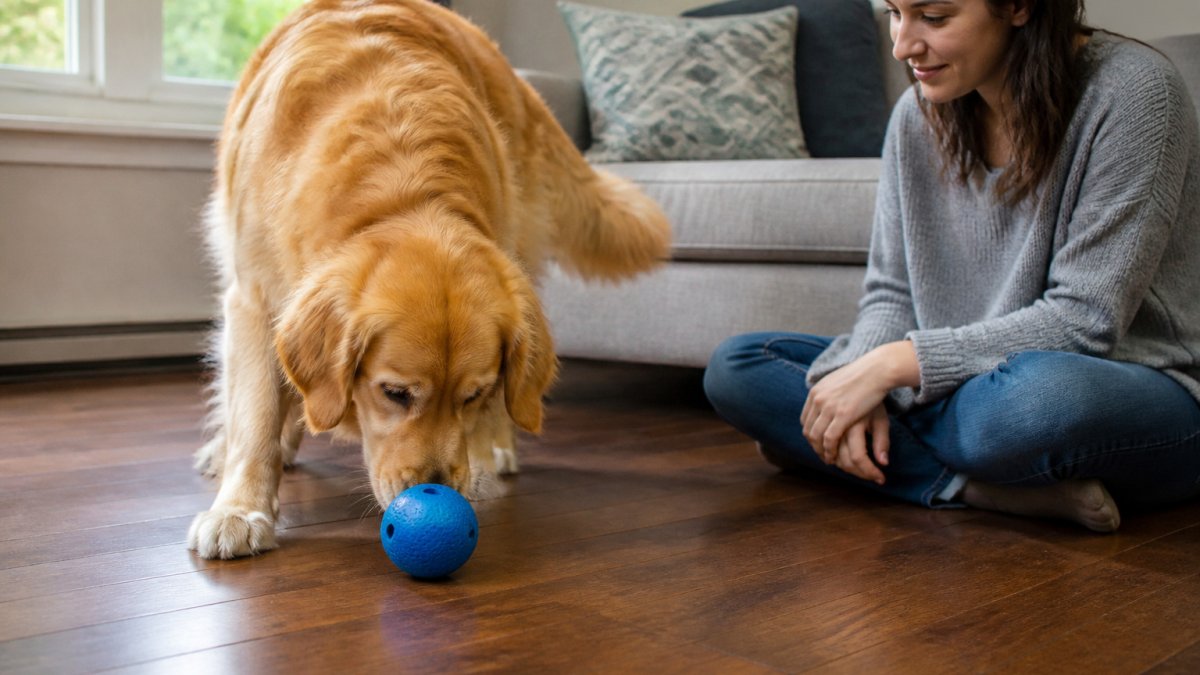
- Fill the ball with a few high-value treats, leaving the opening easy to reach.
- Place the ball on the floor in a quiet room, and sit close so your dog feels safe.
- Let your dog sniff it. When a treat falls out, praise your dog with a happy voice.
- Roll or nudge the ball yourself to show how the food comes out.
- Repeat for 5 to 10 minutes, then end the session on a success.
Most dogs catch on within a few sessions. If your dog only licks the ball, add a crumb of treat to the surface to encourage pawing and nudging.
Treat Ball Training for Puppies: What Changes
Puppies need shorter sessions and easier balls. Their attention span is brief, and they tire quickly.
Puppies also tend to chew everything, so keep an eye on the ball's condition. Replace any toy with cracks or loose pieces.
- Use soft treats so the puppy does not get frustrated
- Keep sessions short and frequent rather than long
- Supervise closely while the puppy is still learning
The Chewzzle ChewClean Treat Ball ($9.99) comes in sizes built for puppies and adult dogs.

For more ideas between sessions, read How to Keep Puppy Entertained Indoors.
How to Adjust a Treat Ball's Difficulty Over Time
Difficulty on a treat ball is set by two things: how easily food falls out, and how much movement the dog has to produce to make that happen. Most owners only change the food. Changing the opening and the fill pattern matters just as much, and it is the part competitors skip.
The three levers, in order of effect
- Opening size. A wider opening releases food with a small nudge. Narrowing it (or covering part of it) forces more rolling. This is the strongest lever and the one to adjust first.
- Treat size and shape. Round kibble rolls out easily; flat or irregular pieces tumble and jam, which slows release. A mix of sizes creates an unpredictable release that holds attention longer than uniform kibble.
- Fill pattern. Filling every opening makes the ball heavy and generous. Filling only some openings, or layering a few high-value treats at the bottom, changes how long the dog works before the payoff.
A staged progression with observable milestones
Move up one step only when your dog clears the current step quickly and calmly. A common pattern is to advance after two or three sessions in a row where the dog empties the ball in under about five minutes without frustration.
- Step 1, Wide opening, loose kibble. The dog nudges once and food appears. Milestone: the dog goes to the ball on its own when you set it down.
- Step 2, Wide opening, mixed sizes. Add a few larger or flatter pieces. Milestone: the dog keeps working after the first easy pieces are gone.
- Step 3, Partly covered opening. Cover or narrow part of the opening so the dog must roll farther. Milestone: the dog rolls the ball several times between rewards instead of pawing at a stationary toy.
Reading the clock instead of guessing
Time the session from the moment the dog first touches the ball to the moment it walks away. If that time is dropping fast across sessions, the task is too easy, go up one step.
Watch out: do not jump two steps at once after a good session. A dog that suddenly cannot get food out often stops trying altogether, and rebuilding that confidence takes longer than advancing slowly would have.
Treat and opening compatibility
Before you change difficulty, check that the treat actually fits the opening with room to spare. A piece that wedges in the opening turns the puzzle into a dead end and teaches the dog that the ball is not worth touching. Test by dropping a handful of the treats through the opening; if any piece needs a push, it is too large.
Measuring progress without overthinking it
You do not need a logbook. Two observations are enough: does the dog start on its own, and does it finish calmly? A dog that begins eagerly and ends relaxed is at the right level.
The article lists three levers for changing difficulty, each with a different effect on how easily food comes out. Browse the ChewClean Treat Ball sizes for puppies and adult dogs as you move up the stages.
| Lever | What it does | Effect on difficulty |
|---|---|---|
| Opening size | Wider lets food out with a small nudge | Narrowing forces more rolling; strongest lever |
| Treat size and shape | Round kibble rolls out; flat or irregular pieces jam | Irregular pieces slow release |
| Fill pattern | Filling every opening versus only some | Changes how long the dog works before payoff |
Troubleshooting: When Your Dog Ignores the Ball or Gets Frustrated
Most treat ball problems are not training failures. They are fit problems, the ball is too hard, the food is too hard to reach, or the session ran past the dog's patience. Match the fix to the behavior you actually see.
The dog freezes or stares at the ball
Freezing usually means the dog does not yet connect movement with food. Put a treat directly on top of the ball and let the dog eat it off the surface. Then roll the ball a few inches with your hand so a treat falls out in view. Repeat three or four times, then stop for the day. A common pattern is that freezing resolves within two or three short sessions once the dog sees food fall.
The dog mouths or chews the ball instead of rolling it
Mouthing is normal, especially in puppies and retrievers, but it defeats the puzzle and risks damage to the toy. Switch to a ball your dog can nudge with its nose or paw without being able to get its jaws around it, usually a larger diameter. Redirect by rolling the ball away with your hand the moment the dog starts to mouth it, then reward the nudge that follows.
The dog gets frustrated and quits
Frustration shows up as pawing without rolling, barking at the ball, or walking away with food still inside. Widen the opening, use smaller or rounder treats, and shorten the session. Stop while the dog is still interested rather than waiting for it to give up. Per the American Veterinary Medical Association's guidance on enrichment, a calm, positive experience matters more than how much food a dog gets from a toy, so treat frustration as a signal to ease the task, not as failure.
The dog ignores the ball entirely
Ignoring is often a value problem, not a skill problem. Try a stronger-smelling treat, run the session before a meal rather than after, and sit on the floor with the dog rather than standing over it. Some dogs need to watch another dog use the ball first. If the dog still ignores it after several attempts, set the ball aside for a week and reintroduce it later, novelty often does the work that repetition cannot.
The dog loses interest after a few days
Novelty fades fast when the release pattern is predictable. Rotate between two or three balls with different opening designs, change the treat mix, and move sessions to different rooms. Feeding an entire meal from the ball rather than a handful of treats also raises the stakes for food-motivated dogs.
The dog guards the ball
Guarding is a safety issue, not a training inconvenience. Do not reach into the ball or take it away while the dog is working. Instead, trade, offer a high-value treat in exchange for the ball, then put it away. If guarding is intense or directed at people or other pets, stop using the toy and consult a veterinarian or a qualified behavior professional before continuing.
Safety and supervision
Check the ball before every session for cracks, loose pieces, or chewed edges, and replace it at the first sign of damage. Supervise all sessions, especially with strong chewers and puppies. A ball small enough to fit entirely in the dog's mouth is a choking risk, size up. Stop play immediately if the dog starts to break pieces off the toy, and remove the ball once the session ends so it does not become a chew toy overnight.
Start Your Dog's First Treat Ball Session Tonight
Pick one treat ball, fill it with a few favorite treats, and sit down with your dog for a five-minute session. Watch how your dog moves, and praise every nudge or paw.
Chewzzle offers treat balls for puppies and adult dogs, so you can start with the one that fits your dog today. Add to cart on the TreatDrop Ball or the ChewClean Treat Ball and get your first session started.
Frequently Asked Questions
Can puppies use treat-dispensing balls?
Yes, puppies can use treat-dispensing balls once they are weaned and eating kibble. Start with a larger opening and a generous amount of kibble so the first experiences feel rewarding. Supervise closely, since young puppies may chew off small pieces. Choose a durable, non-toxic ball sized for the puppy's mouth, and keep sessions short, about five to ten minutes, to avoid frustration while their attention span is still developing.
How long should a dog use a treat-dispensing ball?
Most sessions work best at 5 to 15 minutes, depending on your dog's age, energy level, and how quickly they solve the puzzle. Use the ball for part of a meal or as a short enrichment break rather than leaving it out all day. Pick up the ball when the treats are gone or when your dog loses interest, and always supervise to make sure the ball is not being chewed apart.
What treats work best in a dog treat ball?
Dry kibble and small training treats work best because they fall out easily and are sized for the ball's opening. Soft or sticky treats can clog the openings, and very large pieces will not dispense. Match the piece size to the opening, and avoid overfilling the ball. If you use part of your dog's daily kibble, subtract that amount from their meal to keep calories on track.
Are treat-dispensing toys good for dogs?
For most dogs, yes. Treat-dispensing toys provide mental stimulation, slow down fast eaters, and give dogs a constructive outlet for natural foraging behavior. They are not a substitute for exercise or attention, and they should be used with supervision, especially with heavy chewers. Choose a durable, non-toxic ball, inspect it regularly for cracks or loose parts, and replace it when it shows wear.
