

Best Slow Feeder Dog Bowl for Anxious Rescue Dogs
Table of Contents
- Why Anxious Rescue Dogs Need a Slow Feeder Dog Bowl
- How We Evaluated These Slow Feeder Dog Bowls
- Our Top Pick: Chewzzle ThinkDisc Puzzle Feeder
- Comparison Table: Best Slow Feeders for Anxious Dogs
- Best for Pacing Meals: Chewzzle PuzzleFeast Sliding Puzzle
- Best for Sensory Engagement: Chewzzle SnuffleSphere Foraging Ball
- How to Stop Dog Eating Too Fast by Matching the Feeder to the Dog
- Mental Enrichment for Rescue Dogs: Why Pacing Meals Reduces Anxiety
- Frequently Asked Questions
Last Updated: September 9, 2026
Bringing home a rescue dog is one of the most rewarding experiences, but mealtime often reveals deep-seated anxiety and food insecurity. A slow feeder dog bowl for anxious rescue dogs does more than just pace eating; it transforms a stressful, gulping frenzy into a calm, engaging puzzle that builds confidence. At Chewzzle, our interactive feeders are designed to address the behavioral and physical needs of dogs.
The core problem isn't just speed. When a dog inhales food, they swallow excess air, which increases the risk of gastric dilatation-volvulus (GDV), a life-threatening condition where the stomach twists. Beyond the physical danger, fast eating is often a symptom of past food insecurity, a common issue for rescues who had to compete for resources. A puzzle feeder forces the dog to slow down, engaging their brain and nose, which naturally lowers stress levels and makes mealtime a positive, rewarding experience rather than a source of panic.

Below, we'll explore the best options for anxious rescues, explain how to match a feeder to your dog's specific triggers, and show you how to introduce it successfully. We'll also cover the two angles most guides miss: how to handle noise sensitivity and how to use integration training to build lasting confidence.
Why Anxious Rescue Dogs Need a Slow Feeder Dog Bowl
Many rescue dogs eat as if their bowl will disappear, a direct result of food insecurity from their past. This instinctual behavior is a survival mechanism, but it leads to poor canine digestion, regurgitation, and heightened mealtime anxiety. A slow feeder dog bowl interrupts this frantic pattern by breaking the meal into a series of small, solvable challenges.
The act of working for food provides mental enrichment that exhausts a dog far more effectively than a 30-second inhale. When a dog must nudge, slide, or sniff for each piece of kibble, their brain releases calming neurochemicals. This cognitive stimulation shifts their focus from fear to problem-solving, which is a powerful tool for reducing overall stress levels. For an anxious rescue, the goal is to associate food with safety and fun, not competition and speed.
How We Evaluated These Slow Feeder Dog Bowls
Safety and Material Quality First
For a dog with anxiety, chewing is a common coping mechanism. This means any feeder must withstand significant pressure without breaking into sharp pieces. We prioritize feeders made from durable, non-toxic materials. The construction needs to be durable enough for a determined chewer yet gentle enough to protect a dog's teeth and gums. We also look for non-slip bases to prevent the bowl from skidding across the floor. We consider how easy each feeder is to clean.
Design Complexity and Difficulty Levels
An anxious dog needs a challenge that is difficult enough to engage them but simple enough to guarantee early success. Feeders can be categorized by their cognitive load: maze designs with raised ridges are often easier, while sliding puzzles and foraging balls can require more complex problem-solving. Feeders with adjustable difficulty or multiple solving methods allow you to start easy and increase the challenge as your dog's confidence grows. The Chewzzle range offers a progression from simple foraging balls to multi-step puzzles.
Our Top Pick: Chewzzle ThinkDisc Puzzle Feeder
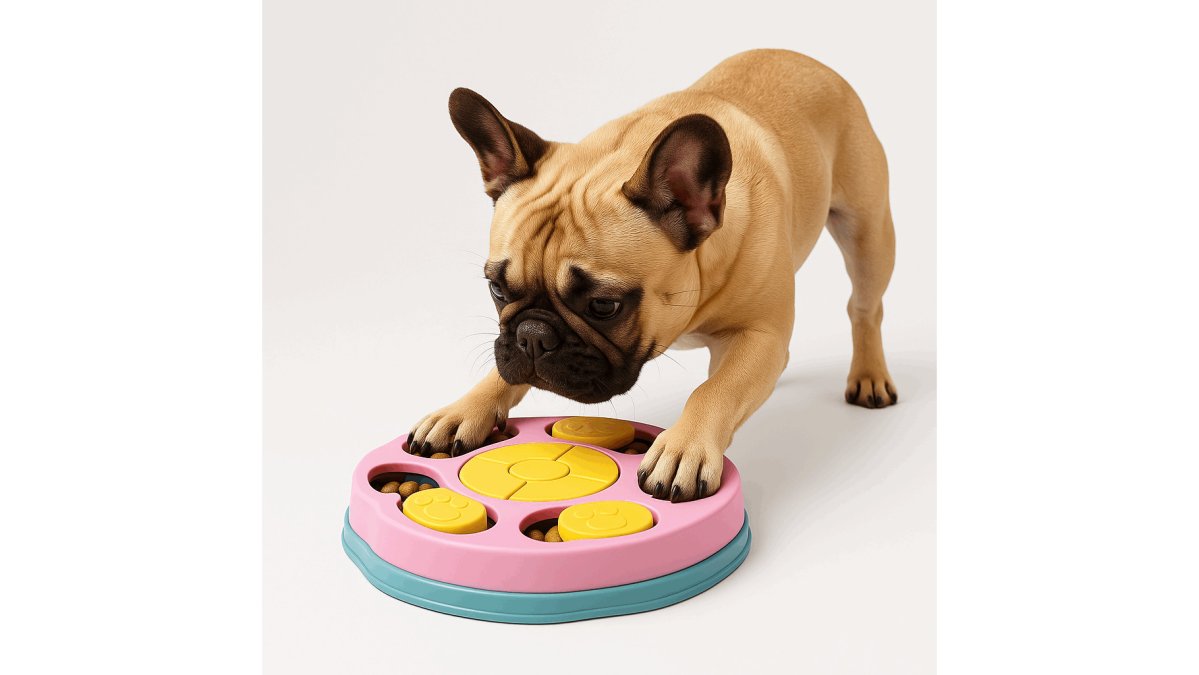
For most anxious rescues, the Chewzzle ThinkDisc Puzzle Feeder is the ideal starting point. Priced at $19.99, it balances mental enrichment with a manageable difficulty curve that encourages success without frustration. The design features recessed compartments and shallow troughs around the rim, where you hide the kibble. Paw-shaped sliding covers and a turning center wheel conceal the food, requiring your dog to use both nose and paw to unlock their meal.
What makes this slow feeder dog bowl effective is its multi-layered approach. A dog must first figure out that the covers slide, then solve the rotating center wheel. This provides focused cognitive work, effectively pacing a meal. The non-slip rubberized base helps keep it planted on the floor. It is made from durable, pet-safe plastic that is easy to rinse, and you can move the food to different compartments between sessions to keep the puzzle novel.
Comparison Table: Best Slow Feeders for Anxious Dogs
To help you choose the right tool, here is a summary of the Chewzzle feeders best suited for anxious dogs, based on their specific needs.
| Feeder | Price | Best For | Key Feature | Difficulty |
|---|---|---|---|---|
| ThinkDisc Puzzle Feeder | $19.99 | First-time puzzle users | Sliding covers + turning wheel | Moderate |
| PuzzleFeast Sliding Puzzle | $49.99 | Dogs needing a longer mental workout | One treat at a time pacing | Advanced |
| SnuffleSphere Foraging Ball | $29.99 | Sensory engagement and sniffing | Soft fleece and TPR, portable | Easy-Moderate |
Best for Pacing Meals: Chewzzle PuzzleFeast Sliding Puzzle
If your dog figures out the ThinkDisc quickly and still seems to gulp, the Chewzzle PuzzleFeast Sliding Puzzle can be a good next step. At $49.99, it is a more significant investment. The premise is simple: a treat sits under each sliding button, and the dog must nose or paw the button aside to get it. Because only one treat is uncovered at a time, it encourages a pause between each bite.

This design is pure mental enrichment for rescue dogs who need to learn patience. It turns a single bowl of kibble into a multi-minute scavenger hunt. The sliding action is quiet and smooth. The non-slip base helps keep it stable on hardwood or tile, and it is suitable for dogs of all sizes, from a small terrier using its nose to a large retriever using its paw.
Best for Sensory Engagement: Chewzzle SnuffleSphere Foraging Ball
For dogs who are more scent-driven than visually motivated, the Chewzzle SnuffleSphere Foraging Ball ($29.99) offers a completely different experience. This soft ball, made from plush fleece and non-toxic TPR, encourages your dog to push it around with their nose and paws, sniffing out kibble hidden within its folds. It mimics the natural foraging behavior of searching for food in the wild, which is deeply satisfying for an anxious dog.

This feeder can be effective for reducing anxiety because the repetitive sniffing action can be calming for dogs. It can help shift the dog into a focused, investigative state. Because it is soft and lightweight, it is suitable for indoor play and crate training routines, and it is gentle on teeth and gums. It is also easy to integrate into a game of fetch or a training session, making it a versatile tool for building a positive bond.
How to Stop Dog Eating Too Fast by Matching the Feeder to the Dog
Understanding how to stop dog eating too fast starts with matching the feeder's difficulty to your dog's personality and anxiety level. A nervous dog who has never used a puzzle needs immediate success, or they may refuse to eat entirely. Start with the easiest option, like the SnuffleSphere, where food is visible and accessible with minimal effort. Once they are confidently foraging, you can transition to the ThinkDisc, which introduces the concept of covers and slides.
If you have a highly intelligent dog who is motivated by food, they may solve the ThinkDisc quickly. Watch for signs of boredom, such as them flipping the bowl over or walking away. This is when you escalate to the PuzzleFeast, which offers a longer sequence of problem-solving. The key is to observe your dog's frustration level. If they whine or give up, you have made it too hard. If they solve it in under a minute, it is too easy. The goal is a meal that takes between 5 and 10 minutes of active thinking.
A common mistake is moving to a complex puzzle too early. This can create a negative association with mealtime, worsening anxiety. Another mistake is using the same puzzle in the same configuration every day, which leads to habituation. We recommend rotating the feeder you use and moving the food to different compartments to keep the challenge fresh.
Mental Enrichment for Rescue Dogs: Why Pacing Meals Reduces Anxiety
Mental enrichment for rescue dogs is about more than just preventing boredom; it is about rebuilding a sense of safety and control. When a dog is forced to work for their food, they are engaging in a problem-solving task that requires focus. This focus displaces anxious thoughts, similar to how a challenging puzzle can distract a human mind from worry. The success of finding food releases dopamine, which reinforces calm behavior.
Pacing meals through puzzle feeders also addresses specific rescue triggers. For example, a dog with food insecurity learns that food is plentiful and requires effort to find, which reduces the panic associated with scarcity. A dog with noise sensitivity benefits from quiet, sliding puzzles rather than loud metal bowls. This is where integration training comes in: you pair the feeder with a calm command like "settle" or "wait" before they start eating. Over time, the feeder itself becomes a cue for relaxation, signaling that it is time to be calm and focused.
Choosing the right slow feeder dog bowl for anxious rescue dogs is a decision about your dog's long-term wellbeing. It is about moving beyond the physical risk of bloat and addressing the emotional scars of food insecurity. At Chewzzle, we believe that mealtime should be a moment of connection and confidence, not stress. Our range of puzzle feeders, from the ThinkDisc to the PuzzleFeast, is designed to grow with your dog, providing the mental stimulation and positive reinforcement they need to thrive. Get started with Chewzzle and turn your dog's next meal into a calming, enriching game that builds trust and reduces anxiety.
Frequently Asked Questions
Do slow feeders mentally stimulate dogs?
Yes. A slow feeder dog bowl that requires problem-solving, like the Chewzzle ThinkDisc or PuzzleFeast, provides mental enrichment. Instead of gulping food, dogs must use their nose and paws to uncover kibble. This cognitive work can reduce stress levels and boredom, which is particularly helpful for anxious rescue dogs learning to feel safe in a new home.
What are the downsides of slow feeder bowls for dogs?
The main downside is frustration. A nervous dog may find a difficult puzzle overwhelming at first. Some dogs also try to chew plastic feeders rather than solve them. To avoid this, start with an easier option like the SnuffleSphere or begin with covers partially open. Always supervise initial sessions to ensure your dog is engaging positively, not getting stressed.
Do vets recommend slow feeders?
Many veterinarians recommend slow feeders for dogs that eat too quickly. Gulping food leads to swallowing air, which can contribute to bloat, a serious condition. Slower eating also supports better canine digestion and portion control. While a slow feeder dog bowl is not a substitute for veterinary care, it is a vet-approved tool for promoting healthier eating habits.
How can I help my rescue dog feel safe during mealtime?
Create a consistent, quiet feeding routine. Place the slow feeder dog bowl in a calm corner away from foot traffic and other pets. Use a non-slip base to keep the bowl steady. Start with a simple puzzle and sit nearby, speaking in a soft tone. This predictable routine builds trust and helps reduce mealtime anxiety tied to past food insecurity.