
How to Stop Your Dog Eating Too Fast: 7 Proven Steps
Table of Contents
- Why Your Dog Is Eating Too Fast
- Dog Bloat Symptoms Every Owner Should Recognize
- Step-by-Step: How to Stop Your Dog Eating Too Fast
- Best Slow Feeder Dog Bowls to Prevent Gulping
- Interactive Puzzle Toys for Dogs: Enrichment That Slows Eating
- Transitioning Your Dog to Slower Eating Habits
- Conclusion
Last Updated: August 27, 2026
Why Your Dog Is Eating Too Fast
Dogs don't naturally eat slowly. Their ancestral instinct is to consume food quickly before another animal takes it, a drive that persists even in climate-controlled kitchens. According to the American Kennel Club's guidance on canine feeding behavior, rapid eating in dogs is strongly linked to competition anxiety, whether real or perceived.
Behavioral Root Causes
Fast eating usually stems from one of three causes. Competition anxiety is most common: dogs that grew up competing with littermates often carry that urgency into adulthood. Resource guarding is a related but distinct issue where dogs eat fast out of possessiveness. Boredom and high drive round out the list, particularly in high-energy breeds where mealtime is the day's most stimulating event.
A critical mistake is treating all fast eaters the same way. A dog eating fast out of resource guarding needs a different approach than one eating fast out of boredom.
Breed-Specific Risk Factors
Breed matters significantly. Deep-chested breeds including Great Danes, German Shepherds, Standard Poodles, Weimaraners, and Boxers face a higher risk of gastric dilatation-volvulus (GDV), a life-threatening condition where the stomach fills with gas and twists on itself. Flat-faced breeds like Bulldogs and Pugs face aerophagia (swallowing air while eating), causing gastrointestinal distress and vomiting. For these breeds, slowing mealtime isn't optional, it's a health priority.
Dog Bloat Symptoms Every Owner Should Recognize
Bloat (gastric dilatation-volvulus) is a veterinary emergency where the stomach expands rapidly with gas and may rotate to trap that gas inside. Recognizing early signs can save your dog's life:
- A visibly distended or hard abdomen
- Unproductive retching or attempting to vomit without bringing anything up
- Restlessness, pacing, or inability to settle
- Excessive drooling
- Rapid, shallow breathing
- Sudden weakness or collapse
Bloat can progress from early symptoms to life-threatening within two to three hours. Contact your veterinarian immediately if your dog shows any combination of these signs after eating.
According to the Merck Veterinary Manual's clinical overview of GDV, rapid eating is consistently identified as a contributing risk factor. Slowing your dog's eating speed is one of the most practical preventive measures available.
Step-by-Step: How to Stop Your Dog Eating Too Fast
These steps are sequenced intentionally. Start with the simplest changes and layer in additional strategies as needed.
Step 1: Switch to Smaller, More Frequent Meals
Divide your dog's daily food allowance into two or three smaller meals instead of one large one. A dog eating one large meal per day has more incentive to eat fast due to the longer gap until the next feeding. Smaller, more frequent meals reduce that urgency while supporting better metabolism and consistent satiety.
Step 2: Use a Muffin Tin or Spread Kibble on a Flat Surface
Spread your dog's kibble across a muffin tin or flat baking sheet. Your dog must nose each cup individually, naturally slowing the eating process. This introduces physical separation between portions, forcing the dog to move from cup to cup rather than simply inhaling the meal. Dogs that figure it out quickly are good candidates for purpose-built slow feeder bowls.

Step 3: Try Hand Feeding to Build Calm Mealtime Habits
Hand feeding is an underused behavioral modification tool. Feed your dog their meal one small handful at a time. This slows eating to a natural pace, builds positive associations between you and food delivery, and gives direct feedback on food-related behavior, particularly valuable for identifying resource guarding early.
Step 4: Separate Pets During Mealtime
If you have multiple pets, feed them in separate rooms or on opposite sides of the space. The presence of another animal triggers competition instincts even in dogs that normally get along well. Many dogs slow down noticeably within the first week of consistent separation.
Step 5: Consider Dietary Texture and Food Type
Dry kibble is easiest to gulp. Wet food or raw food requires more chewing effort and is physically harder to inhale in large quantities. A mix of wet and dry food often slows eating without other intervention. Larger kibble pieces also require more chewing than small ones.
| Step | What It Does | Best For |
|---|---|---|
| Smaller, more frequent meals | Reduces urgency and portion size | All dogs |
| Muffin tin or flat surface | Separates kibble to slow access | Budget-conscious owners |
| Hand feeding | Builds calm habits, reduces anxiety | Rescue dogs, food-aggressive dogs |
| Separate pets at mealtime | Removes competition trigger | Multi-pet households |
| Adjust dietary texture | Makes gulping physically harder | Dogs on dry-only diets |
Best Slow Feeder Dog Bowls to Prevent Gulping
Slow feeder bowls use ridges, mazes, and compartments that force dogs to work for each bite, turning a simple meal into a problem-solving activity.
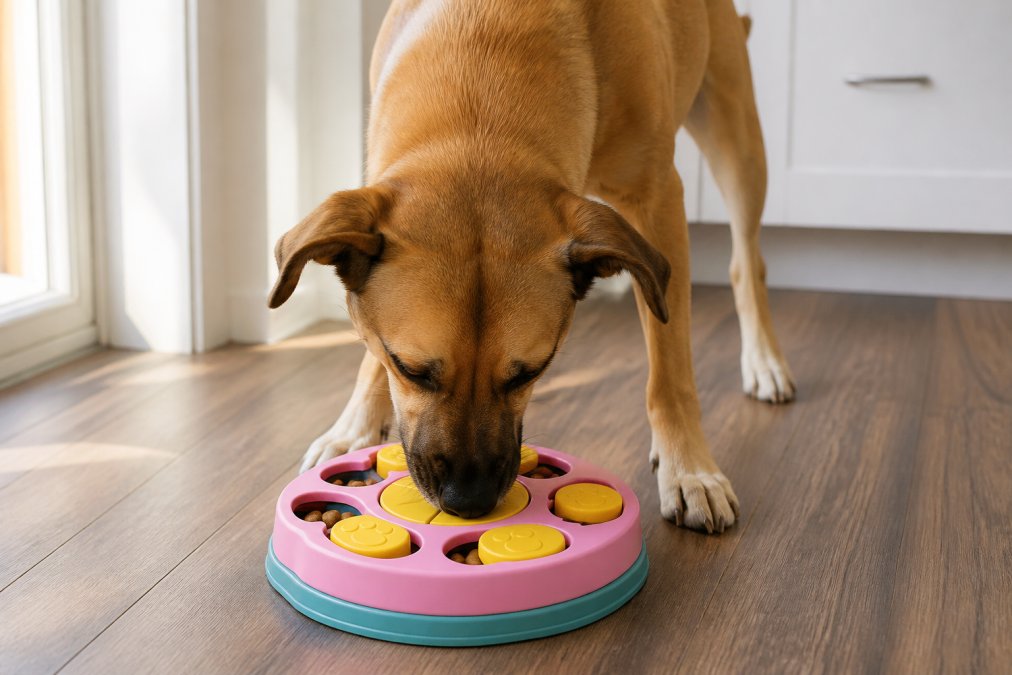
The Chewzzle ThinkBowl Slow Feeder ($19.99) features puzzle-style compartments requiring your dog to use their nose and tongue to extract kibble piece by piece, turning a 30-second meal into a three-to-five-minute workout. The non-slip base and non-toxic materials make it safe for enthusiastic eaters.
For dogs that master basic slow feeders quickly, the Chewzzle PuzzleFeast Sliding Puzzle ($49.99) increases the challenge. Each treat sits under a button your dog must nose or paw aside, with only one treat uncovered at a time. It's particularly effective for high-drive breeds.

Interactive Puzzle Toys for Dogs: Enrichment That Slows Eating
Puzzle feeders turn the entire meal into an enrichment activity. While slow feeder bowls are passive, puzzle toys are active, the dog must solve something to access food. This mimics natural foraging behaviors and reintroduces the search element that domestic feeding eliminates.
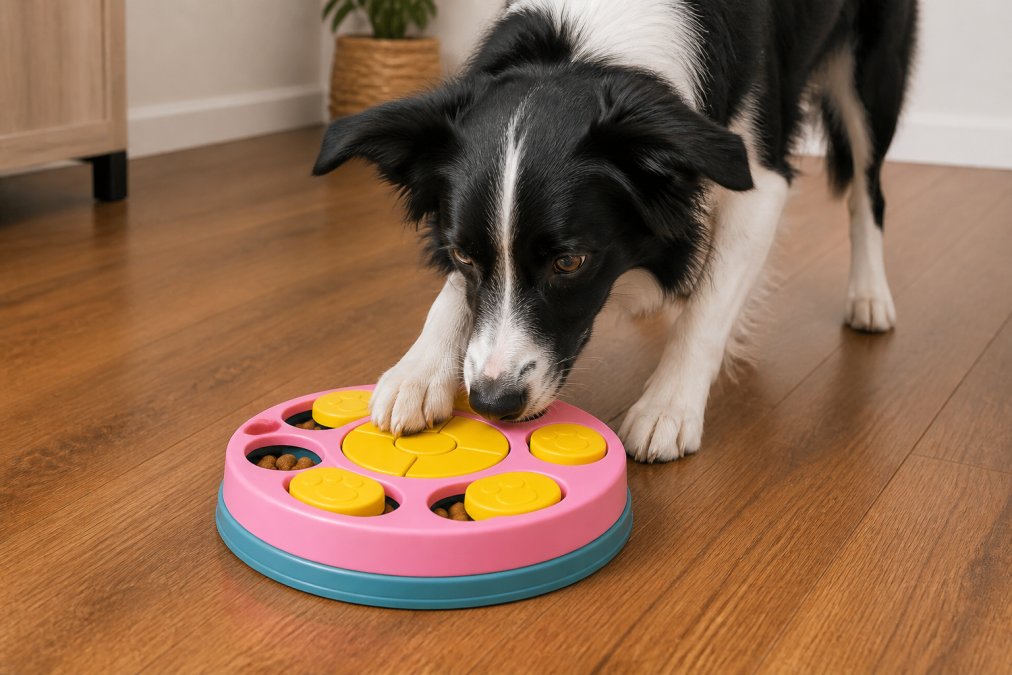
The Chewzzle RollFeast Treat Ball ($9.99) is a practical entry point. Your dog rolls or nudges the ball to dispense kibble piece by piece. The Chewzzle SnuffleSphere Foraging Ball ($29.99) uses soft fabric layers your dog must sniff and nose through to find hidden treats, particularly effective for dogs with strong scent drive.

According to the American Veterinary Society of Animal Behavior's position on behavioral enrichment, mental stimulation through food-based enrichment is associated with reduced anxiety and improved behavioral outcomes. If your dog finishes their meal in under two minutes and then paces or seeks attention, they need more enrichment, not just slower eating.
Transitioning Your Dog to Slower Eating Habits
The biggest mistake is introducing every change at once. A dog accustomed to a standard bowl will find a puzzle feeder confusing on the first attempt. Transition gradually: start with the simplest intervention and let your dog adjust for a week before adding a slow feeder bowl.
Key transition notes:
- Expect frustration in the first two to three days. This is normal. Don't revert to a standard bowl, or you'll teach the dog that persistence gets results.
- Start with lower difficulty levels. Make treat placement obvious initially and increase difficulty as confidence builds.
- Use high-value treats to introduce new feeders. Regular kibble may not sustain engagement on the first attempt.
- Monitor total food intake. Some dogs eat less when frustrated by a puzzle feeder. Track intake for the first two weeks to ensure they're getting their full daily portion.
Most dogs adapt to slower eating habits within two to four weeks of consistent practice.
Fast eating in dogs is a solvable problem requiring behavioral awareness, portion management, and the right enrichment tools. Chewzzle's range of slow feeders and puzzle toys, from the ThinkBowl at $19.99 to the PuzzleFeast Sliding Puzzle at $49.99, addresses both the speed problem and the mental stimulation gap underlying it. Add the Chewzzle ThinkBowl or RollFeast Treat Ball to your cart and give your dog a mealtime that works with their instincts instead of against them.
Frequently Asked Questions
Q: Why is my dog eating so quickly?
A: Dogs eat fast for several reasons. Competition with other pets, a history of food scarcity (common in rescues), food aggression, or simple excitement can all drive gulping behavior. Some breeds are naturally predisposed to eating fast. In most cases it is a behavioral pattern rather than a medical issue, but it is worth mentioning to your veterinarian if the behavior is sudden or accompanied by vomiting or gastrointestinal distress.
Q: Can a slow feeder bowl actually help prevent bloat in dogs?
A: Slow feeder bowls reduce the speed at which a dog consumes food, which limits the amount of air swallowed during eating, a process called aerophagia. Swallowing excess air is one contributing factor to gastric dilatation-volvulus (GDV), commonly known as bloat. While a slow feeder bowl alone cannot guarantee prevention, veterinary guidance consistently recommends slowing mealtime as part of a broader bloat-prevention strategy, especially for large and deep-chested breeds.
Q: What are the health risks of a dog eating too fast?
A: Eating too fast puts dogs at risk for regurgitation, vomiting, choking, and gastrointestinal distress. The most serious risk is bloat, or GDV, a life-threatening condition where the stomach fills with gas and can twist on itself. Deep-chested breeds like Great Danes, German Shepherds, and Standard Poodles face the highest risk. Beyond GDV, chronic fast eating can impair digestion and reduce satiety signals, potentially contributing to overeating over time.
Q: How do interactive puzzle toys help dogs eat more slowly?
A: Interactive puzzle toys for dogs require them to nose, paw, or roll the toy to access food one small portion at a time. This physically prevents gulping by making it impossible to consume a full portion in seconds. The mental stimulation involved also engages problem-solving instincts, which slows the eating process further and promotes a calmer mealtime. Options like the Chewzzle PuzzleFeast Sliding Puzzle or RollFeast Treat Ball are designed specifically with this pacing mechanism built in.
This article was written using GrandRanker