

Best Treat Ball Toys for Puppy Crate Training Success
Last Updated: November 5, 2026
Quick Summary
Treat ball toys are hollow or grooved toys that release kibble or treats as a puppy rolls, nudges, or chews them, turning crate time into a puzzle instead of a pause. Our top pick for most puppies is the Chewzzle TreatDrop Ball, a soft silicone option for gentle to moderate chewers.
- The Chewzzle TreatDrop Ball costs $14.99 and suits gentle to moderate chewers.
- The Chewzzle ChewClean Treat Ball is natural rubber with a 5cm diameter for strong chewers.
- The RollFeast is compatible with dry kibble or treats up to 0.59 x 0.91 inches.
- Supervise the first week of crate sessions with the door open or while you are in the room.
- Build duration from two minutes on day one to ten to fifteen minutes by the end of week one.
Table of Contents
- Why Treat Ball Toys Belong in Your Crate Training Plan
- Quick Comparison: Best Treat Ball Toys for Crate Training
- Safe Puppy Crate Toys: What to Check Before You Buy
- How to Keep a Puppy Busy in a Crate Without Creating Bad Habits
- Building a Puppy Crate Training Schedule Around Enrichment
- Dietary Integration: What to Put in a Treat Ball
- Step-by-Step: Introducing a Treat Ball in the Crate
- Cleaning, Durability, and Noise-Dampening Tips
- Frequently Asked Questions
Why Treat Ball Toys Belong in Your Crate Training Plan
A crate should feel like a den, not a holding cell. That is why the best treat ball toys for puppy crate training earn a permanent spot in your daily routine.
The benefits stack up quickly:
- Mental stimulation helps tire a puppy out
- Slow feeding can help reduce gulping
- Positive reinforcement can build a calm association with the crate
The American Veterinary Medical Association notes that enrichment supports both behavioral and physical health in dogs, which is why AVMA guidance on canine enrichment treats puzzle feeding as more than a gimmick.
Quick Comparison: Best Treat Ball Toys for Crate Training
Here are the four treat-dispensing options we recommend, ranked by how well they fit crate training specifically.
| Toy | Price | Best For | Standout Feature |
|---|---|---|---|
| Chewzzle TreatDrop Ball | $14.99 | Gentle to moderate chewers | Textured silicone cleans teeth |
| Chewzzle RollFeast Treat Ball | $9.99 | Small and medium dogs | Rolling puzzle releases kibble |
| Chewzzle ChewClean Treat Ball | $9.99 | Strong chewers | Natural rubber, 5cm diameter |
| Chewzzle Launch & Learn Puppy Trainer | $69.99 | Focus and self-play training | Automatic reward launcher |
Our top pick for most puppies is the Chewzzle TreatDrop Ball. The soft silicone is gentle on young teeth, the treat-dispensing design stretches mealtime, and the textured surface is designed to help reduce plaque.
The RollFeast is the budget entry point. It dispenses kibble as your dog rolls or nudges it, which suits small and medium breeds and puppies still learning the game.
If you want to browse the full range, explore Chewzzle's puzzle toys for puppies to match a toy to your puppy's chewing style. You can also view the RollFeast Treat Ball directly if the rolling design fits your setup.

Safe Puppy Crate Toys: What to Check Before You Buy
Safety comes before enrichment. A poorly fitting or breaking toy can become a choking hazard.
Size, Material, and Choking Hazard Checks
Run through this checklist before anything goes in the crate:
- Toy is larger than your puppy's throat width so it cannot be swallowed
- No loose parts, squeakers, or small caps that can detach
- Material is non-toxic and free of BPA and phthalates
Watch out: a toy sized for a large adult dog can choke a small puppy, and one small enough for a Chihuahua can be swallowed whole by a Labrador. Match size to your puppy's mouth, not the breed it will grow into.
The Chewzzle ChewClean Treat Ball is made from natural rubber and has a 5cm diameter. For more, read our complete guide to puppy puzzle toy safety.

Crate-Specific Safety Protocols Most Guides Skip
A toy that is safe on a living room floor is not automatically safe in a crate. Three protocols close that gap:
- Supervise the first sessions, then audit before you leave. For the first week, only offer the treat ball with the crate door open or while you are in the room. Once your puppy settles reliably, do a 30-second audit before closing the door: tug the toy, check the dispensing hole for cracks, and confirm no treat fragments have broken loose.
- Match toy size to crate size, not just puppy size. A large rolling ball in a small crate becomes a foot trap when your puppy stands up suddenly. Size the toy so your puppy can nose it into a corner but not wedge it under the crate pan or between the bars.
- Remove the toy if your puppy is a determined destroyer. A puppy left alone with a punctured rubber ball can swallow chunks before you hear anything. If you find fresh bite marks, retire the toy immediately.
Watch out: never leave a plush, rope, or squeaker toy in a crate with an unattended puppy. Those are floor toys. The only toys that belong behind a closed door are solid rubber or silicone treat dispensers with no detachable parts.
Noise and Movement Inside the Crate
A hard toy rolling against a crate tray at night is a pain point most guides ignore. Two fixes: line the crate floor with a towel or mat to dampen sound, and choose a softer silicone toy for overnight crating. Also check that the toy cannot roll under the crate pan or wedge between the bars, where a puppy can paw at it for hours and work up frustration.
How to Keep a Puppy Busy in a Crate Without Creating Bad Habits
The trick to keeping a puppy busy in a crate is giving it a job, not a distraction. A treat ball rewards calm, focused behavior.
Three habits to avoid:
- Do not use the crate as punishment, or the toy inside it becomes a signal of bad things
- Do not leave a puppy crated with a toy for hours on end without a potty break
- Do not swap toys constantly, because novelty can overstimulate instead of calm
Instead, build a routine. A stuffed treat ball goes in at nap time and comes out when your puppy settles.
For anxious rescues, a food puzzle can give nervous energy a constructive outlet during crate training.
Building a Puppy Crate Training Schedule Around Enrichment
A crate training schedule works best when enrichment is built into the rhythm of the day. Puppies need frequent potty breaks, short crate sessions, and structured play, and a treat ball slots into each window.
Here is a simple daily framework:
| Time | Activity | Toy Use |
|---|---|---|
| Morning | Potty, breakfast | Stuffed treat ball in crate for 20 minutes |
| Midday | Short training session | Treat ball as reward for settling |
| Afternoon | Nap in crate | Frozen treat ball for extended calm |
| Evening | Play and wind-down | Rolling puzzle toy for active engagement |
The pattern matters more than the exact clock. Young puppies cannot hold their bladder long, so keep crate sessions short and pair each one with a food puzzle to build a positive association.
Dietary Integration: What to Put in a Treat Ball
What goes inside the ball matters as much as the ball itself.
Good fillings:
- Dry kibble sized to fit the dispensing hole
- Small training treats broken into pieces
- A mix of kibble and a few high-value treats for harder puzzles
The Chewzzle RollFeast Treat Ball is compatible with most dry kibble or treats up to 0.59 x 0.91 inches, so check your kibble size before filling.
Watch out: do not subtract a full meal and replace it with high-calorie treats. Use your puppy's daily ration, not extra snacks, or you will overshoot calorie needs quickly.
Step-by-Step: Introducing a Treat Ball in the Crate
Introduce the treat ball before you rely on it. A puppy that has never seen a puzzle toy will ignore it or bark at it, so teach the game first.
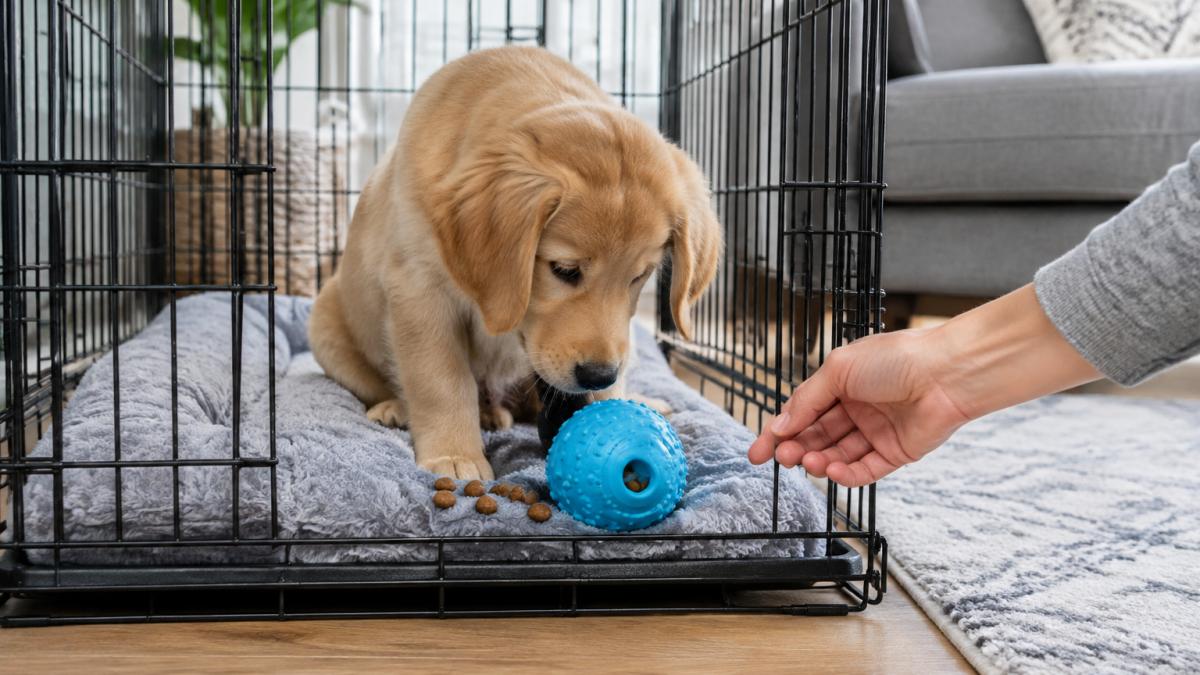
- Start outside the crate. Show your puppy the ball with a few treats visible, and let them sniff and paw at it. Do this on a hard floor, not carpet, so the ball rolls and the reward comes fast.
- Load it lightly. Use a small handful of kibble so the reward comes fast and frustration stays low. A common mistake is overstuffing the ball on day one; a puppy that cannot get anything out will walk away.
- Roll it yourself. Nudge the ball so treats fall out, then let your puppy take over. Reward any nose contact, even if no treat falls.
- Move it into the crate with the door open. Place the loaded ball inside and let your puppy walk in and out freely. Do not close the door yet; the goal is for the crate to predict the toy, not to trap the puppy with it.
- Close the door briefly. Start with sessions of one to two minutes, then extend as your puppy settles. End every session while your puppy is still calm and still interested, not after they have given up.
- Build duration across a week. A workable progression is two minutes on day one, five minutes by day three, and ten to fifteen minutes by the end of week one, always paired with a potty break before and after.
A One-Week Crate Integration Schedule
Treat balls build positive crate associations fastest when they follow a predictable rhythm rather than being used as an emergency distraction. A simple schedule:
| Day | Crate session | Treat ball role |
|---|---|---|
| 1 | Door open, puppy free to enter | Loaded ball on crate floor, no door |
| 2 | Door closed 1-2 minutes | Loaded ball, you in the room |
| 3 | Door closed 5 minutes | Loaded ball, you step out briefly |
| 4 | Door closed 10 minutes | Frozen ball for longer calm |
| 5 | Nap-time crate session | Ball goes in at nap, comes out on wake |
| 6 | Overnight practice | Quiet silicone ball only, mat under crate |
| 7 | Normal routine | Ball becomes the crate cue, not a bribe |
The pattern matters more than the exact clock. Young puppies cannot hold their bladder long, so keep crate sessions short and pair each one with a food puzzle to build a positive association. Adjust the schedule as your puppy's stamina grows.
When the Introduction Goes Wrong
Most introductions hit one of three snags. Handle them early rather than pushing through:
- Puppy ignores the ball. Go back to step one outside the crate and use higher-value treats for two or three sessions. Do not leave the ball in the crate hoping interest develops; a ignored toy teaches nothing.
- Puppy guards the ball. Practice with the crate door open and trade the ball for a treat before removing it. If guarding persists, use the ball only outside the crate and consult a trainer before combining it with confinement.
- Puppy destroys the ball. Switch to a natural-rubber model sized for strong chewers and shorten sessions. A destroyed toy in a crate is an ingestion risk, not a training problem.
For a detailed walkthrough of the training mechanics, read how to use treat dispensing balls for dog training. Expect the first few sessions to be messy, that is normal, not a sign the toy is wrong for your puppy.
Cleaning, Durability, and Noise-Dampening Tips
Cleaning is where most owners give up on puzzle toys, so pick a design you can maintain. Silicone and rubber balls are generally simple to rinse under warm water.
Durability depends on chew strength. Soft silicone suits gentle to moderate chewers, while the natural rubber ChewClean is built for stronger chewers.
Noise is the quiet problem nobody warns you about. A hard plastic ball rattling against a crate tray at night will wake the whole house. Two fixes:
- Line the crate floor with a towel or mat to dampen sound
- Choose a softer silicone toy for overnight crating
Crate training asks a lot of a young puppy, and the right toy can make a stressful hour feel calmer.
Frequently Asked Questions
Are treat dispensing toys safe to leave in a crate with a puppy?
Treat dispensing toys can be safe in a crate if you match the size to your puppy and choose durable, non-toxic materials. Pick a ball large enough that it cannot be swallowed, and check for loose pieces before each use. Supervise the first few sessions, then limit unsupervised crate time to 20-30 minutes until you know how your puppy interacts with the toy. Remove any toy that shows cracks, tears, or missing chunks immediately.
How do treat ball toys help with puppy crate training?
Treat ball toys turn the crate into a place where good things happen. When your puppy gets a food puzzle only inside the crate, it builds a positive association and reduces whining during alone time. The mental stimulation from pawing and rolling the ball can help tire a puppy out. Pair the toy with calm praise and short sessions so your puppy learns the crate predicts rewards, not isolation.
What should I put in a treat ball for crate training?
Use small, dry kibble or low-calorie training treats that fit through the dispensing opening. For slower release, mix in a few larger pieces or freeze a stuffed ball for teething puppies. Avoid sticky, sugary treats that are hard to clean out. If you are using the ball during meals, subtract that kibble from your puppy's daily portion so you do not overfeed. Always provide fresh water before and after crate time.
How long should a puppy stay in a crate with a toy?
Start with 10-15 minute sessions and build to a maximum of one hour for young puppies, depending on age and bladder control. A general rule is one hour of crate time per month of age, up to four hours. Always potty your puppy before crate time, and never leave a toy in the crate if your puppy has a history of destroying and ingesting objects. Rotate toys so the treat ball stays novel and exciting.
Can treat toys prevent crate anxiety in puppies?
Treat toys can reduce mild crate stress by giving your puppy a job to do, but they are not a cure for true separation anxiety. For mild whining, a food puzzle paired with a consistent schedule can be part of a calm routine. If your puppy panics, drools heavily, or tries to escape, talk to your veterinarian or a certified trainer. Use the toy as one part of a calm routine that includes gradual alone-time practice and positive reinforcement.
