

Dangers of Rapid Eating in Dogs: What Every Owner Should Know
Last Updated: October 22, 2026
Quick Summary
Rapid eating in dogs causes swallowed air, unchewed food, and digestive upset, and it is one of several factors linked to bloat, though not a reliable predictor on its own. Fast eaters face choking, gas, bloating, and diarrhea, and the dangerous form of bloat, GDV, is a surgical emergency where minutes matter.
- Rapid eating in dogs means finishing a meal in under a minute without chewing properly.
- Split the daily portion into two or three smaller meals to reduce meal size and speed.
- Feed separately in multiple-dog homes so food competition and food guarding drop fast.
- GDV signs include a distended belly, unproductive retching, and pacing restlessness after a meal.
- Call your veterinarian if diarrhea lasts more than a day or vomiting repeats after meals.
Table of Contents
- Why Dogs Eat So Fast (And Why It Matters)
- Health Risks of Rapid Eating in Dogs
- Can Eating Too Fast Cause Bloat in Dogs?
- Dog Eating Too Fast Diarrhea and Digestive Upset
- How to Tell Vomiting, Regurgitation, Choking, and Bloat Apart
- Slow Feeder for Dogs: A Practical Step-by-Step Plan
- How to Slow Down a Puppy Eating (and Senior Dogs, Too)
- When to Call Your Veterinarian
- Frequently Asked Questions
Why Dogs Eat So Fast (And Why It Matters)
Rapid eating in dogs is a survival instinct, not a personality flaw.
Rapid eating in dogs is defined as finishing a meal in under a minute without chewing properly. The behavior traces back to food competition, food guarding, and simple excitement at mealtime.
Below, we'll walk through what fast eating does to a dog's body, how to tell a mild stomach upset from an emergency, and a step-by-step plan to slow mealtime down.
Health Risks of Rapid Eating in Dogs
The main health risks of rapid eating in dogs are swallowed air, unchewed food, and the digestive problems that follow. Food gulping sends whole kibble and pockets of air into the stomach, which is where most trouble begins.
Choking and Airway Obstruction
Choking is a real risk when a dog swallows food without chewing. Large kibble or treats can lodge in the throat, and a dog that eats fast often doesn't stop to notice. Supervised feeding and smaller pieces reduce the odds.
Swallowed Air, Gas, and Bloating
Swallowed air is the hidden cost of fast eating. Dogs take in air with every gulp, and that air produces gas, burping, and abdominal discomfort. Bloating after a meal is a sign the stomach is distended, and it deserves attention rather than a shrug.
Can Eating Too Fast Cause Bloat in Dogs?
Eating too fast is one of several factors linked to bloat, but it is not a reliable predictor on its own.
The honest summary of the evidence: fast eating, large single meals, and gulping air are commonly cited as contributing factors, while the underlying cause of the twist is not fully understood. A dog that eats quickly is not destined to bloat, and a dog that eats slowly can still bloat.
Which Dogs Carry Higher Risk
Risk is not evenly distributed. A common pattern reported by veterinarians and breed clubs includes:
- Body shape. Large and giant breeds with deep, narrow chests carry the highest reported risk. Great Danes, Standard Poodles, Weimaraners, Irish Setters, and similar builds are frequently named.
- Age. Risk rises with age; middle-aged and older large-breed dogs are overrepresented in case reports.
- Meal size and speed. One large meal per day, eaten rapidly, is a commonly cited combination. Splitting the daily ration into two or three meals is a low-cost change.
None of these factors proves causation. They are reasons to be watchful, not reasons to panic, and they are not a substitute for veterinary advice about your individual dog.
GDV: The Emergency You Can't Wait On
GDV is the emergency you cannot wait on. The classic cluster of signs includes:
- A distended, tight, or drum-like abdomen
- Retching or heaving with nothing coming up
- Restlessness, pacing, or an inability to settle
If you see this cluster, especially after a meal, call your veterinarian or the nearest emergency hospital immediately and describe the signs. Do not wait to see if it passes, do not induce vomiting, and do not try to relieve it at home. Minutes matter, and there is no home fix.
A slow feeder can reduce how much air a dog swallows and how fast a meal disappears, but no feeding product prevents GDV. If you suspect bloat, the feeder is irrelevant, get to veterinary care.
What Slowing Eating Can and Cannot Do
Slowing a fast eater is low-risk and worth doing for digestive comfort, gas, and regurgitation. It is reasonable to think of it as one supportive habit among several, not a guarantee against a serious condition. Pair it with portion control, meal splitting, and a conversation with your veterinarian about your dog's individual risk profile.
Dog Eating Too Fast Diarrhea and Digestive Upset
Diarrhea is a common result of dog eating too fast. Unchewed food hits the gut in a rush, and the digestive system responds with stomach upset, loose stool, and gas. Many owners notice a pattern: a speed-eating episode followed by a messy afternoon.
Watch for vomiting, regurgitation, and diarrhea clustering after meals. If loose stool repeats or comes with lethargy, call your veterinarian to rule out other causes.
How to Tell Vomiting, Regurgitation, Choking, and Bloat Apart
Distinguishing these four is the single most useful skill a fast eater's owner can build. Each looks different, each has a different timing pattern, and each calls for a different response. The table below is a starting point; the notes after it explain what to watch for.
| Sign | What It Looks Like | Typical Timing | What It Usually Means | Urgency |
|---|---|---|---|---|
| Regurgitation | Undigested food reappears with little effort, often tube-shaped and still recognizable | Within minutes to an hour of eating | Food never reached the stomach properly; often linked to fast eating or esophageal issues | Monitor; call vet if repeated |
| Vomiting | Retching, heaving, digested or partly digested food, often bile-colored | Variable; can be hours after eating | Stomach upset, irritation, or underlying illness | Monitor; call vet if repeated or accompanied by lethargy |
| Choking | Pawing at mouth, gagging, distress, no air movement, possible blue gums | During or immediately after eating | Airway obstruction by food or treat | Emergency care now |
| Bloat / GDV | Swollen, tight belly, retching with nothing up, restlessness, drooling | Usually within a couple of hours of a large meal | Possible twisted stomach | Call vet immediately |
Reading the Timing
Timing is often the fastest clue. Regurgitation tends to happen soon after eating because the food never made it past the esophagus. Vomiting can happen at any point and often includes digested food or bile. Choking happens during the meal itself. Bloat signs usually appear within a couple of hours of a large meal, which is why owners of high-risk breeds are advised to watch their dog after eating rather than leave immediately.
What to Do Next
- One episode of regurgitation in an otherwise bright dog. Slow the next meal, split the portion, and note whether it repeats.
- Repeated regurgitation or vomiting, or any lethargy. Call your veterinarian the same day.
- Choking with no air movement. This is an emergency; seek immediate veterinary care and do not attempt to pull a lodged object you cannot see.
Keep a simple log for a week: what the dog ate, how fast, and what happened after. Patterns are easier to spot on paper than from memory, and the log gives your veterinarian concrete information.
Do not confuse a single soft burp or a little gas with bloat. The emergency pattern is a combination of signs, a distended belly plus unproductive retching plus restlessness, not any one symptom alone.
Slow Feeder for Dogs: A Practical Step-by-Step Plan
A slow feeder for dogs works best when you change the routine, not just the bowl. Here is the plan we'd follow, in order.
- Split the meal. Divide the daily portion into two or three smaller meals.
- Start with a slow-feeder bowl or puzzle. Our ThinkDisc Puzzle Feeder hides kibble under sliding paw-shaped covers and a turning center wheel, so a bowlful takes several minutes instead of seconds.
- Feed separately in multiple-dog homes. Remove food competition and food guarding drops fast.
- Supervise the first sessions. Watch for frustration, and start with covers partly open.
- Rotate the setup. Move food between compartments so it doesn't become routine.
- Add feeding enrichment between meals. A RollFeast Treat Ball turns a snack into a few minutes of work.
- Track eating speed weekly. If meals still vanish in under a minute, move to a harder puzzle like the PuzzleFeast Sliding Puzzle.
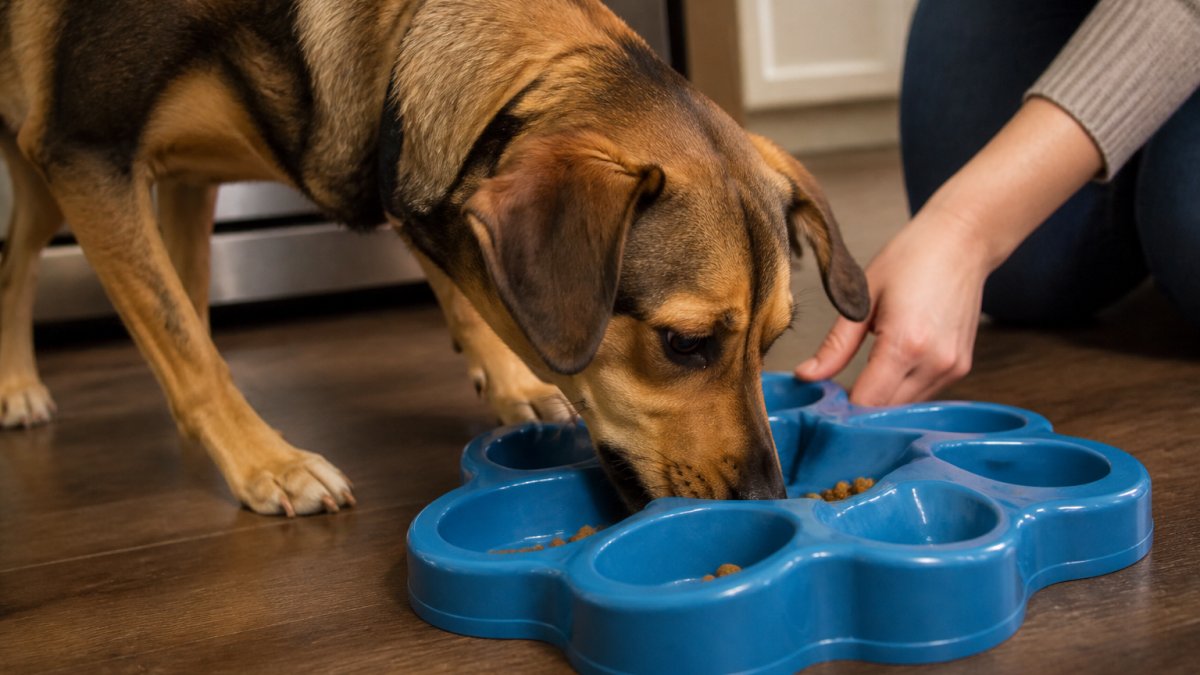
Which Slow Feeder Fits Your Dog
Match the feeder to the dog, not the other way around. The TreatDrop Ball suits gentle to moderate chewers who like a soft silicone toy. Food-motivated dogs who solve puzzles do well with the ThinkDisc. Dogs that chew and destroy plastic rather than solving it need supervision and a different approach.


Move the food to different compartments between sessions. Once a puzzle becomes routine, dogs solve it faster, and mealtime speeds back up.
How to Slow Down a Puppy Eating (and Senior Dogs, Too)
Slowing a puppy eating is mostly about smaller meals and shorter, more frequent feeding sessions. Puppies gulp out of excitement, so break the day into three or four small meals and use a shallow puzzle feeder.
Senior dogs need a gentler pace. Dental issues make chewing harder, so softer kibble and a shallow slow feeder help. Dogs with medical conditions should have any feeding change cleared with their veterinarian first.
When to Call Your Veterinarian
Call your veterinarian if a fast eater shows repeated vomiting, diarrhea that lasts more than a day, a swollen abdomen, retching with nothing coming up, or signs of discomfort after meals.
For routine speed eating, a slow feeder and smaller meals are a sensible first step. For anything that looks like GDV, skip the home remedies and go straight to veterinary care.
Frequently Asked Questions
Can eating too fast cause bloat in dogs?
Yes, rapid eating in dogs is a recognized risk factor for bloat (gastric dilatation), where the stomach fills with gas and can twist. Swallowed air during food gulping increases the chance. Large, deep-chested breeds like Great Danes and Standard Poodles face higher risk, but any dog can be affected. Bloat is life-threatening and needs immediate veterinary care, so watch for a distended abdomen, retching without vomit, restlessness, and drooling after meals.
Can a puppy eating too fast cause diarrhea?
It can. When a puppy eats too fast, food arrives in the stomach largely unchewed and in a large volume. That overloads digestion and can lead to loose stools, gas, and stomach upset. Puppies are especially prone because they are growing, highly food-motivated, and often competing with littermates. Feeding smaller meals more often, using a slow feeder for dogs, and supervising mealtime usually clears up mild cases. If diarrhea lasts more than a day or comes with vomiting or lethargy, call your vet.
How do I slow down a dog that gulps food?
Start with a slow feeder for dogs or a puzzle feeder that releases kibble a few pieces at a time. Split daily food into three or four smaller meals instead of one or two large ones. Feed alone if food competition with other dogs is driving the speed. Avoid exercise for 30 to 60 minutes before and after meals. For a puppy eating fast, use a smaller puzzle and supervise the first sessions. Most dogs adjust within a week, though determined eaters may need a mix of tools.
When should I call a veterinarian if my dog eats too fast?
Call right away if you see a swollen or hard abdomen, retching without producing vomit, drooling, foaming at the mouth, restlessness, or collapse after a meal. These are signs of bloat or gastric dilatation-volvulus (GDV), a life-threatening emergency. Also call if rapid eating in dogs is followed by repeated vomiting, diarrhea lasting more than 24 hours, or choking that does not clear in seconds. Mild gas or one episode of soft stool can usually wait, but repeated signs need a vet.
Speed eating is one of the few dog problems you can meaningfully improve with a change at the bowl. If your dog inhales every meal, start with smaller portions, separate feeding, and a puzzle that makes food work for its dinner. Chewzzle builds slow feeders and puzzle toys from durable, non-toxic materials that mimic natural foraging, so mealtime becomes a game instead of a race. Browse the collection and add to cart to get your fast eater started on a calmer routine.