

How to Introduce Puzzle Feeder to Dog: First-Time Guide
Table of Contents
- Why Start with a Puzzle Feeder: Mental Stimulation and Healthy Eating
- Choosing the Right Puzzle Feeder for Your Dog's First Experience
-
How to Teach a Dog to Use a Puzzle Feeder Step by Step
- Before You Start: Set Up the Session
- Step 1: Introduce the Feeder Without Food (1-2 minutes)
- Step 2: Demonstrate How the Puzzle Works (1-2 minutes)
- Step 3: Load the Feeder at the Easiest Setting
- Step 4: Let Your Dog Work, Then Help Only If Needed
- Step 5: End on a Win
- The Progression Plan: Moving from Easy to Hard
- Adapting the Sequence to Your Dog
- Best Treats for Dog Puzzle Toys: Motivation That Works
- What to Do If Your Dog Gets Frustrated with a Puzzle Feeder
- How Long Should a Dog Use a Puzzle Feeder: Duration and Progression
- Safety and Supervision During First-Time Use
- Frequently Asked Questions
Last Updated: October 15, 2026
Why Start with a Puzzle Feeder: Mental Stimulation and Healthy Eating
When you introduce puzzle feeder dog toys, you're giving your dog a food toy that makes them work for their meal instead of gulping it down in seconds.

Fast eating leads to bloating, poor digestion, and sometimes serious health issues.
Puzzle feeders also provide mental enrichment. Dogs need mental stimulation as much as physical exercise, and problem-solving toys reduce boredom behaviors like chewing furniture or barking.
This is especially valuable for anxious rescue dogs or high-energy breeds stuck indoors: the focused activity calms them while building confidence.
Choosing the Right Puzzle Feeder for Your Dog's First Experience
Start with an Easy Puzzle for Beginners
When you introduce puzzle feeder dog options, pick a feeder that won't frustrate your dog on day one.
Look for these features in a beginner feeder:
- Large, accessible compartments
- Minimal steps required to reach food
- No small parts that could be choking hazards
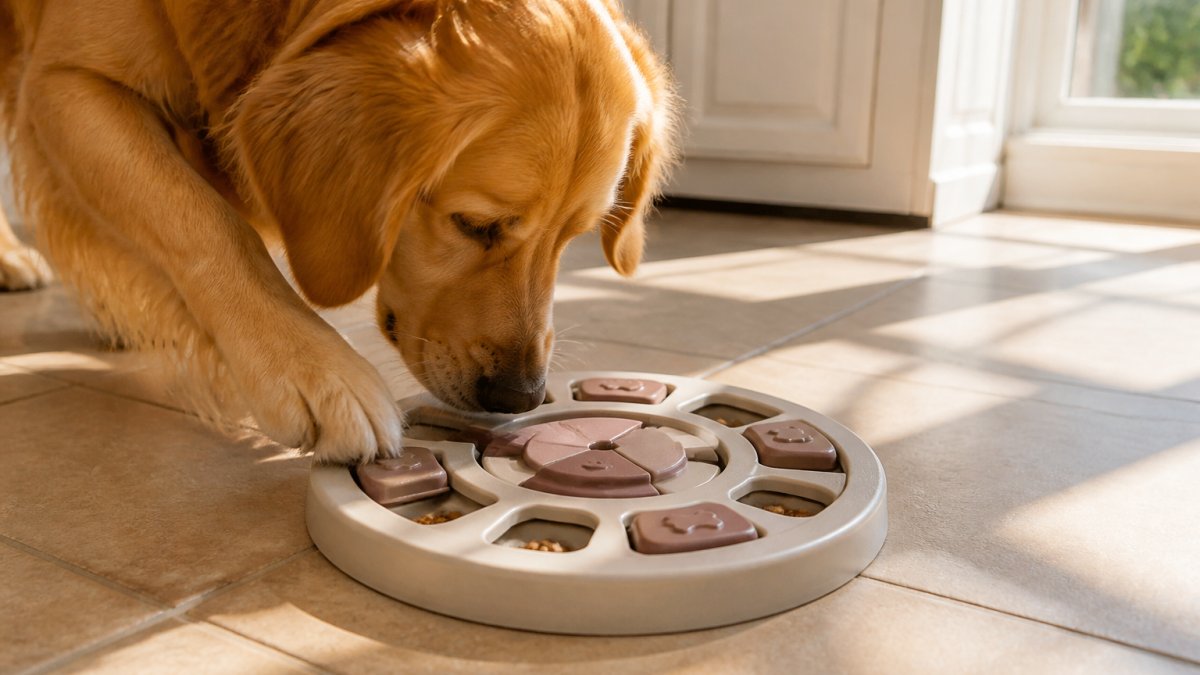
The Chewzzle ThinkDisc Puzzle Feeder works well for first-timers: paw-shaped sliding covers, a turning center wheel, visible compartments, and a non-slip base.
Starting simple builds confidence; once your dog masters an easy puzzle, introduce harder ones over time.
Consider Your Dog's Size and Chewing Style
Puzzle feeders come in different sizes. A small dog needs a feeder they can manipulate with paws or nose; a large dog needs something sturdy enough to handle their strength.
Also think about how your dog interacts with toys:
- Gentle explorers: Use nose and paws carefully; most puzzles work.
- Aggressive chewers: Bite and gnaw; need durable materials that won't break apart.
- Mouth-focused dogs: Grab and shake; need feeders that stay intact under pressure.
If your dog destroys plastic toys, avoid thin-walled puzzles and choose durable silicone or reinforced plastic. The Chewzzle TreatDrop Ball is soft, durable silicone that won't splinter.

How to Teach a Dog to Use a Puzzle Feeder Step by Step
Most owners skip this sequence, which is why first sessions fail. The goal is one reliable win, then added difficulty only when your dog shows a clear readiness cue.
Before You Start: Set Up the Session
- Pick a quiet room with a non-slip floor; a rug or yoga mat under the feeder prevents sliding.
- Use part of your dog's regular meal, not an extra one. If your dog eats 1 cup of kibble twice a day, reserve 1/4 to 1/2 cup for the first session and bowl-feed the rest.
- Count treats against the day's intake, subtracting equivalent kibble. Keep treats under 10 percent of daily calories.
Step 1: Introduce the Feeder Without Food (1-2 minutes)
Place the empty feeder on the floor and let your dog sniff, paw, and circle it. Don't coax or push. If your dog ignores it, try again later, two or three short exposures usually get a curious dog engaged.
Step 2: Demonstrate How the Puzzle Works (1-2 minutes)
With your dog watching, slide one cover open or turn the wheel so two or three kibble pieces drop out, and let your dog eat them. Repeat two or three times. This links the object to food without requiring any solving.
Step 3: Load the Feeder at the Easiest Setting
Fill only two or three compartments, leaving the rest empty. On a sliding-cover feeder, leave one cover halfway open so food is visible; on a ball-style feeder, use larger kibble so pieces fall out with a single nudge. Place it down and step back.
Step 4: Let Your Dog Work, Then Help Only If Needed
Give your dog 30 to 60 seconds of uninterrupted effort. If they stop and look at you, slide one cover a quarter open and let them finish the motion. Never push their nose or paw into the feeder, learning happens when they complete the last part themselves.
Step 5: End on a Win
As soon as your dog gets food out, praise calmly, let them finish the loaded compartments, then pick up the feeder. Don't refill on day one, ending while your dog is still interested makes them want it again tomorrow.
The Progression Plan: Moving from Easy to Hard
Use observable cues, not a calendar. Advance only when your dog meets the readiness cue for the current stage twice in a row.
| Stage | Setup | Readiness cue to advance | Typical time at this stage |
|---|---|---|---|
| 1. Exposed food | 2-3 compartments, one cover half open | Dog eats all food in under 2 minutes without help | 2-4 sessions |
| 2. Covered food | 3-4 compartments, all covers closed | Dog opens all compartments in under 3 minutes | 4-6 sessions |
| 3. Multi-step | Feeder with two mechanisms (slide plus turn) | Dog solves in under 4 minutes with no whining or pawing at the feeder body | 1-2 weeks |
| 4. Harder puzzle or ball | New feeder type or smaller openings | Dog solves in under 5 minutes and stays engaged | Ongoing |
If your dog needs more than 8 to 10 minutes at any stage, drop back one stage for two sessions. Solving in under 2 minutes means ready for the next stage; needing 10 to 15 minutes does not.
Adapting the Sequence to Your Dog
- Puppies (under 6 months): Soft or soaked kibble, shallow feeder with wide openings, 3-5 minute sessions, puppies tire mentally faster than adults.
- Senior dogs: Low sides and large compartments; avoid puzzles needing high paw lifts or hard pushing, and watch for stiffness afterward.
- Anxious or rescue dogs: Do steps 1 and 2 across two or three days before adding food, and sit on the floor nearby rather than standing over the feeder.
Best Treats for Dog Puzzle Toys: Motivation That Works
The right food makes all the difference. Your dog needs to be motivated to work at the puzzle.
High-value treats work best for first-time introduction:
- Small pieces of cooked chicken
- Soft training treats
- Freeze-dried meat
Start with whatever your dog loves most; once they understand the puzzle, switch to regular kibble for daily meals.
For the Chewzzle TreatDrop Ball and Chewzzle RollFeast Treat Ball, use kibble-sized treats or dry food so pieces fit through the openings. The Chewzzle PuzzleFeast Sliding Puzzle works with both kibble and treats, fill it with whatever motivates your dog most during the learning phase.

What to Do If Your Dog Gets Frustrated with a Puzzle Feeder
Frustration is the top reason first-time introductions fail. The useful skill is identifying which failure mode you're seeing and what to change.
First, Read the Behavior Correctly
Not every pause is frustration. A dog that stops, sniffs, and re-engages is problem-solving; one that stops and looks at you, whines, or walks away is frustrated.
Signs that mean stop the session now:
- Rapid, repetitive pawing with no progress for more than 30 seconds
- Whining, barking, or growling at the feeder
- Walking away and not returning
Failure Mode 1: Your Dog Flips or Throws the Feeder
This is the most common failure with light plastic feeders: the dog learns that flipping dumps food out faster than solving.
What to do:
- Switch to a heavier feeder or one with a weighted, non-slip base, an unflippable feeder removes the shortcut.
- Place it against a wall or in a corner so it can't be tipped backward.
- Reduce difficulty for two sessions so the dog relearns that solving, not flipping, produces food.
- If flipping continues after three sessions, switch to a snuffle mat or a treat-dispensing ball that can't be flipped.
Failure Mode 2: Your Dog Chews the Feeder
Chewing is a safety issue, not just a training issue. A dog that breaks off pieces of plastic or silicone can swallow them.
What to do:
- End the session immediately and remove the feeder.
- Inspect for bite marks, cracks, or missing pieces. If any piece is missing, check your dog's mouth and watch for vomiting, drooling, or appetite loss over 24 hours; contact your veterinarian if you see those signs.
- Switch to a power-chewer-rated feeder, or a food-dispensing toy made from a single piece of durable rubber with no removable parts.
- Supervise every session until chewing stops, never leave a chewer alone with a puzzle feeder.
- If chewing persists across two or three feeders, add more physical exercise before puzzle time. A tired dog puzzles; a restless dog chews.
Failure Mode 3: Your Dog Gives Up and Walks Away
The dog isn't stubborn, the puzzle is too hard, the food isn't motivating enough, or the session ran too long.
What to do:
- Drop back one difficulty stage for two sessions.
- Use higher-value food for one session, cooked chicken, freeze-dried meat, or a little cheese usually restarts engagement.
- Shorten sessions to 3-5 minutes.
- Sit on the floor near the feeder; your presence often keeps a hesitant dog engaged.
- If your dog walks away three sessions in a row, pause puzzle feeders for a week and try a snuffle mat, some dogs need a slower on-ramp.
Failure Mode 4: Your Dog Solves It Too Fast and Loses Interest
This opposite problem is easy to miss: if your dog empties the feeder in under 2 minutes and then stares at you, the puzzle is too easy.
What to do:
- Move to the next difficulty stage.
- Add a second feeder in another room so your dog has to search.
- Freeze a stuffed feeder overnight for a longer challenge.
- Rotate two or three feeders so none becomes boring.
When to Stop Altogether
Stop using puzzle feeders and talk to your veterinarian or a certified behavior consultant if:
- Your dog shows aggression toward the feeder or you during sessions
- Your dog has injured a paw or mouth on the feeder
- Your dog has a history of choking, swallowing foreign objects, or GI surgery
How Long Should a Dog Use a Puzzle Feeder: Duration and Progression
Start with 5-10 minute sessions, enough to keep your dog engaged without mental fatigue.
After your dog masters the beginner feeder, increase session length gradually:
- Week 1-2: 5-10 minutes per session
- Week 3-4: 10-15 minutes per session
- Week 5+: 15-20 minutes per session
Most dogs shouldn't use a puzzle feeder for more than 20-30 minutes at a time, mental work is tiring. For daily feeding, use a puzzle feeder for one meal and bowl-feed the rest. Once your dog consistently solves the easy puzzle, introduce a moderately challenging one like the Chewzzle PuzzleFeast Sliding Puzzle.
| Progression Stage | Feeder Type | Session Length | Frequency |
|---|---|---|---|
| Beginner | Easy puzzle with large openings | 5-10 minutes | 3-4 times per week |
| Intermediate | Moderate puzzle with multiple steps | 10-15 minutes | 4-5 times per week |
| Advanced | Complex puzzle with hidden compartments | 15-20 minutes | 5-6 times per week |
Safety and Supervision During First-Time Use
Always supervise the first few sessions, watching for stress, frustration, or choking hazards. If your dog tries to break the feeder apart, remove it and switch to a more durable option.
Introducing a puzzle feeder takes patience, but the payoff is real: mental stimulation, slower eating, and a healthier routine. Start simple, use high-value treats, keep sessions short and positive, and adjust when you see frustration.
Frequently Asked Questions
How do I introduce my dog to a puzzle feeder for the first time?
Start by letting your dog explore the empty feeder without any pressure, just let them sniff and nudge it. Next, show them how the puzzle works by manually sliding the covers or rotating the wheel to reveal a piece of kibble or treat. Once they see food appearing, most dogs catch on quickly. Begin with just a few pieces of their regular kibble in easy-to-access spots, and reward them enthusiastically when they solve it. Keep the first session short (5-10 minutes) and low-stress so they associate the feeder with positive experiences.
What are the best treats for dog puzzle toys?
Use what motivates your dog most: their regular dry kibble works well for daily meals, but high-value treats like small pieces of cheese, cooked chicken, or commercial dog treats create stronger engagement during training sessions. For dogs less interested in food, try soaking kibble in low-sodium broth or mixing in a small amount of wet food to increase the scent and appeal. Keep treat pieces small enough to fit through the feeder's openings but large enough that your dog can clearly see them, this visibility encourages exploration and problem-solving.
How long should a dog use a puzzle feeder each day?
For beginners, start with 5-10 minutes per session once or twice daily. As your dog becomes confident and skilled, you can extend sessions to 15-20 minutes or use the feeder for an entire meal portion. Most dogs benefit from 15-30 minutes of puzzle-based enrichment daily, but this varies by age, energy level, and motivation. Puppies and high-energy dogs often thrive with longer engagement, while older or less food-motivated dogs may prefer shorter sessions. Rotate between different feeders or puzzle types to maintain interest and prevent boredom.
What should I do if my dog gets frustrated and stops trying?
If your dog loses interest or shows signs of frustration (whining, walking away, excessive chewing), the puzzle is likely too difficult for their current skill level. Go back to an easier feeder or make the current one simpler by partially opening covers or pre-positioning treats so they're more visible. Demonstrate the solution again by moving the puzzle pieces yourself while your dog watches. Break sessions into shorter, more frequent attempts, and always end on a positive note with a success. If disengagement persists, try a different feeder style, some dogs prefer rolling toys while others prefer sliding puzzles.