

How to Keep Your Dog Occupied While Working
Table of Contents
- Why Your Dog Disrupts Your Workday (And How to Fix It)
- Start the Day Right: How to Tire Out a Dog Before Work
- Set Up a Dog-Proof Workspace for Focused Hours
- The Best Puzzle Toys for Anxious Dogs That Need Calm
- Boosting Mental Stimulation for Dogs at Home All Day
- Teaching the 'Settle' Command for Uninterrupted Calls
- Conclusion: Building a Routine That Works for Both of You
- Frequently Asked Questions
Last Updated: September 7, 2026
Why Your Dog Disrupts Your Workday (And How to Fix It)
The most common reason dogs interrupt remote work isn't spite; it's unmet needs. A dog that hasn't burned physical energy or exercised their brain will find their own entertainment. Keeping your dog occupied while working starts with understanding that boredom and anxiety are the root causes of most mid-call chaos.
Dogs don't disrupt meetings because they want attention, but because they lack an appropriate outlet. The fix involves pre-work exercise, environmental setup, and structured mental challenges.
Start the Day Right: How to Tire Out a Dog Before Work
A tired dog is a quiet dog, and the work of tiring them out needs to happen before you open your laptop. But a single generic walk isn't enough. The most effective pre-work routine is tailored to your dog's age and breed.
Match the Workout to Your Dog's Age
Puppies (under 1 year): Their growing bones and joints are vulnerable, so avoid forced running or repetitive jumping. Instead, focus on short, frequent bursts of play. A 10-minute session of fetch in the yard, followed by a 10-minute sniffy walk, is ideal. Finish with a 5-minute training session on basic cues like 'sit' and 'down.' This combination provides physical output without risking joint damage, and the training component provides essential mental fatigue.
Adult Dogs (1-7 years): This is where you can maximize aerobic output. For most breeds, a brisk 30-minute walk where your dog gets to sniff freely is the baseline. Sniffing is a high-intensity cognitive workout, a dog's nose has up to 300 million receptor cells, and processing those scents raises their heart rate in a calming way.
Senior Dogs (7+ years): The goal shifts from exhaustion to gentle stimulation. A 15-20 minute walk at a slower pace, with plenty of opportunities to stop and sniff, is appropriate. Pay close attention to their cues, if they start lagging behind, it's time to head home. For seniors with arthritis or mobility issues, consider a short session with a snuffle mat indoors instead of a walk.
Match the Workout to Your Dog's Breed Drive
Generic advice fails here because it ignores the massive difference in energy types. There are two primary categories:
High-Drive Working Breeds (e.g., Border Collies, Australian Shepherds, German Shorthaired Pointers): These dogs require a 'job' to feel satisfied. A simple walk is rarely enough. Incorporate a structured activity that mimics their historical purpose, like a 15-minute game of fetch that requires them to 'wait' before chasing, or a short session of 'find it.' Without this cognitive component, you'll have a physically tired but mentally wired dog who will find their own 'job.'
Companion and Low-Energy Breeds (e.g., Bulldogs, Cavalier King Charles Spaniels): These dogs need less aerobic work and more environmental enrichment. A 20-minute walk is usually sufficient for physical needs; the real fatigue comes from mental games. A 10-minute session with a puzzle feeder or a simple trick-training session will often tire them out more effectively than a long run.
The 'Decompression Walk' Protocol
A common pattern among professional dog trainers is the 'decompression walk', a walk designed for the dog, not for human exercise. The rules are simple:
- Let the dog set the pace. This is not a power walk. Allow them to stop and sniff as long as they need.
- Vary the route. The same path daily becomes mentally dull. Try a new street, a local park, or even just walking the same block in the opposite direction.
- End with a 'settle' cue. When you get home, have your dog lie on their bed and reward them for calm behavior. This transitions them from 'adventure mode' to 'work mode.'
By tailoring the morning routine to your dog's specific age and breed profile, you are meeting their psychological needs, far more effective than a generic 'walk and play' recommendation and the first step in building a sustainable, distraction-free workday.
Set Up a Dog-Proof Workspace for Focused Hours
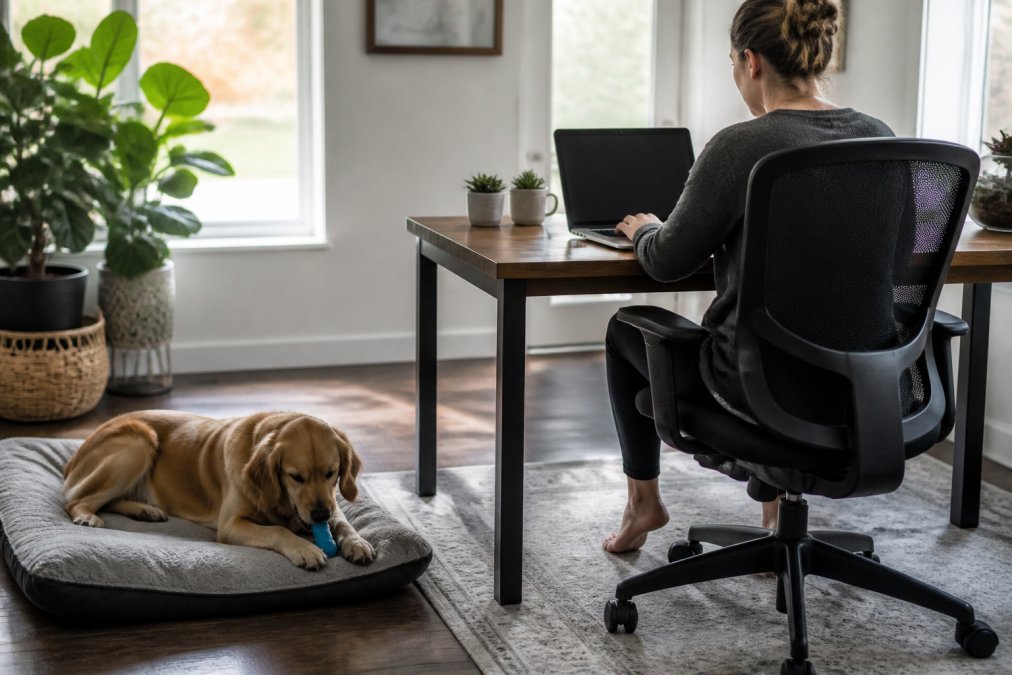
Your workspace needs to be designed so that your dog's default choice is calm behavior, not mischief. This means creating a designated zone that is comfortable, safe, and stocked with the right distractions. 'Dog-proofing' goes beyond removing a few cables, it requires a safety audit for the times you cannot watch your dog.
The Unsupervised Play Safety Audit
Before you rely on any toy to occupy your dog for an hour while you're on a call, run through this checklist. Most toy-related accidents happen from a mismatch between the toy and the dog's chewing style.
-
The 'No-Small-Parts' Rule: If a toy has any small parts that can be chewed off, like plastic eyes, squeakers, or rope ends, it is not safe for unsupervised use. These parts are choking hazards. Only offer toys that are one solid piece for solo play.
-
The 'Fingernail' Test: Press your fingernail into the toy. If it leaves an indentation, the material is too soft and can be torn apart and ingested. If it is too hard (like a solid nylon bone), it can cause dental fractures. The ideal material is firm but slightly pliable, like natural rubber.
-
The 'Size' Check: The toy should be too large to fit entirely inside your dog's mouth. This prevents accidental swallowing. If you have a power chewer, err on the side of larger.
-
The 'Rotation' Rule: Never leave the same toy out for days on end. Not only does this cause habituation (boredom), but it also means you won't notice wear and tear. Inspect toys weekly for cracks or pieces that have been chewed off. Discard and replace any toy that shows significant damage.
The 'Meeting Zone' Setup
When you have a video call that requires your full attention, you need a specific setup different from your general workspace. This is the 'Meeting Zone', a safe haven your dog associates with high-value rewards.
-
Location: Place a comfortable bed or mat in a corner of the room where your dog can see you but is not directly under your desk. This visual connection reduces anxiety, but the physical distance prevents them from being underfoot.
-
The High-Value Item: Reserve a specific, long-lasting chew exclusively for meeting times. A frozen stuffed Kong or a bully stick (supervised for the first few minutes to ensure they don't swallow the end piece) can provide 30-60 minutes of engagement. The key is that this item is ONLY given when you are on a call, creating a powerful positive association with your work.
-
The White Noise Buffer: Consider using a white noise machine or a fan in the room. This serves two purposes: it muffles the sound of your voice (which can be arousing for some dogs) and it masks outside noises (like the mail carrier) that might trigger barking.
What to Do When a Meeting Runs Long
Even with the best setup, meetings run over. If your dog has finished their high-value chew and is starting to get restless, do not wait for a break in the meeting to intervene. Have a backup plan ready.
-
The 'Mat Reset': If your dog gets up and approaches you, quietly cue them back to their mat and toss a low-value treat (like a piece of kibble) onto the mat. This reinforces the 'stay on your mat' behavior without verbal interruption.
-
The 'Emergency' Puzzle: Keep a pre-loaded puzzle feeder (like a treat-dispensing ball) within arm's reach. If you sense your dog is about to bark, roll the puzzle across the floor. The sudden movement and the promise of food will redirect their attention instantly.
By implementing a formal safety audit and a structured 'Meeting Zone' protocol, you are building a system that anticipates failure points. This proactive approach ensures your dog remains safe and occupied, even when you cannot watch them, the true definition of a dog-proof workspace.
The Best Puzzle Toys for Anxious Dogs That Need Calm
For dogs prone to separation anxiety or stress when you're focused elsewhere, puzzle toys that dispense treats are a powerful tool. They redirect nervous energy into problem-solving, providing mental stimulation for dogs at home that is just as tiring as a long walk. The best puzzle toys for anxious dogs require persistence and offer a clear reward, building confidence as the dog succeeds.
The key is to match the difficulty to your dog's skill level to avoid frustration. Start with an easy puzzle and gradually increase the challenge. This builds a sense of accomplishment and teaches your dog that being calm and working on a puzzle leads to positive outcomes.
Chewzzle SmartPaws Interactive Puzzle: A Detailed Look
Our top recommendation for anxious dogs is the Chewzzle SmartPaws Interactive Puzzle, priced at $39.99. This training toy is designed to challenge dogs mentally and reduce destructive behaviors through treat-based problem-solving. It boosts canine intelligence by encouraging focus and cognitive function, making it an excellent tool for puppies learning to channel their energy and for rescue dogs building confidence. The durable, non-toxic materials ensure it can withstand determined chewers, offering a safe and productive outlet for stress.
Chewzzle MindMaze IQ Puzzle: A Detailed Look
For dogs that need a more complex challenge, the Chewzzle MindMaze IQ Puzzle at $29.99 is a strong choice. This interactive IQ trainer dispenses treats as your dog learns to unlock hidden rewards, enhancing mental enrichment and reducing boredom-related behaviors. It's designed to improve focus, making it a practical tool for dogs that get distracted easily. The treat-dispensing play mimics natural foraging behaviors, keeping your dog engaged and satisfied while you handle your work tasks.
Boosting Mental Stimulation for Dogs at Home All Day
Relying on a single toy won't sustain your dog's interest for an eight-hour workday. To truly keep a dog occupied while working, you need to rotate enrichment activities to prevent habituation.
Think of it as a menu of options that you cycle through. Interactive toys and treat-dispensing puzzles are excellent for short, intense bursts of focus. For longer engagement, a frozen stuffed toy or a chew bone can provide hours of soothing activity. This variety is crucial for canine cognitive health, as it provides the necessary cognitive engagement to prevent boredom and the destructive behaviors that follow.
A practical approach to boosting mental stimulation for dogs at home is to use a portion of their daily kibble for puzzle feeders instead of a bowl, turning every meal into a brain game. You can also hide small treats around a room for a scavenger hunt, tapping into their natural scent work abilities. This occupies their time and provides a healthy outlet for their energy.
Teaching the 'Settle' Command for Uninterrupted Calls
While toys and exercise are essential, the most valuable tool for a peaceful workday is teaching your dog to switch off and relax on cue. The 'settle' command teaches your dog to lie down calmly on their mat, regardless of what's happening around them.
This is different from a 'down' command, which is a position; 'settle' is a state of mind. To teach it, start by rewarding your dog for calm behavior while lying down. Use a specific word like "settle" or "relax" and offer a treat when they are calm. Gradually increase the duration and add distractions.
This method relies on positive reinforcement, which strengthens the behavior you want to see. According to the American Veterinary Society of Animal Behavior, reward-based training is the most effective and humane way to modify pet behavior. A dog that has learned to settle can be cued to relax during a video conference, preventing interruptions and reducing their own stress. This is a skill that requires practice, but the payoff is a dog that knows how to be calm, making your work-life balance significantly better.
Conclusion: Building a Routine That Works for Both of You
Creating a productive work-from-home environment with a dog requires more than just buying a toy. It demands a structured routine that addresses your dog's physical and psychological needs. By tiring them out before work, setting up a safe space, and providing a rotating selection of enrichment tools, you address the root causes of disruption.
This system isn't about ignoring your dog; it's about teaching them to be independent and calm. The strategies we've covered build a foundation for better behavior. For extra engagement, Chewzzle's line of interactive puzzles and slow feeders provides the durable, non-toxic enrichment that turns your work hours into a positive experience for your pet.
Frequently Asked Questions
How long can I leave my dog alone while working from home?
Even when working from home, your dog needs regular breaks. Most adult dogs can handle 4-6 hours of quiet time between bathroom breaks and play sessions. Puppies and senior dogs need more frequent pauses, often every 2-3 hours. If you have back-to-back meetings, use a puzzle toy to keep your dog occupied while working. Schedule a short walk or a game of fetch during your lunch break to break up the day and prevent restlessness.
How much mental stimulation does a dog need daily?
Most dogs benefit from at least 15-30 minutes of focused mental stimulation each day, in addition to their physical exercise. This can include puzzle toys, training sessions, or scent work. High-energy breeds may need more. A dog that receives adequate cognitive engagement is less likely to develop destructive habits. Try a session with a treat-dispensing toy before a conference call to help your dog settle and sleep while you work.
What are the best interactive toys for bored dogs during work hours?
The best options rotate between different types of enrichment. Treat-dispensing puzzle toys like the Chewzzle MindMaze IQ Puzzle work well for short bursts of focus. For longer engagement, a durable chew toy or a frozen marrow bone can keep a dog busy for an hour or more. Rotating toys every few days keeps them novel and interesting. Supervise play with new toys initially to ensure your dog uses them safely.
Why is my dog so restless when I'm on a call?
Dogs pick up on changes in your attention and voice tone. When you talk on the phone, your dog may feel ignored or confused about who you are talking to. This often triggers attention-seeking behaviors like whining or pawing. Teach a 'settle' command by rewarding calm behavior on a mat or bed. Pair this with a puzzle feeder or chew toy to create a positive association with call time.
Building a routine that works takes patience, but the reward is a calmer dog and more focused work sessions. Chewzzle's interactive puzzle toys are designed to support this goal by providing the mental stimulation that keeps your dog engaged and content. With durable materials and designs that mimic natural foraging, they offer a practical solution for reducing anxiety and preventing boredom. Get started with Chewzzle and turn your workday into a peaceful, productive time for both of you.