

How to Stop Puppy From Chewing Furniture
Table of Contents
- Why Puppies Chew Furniture
- Puppy Teething Timeline and What to Expect
- How to Puppy Proof Your House
- Best Chew Toys for Puppies
- Mental Stimulation for Puppies to Reduce Destructive Chewing
- Training Techniques to Stop Furniture Chewing
- When to See a Vet About Excessive Chewing
- Frequently Asked Questions
Last Updated: September 19, 2026
Why Puppies Chew Furniture
Puppies chew. It's not a behavioral problem yet, it's a normal part of development. Understanding why your puppy is chewing furniture is the first step in learning how to stop puppy from chewing furniture before it becomes a destructive habit.
Chewing serves multiple purposes for puppies. It helps them explore their world, relieve stress, and work through the discomfort of teething. When a puppy's baby teeth start coming in around three weeks of age, their gums itch intensely. Chewing provides relief. It also builds jaw strength and helps loosen baby teeth so adult teeth can come in properly.
Boredom and excess energy drive a lot of furniture chewing too. Puppies have short attention spans but high energy levels. Without mental stimulation or physical exercise, they'll find their own entertainment, usually your couch. Separation anxiety plays a role as well. When puppies feel stressed or lonely, chewing becomes a self-soothing behavior.
The key insight most new puppy owners miss is this: stopping furniture chewing isn't about punishment. It's about redirecting that natural instinct toward appropriate outlets. A puppy isn't being destructive out of spite. They're following their biology.
Puppy Teething Timeline and What to Expect
Puppies go through predictable teething stages. Knowing what to expect helps you prepare and manage the behavior at each phase.
Weeks 3-5: Baby teeth start erupting. Your puppy's gums feel tender and itchy. Chewing intensity increases noticeably during this window.
Weeks 5-8: All 28 baby teeth have come in. Chewing peaks because teething discomfort is at its highest. This is when furniture chewing becomes most aggressive.
Weeks 8-16: Baby teeth begin loosening as adult teeth push through. Chewing remains intense but gradually shifts as teeth fall out.
Weeks 16-24: Adult teeth continue erupting. By six months, most puppies have their full set of adult teeth. Chewing behavior typically starts declining around this point, though it may persist if habits weren't redirected earlier.
Months 6-12: Chewing usually tapers significantly, but some puppies continue the behavior out of habit or boredom rather than teething discomfort.
The teething timeline varies by breed. Smaller breeds often finish teething faster than larger breeds. Large breed puppies may experience extended discomfort because they have more teeth coming in and their jaw growth is slower.
During peak teething months, expect your puppy to chew more intensely. This is temporary. The behavior will naturally decrease once adult teeth are fully in. Until then, your job is to redirect the chewing impulse toward appropriate toys rather than furniture.
How to Puppy Proof Your House
Before your puppy ever arrives, eliminate temptation. A puppy-proofed home reduces the opportunities for furniture chewing and makes training far easier.
Start by identifying high-risk areas. Baseboards are prime targets because they're low, accessible, and smell interesting to puppies. Couch corners, chair legs, and table edges get chewed because puppies naturally gravitate toward edges. Bed frames and closet doors are also common targets.
Physical barriers work. Use baby gates to restrict access to rooms with expensive furniture. Keep your puppy in a smaller, puppy-proofed space when you can't supervise directly. This isn't punishment, it's prevention. A puppy confined to a playpen or small room with appropriate chew toys can't destroy your dining room chairs.
Protect vulnerable furniture pieces. Apply bitter sprays to baseboards and furniture legs. These taste unpleasant to dogs without being harmful. Reapply regularly, especially after cleaning or rain. Some puppies ignore bitter sprays, but many find them effective enough to redirect their chewing elsewhere.
Remove temptation completely. Put away throw blankets, pillows, and cushions that smell like you. Close closet doors. Keep shoes off the floor. Puppies are drawn to items that smell like their pack, your belongings carry your scent, making them irresistible.
Manage your puppy's environment. Puppies should never have unsupervised access to furniture-filled rooms during their first six months. This isn't about trust, it's about preventing the habit from forming in the first place. Once a puppy learns that chewing the couch feels good and nothing stops them, that habit becomes deeply ingrained.
A common mistake is waiting until furniture chewing becomes a problem before puppy-proofing. By then, your puppy has already learned that furniture tastes interesting and provides relief. Prevention is exponentially easier than correction.
Best Chew Toys for Puppies
The right chew toys redirect your puppy's natural instinct toward appropriate outlets. Not all toys are created equal. Some hold a puppy's interest for minutes. Others keep them engaged for hours.
Chewzzle Launch & Learn Puppy Trainer →
Durable rubber toys work well for teething puppies. They're firm enough to satisfy the chewing urge without being so hard they damage developing teeth. Look for toys specifically designed for puppies rather than adult dogs, puppy versions are softer and safer.
Puzzle toys that dispense treats combine mental stimulation with the satisfaction of chewing. Your puppy works to extract treats, which keeps them engaged longer than a passive chew toy. This approach addresses both boredom and teething discomfort simultaneously.
The Chewzzle SmartPaws Interactive Puzzle is designed specifically for this. It challenges your puppy's problem-solving skills while dispensing treats as a reward. The adjustable difficulty means you can start simple and increase the challenge as your puppy learns. This keeps them engaged without frustration.

For puppies who need constant chewing relief, the Chewzzle MindMaze IQ Puzzle offers similar benefits at a lower price point. It's ideal for puppies under six months who are in peak teething discomfort.
Rotating toys prevents boredom. Don't leave all toys out at once. Rotate them every few days so your puppy stays interested. A toy that seemed boring last week becomes exciting again when you reintroduce it.
Frozen toys provide extra relief. Soak a rubber toy in water and freeze it. The cold numbs your puppy's sore gums and provides intense chewing satisfaction. This is especially helpful during peak teething weeks.
Match toy size to your puppy's size. A toy too small becomes a choking hazard. A toy too large frustrates your puppy because they can't get a good grip. Most quality puppy toys come in size-appropriate options.
Mental Stimulation for Puppies to Reduce Destructive Chewing
Boredom drives destructive chewing. A mentally stimulated puppy is far less likely to chew your furniture.
Mental stimulation works differently than physical exercise. A tired puppy from a walk might still chew furniture if their brain is unstimulated. A puppy that's worked their mind through problem-solving and learning will settle down faster and stay calm longer.
Puzzle toys provide ongoing mental engagement. They force your puppy to think, problem-solve, and work for rewards. This mental effort exhausts puppies faster than physical activity alone. The Chewzzle Launch & Learn Puppy Trainer combines mental challenge with physical play. Your puppy learns to drop a ball into the launcher, which shoots it back out. This reinforces focus, patience, and self-play, all skills that reduce destructive chewing.

Training sessions stimulate the brain. Short, frequent training sessions (5-10 minutes) teach your puppy new behaviors while tiring them mentally. Sit, stay, come, leave it, each command requires focus and thinking. A puppy that's just learned something new often settles into calm behavior afterward.
Scent games engage natural instincts. Hide treats around a room and let your puppy find them. This mimics natural foraging behaviors and keeps their mind engaged. Hide treats in a muffin tin covered with tennis balls. Your puppy has to move the balls to find the treats.
Vary activities daily. Puppies get bored with the same routine. Monday might be a training session, Tuesday a puzzle toy challenge, Wednesday a scent game.
Training Techniques to Stop Furniture Chewing
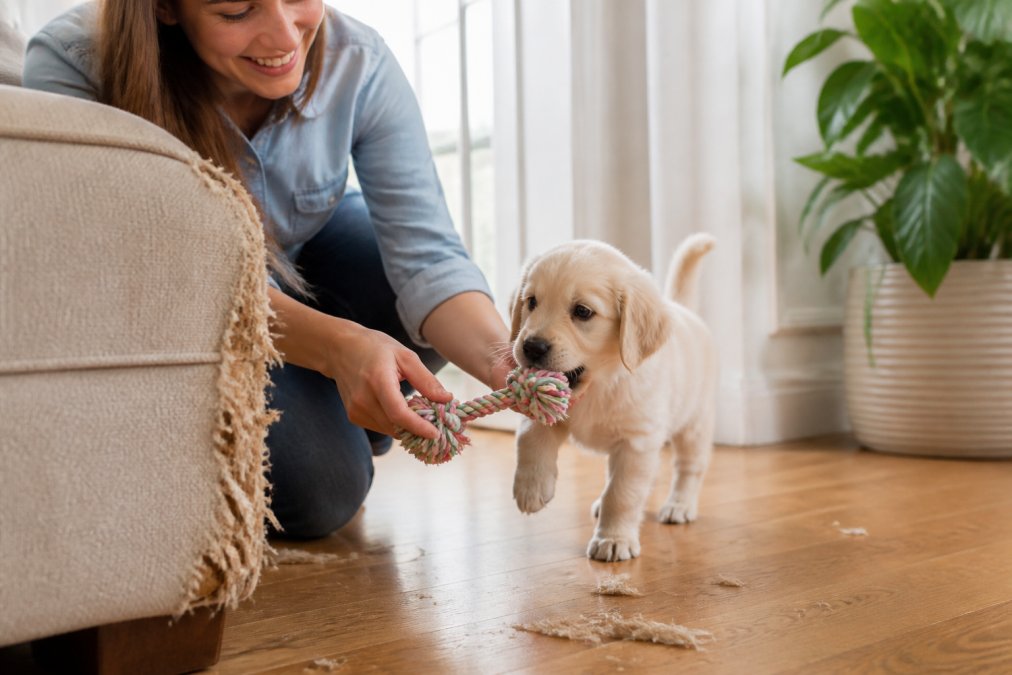
Training redirects your puppy's chewing instinct toward appropriate outlets. Learning how to stop puppy from chewing furniture means teaching your puppy what they can chew, not just punishing what they can't.
When to See a Vet About Excessive Chewing
Most furniture chewing is normal puppy behavior. Some chewing, however, signals underlying health or behavioral issues that need professional attention.
Frequently Asked Questions
What age do puppies stop chewing furniture?
Most puppies stop destructive chewing between 6 and 12 months of age as their adult teeth fully emerge and they mature behaviorally. However, some dogs continue to chew into their second year if not trained. The intensity typically peaks during teething (3 to 6 months) when discomfort drives the behavior. Consistent redirection, appropriate chew toys, and mental stimulation speed up the process. If your puppy is older than 18 months and still chewing furniture excessively, consult your vet to rule out anxiety or other underlying issues.
How can mental stimulation for puppies help reduce destructive chewing?
Boredom is one of the top reasons puppies chew furniture. Interactive puzzle toys like the Chewzzle SmartPaws and MindMaze IQ Puzzle engage your puppy's problem-solving skills and tire their mind, leaving less mental energy for destructive behavior. When puppies are mentally challenged through treat-dispensing toys and training games, they're less likely to seek stimulation by chewing baseboards or cushions. Aim for 15 to 20 minutes of puzzle play daily, rotating toys to keep novelty high and engagement strong.
What makes Chewzzle toys different from other chew toys on the market?
Chewzzle toys combine durable, non-toxic materials with interactive puzzle designs that reward problem-solving rather than mindless chewing. Unlike basic rubber toys, Chewzzle products like the Launch & Learn Puppy Trainer and SmartBounce Rolling Ball actively engage your puppy's intelligence and redirect energy into productive behavior. They're designed to hold up to determined chewing and are easy to clean. Each toy serves a specific training or enrichment purpose, making them an investment in both behavior management and long-term mental health.
Is it normal for a puppy to chew furniture?
Yes, chewing is completely normal puppy behavior driven by teething, curiosity, and energy. However, destructive furniture chewing should be redirected, not ignored. Normal exploration becomes a problem when puppies target baseboards, couch legs, and cushions regularly. This signals boredom, lack of exercise, separation anxiety, or teething discomfort. The goal isn't to stop chewing entirely but to redirect it toward appropriate items like Chewzzle toys and away from your furniture. With proper supervision, exercise, and training consistency, most puppies outgrow destructive chewing by their first birthday.