

Is Mental Stimulation Enough for Hyper Puppies?
Table of Contents
- Why Mental Stimulation Alone Isn't Enough for Hyper Puppies
- How to Calm a Hyper Puppy: The Missing Piece
- Mental Stimulation for Puppies: What Actually Works
- How Much Exercise Does a Puppy Need Daily?
- Puppy Puzzle Toys: Building a Sustainable Enrichment Plan
- The Over-Stimulation Threshold: When Enrichment Backfires
- Creating a Calmness Training Protocol for Your Puppy
- Frequently Asked Questions
Last Updated: October 8, 2026
Why Mental Stimulation Alone Isn't Enough for Hyper Puppies
Is mental stimulation enough for hyper puppies? The short answer is no. Mental enrichment is crucial, but it's only half the equation.
Most owners load up on puzzle toys and training sessions, then wonder why their pup is still bouncing off the walls at midnight.
A tired body without a tired mind means destructive chewing and anxiety; a stimulated mind without a physical outlet means restless energy with nowhere to go.
The ones who see results pair interactive puzzle toys with structured physical activity.
How to Calm a Hyper Puppy: The Missing Piece
The missing piece is balance: your hyper puppy needs mental and physical outlets working in tandem.
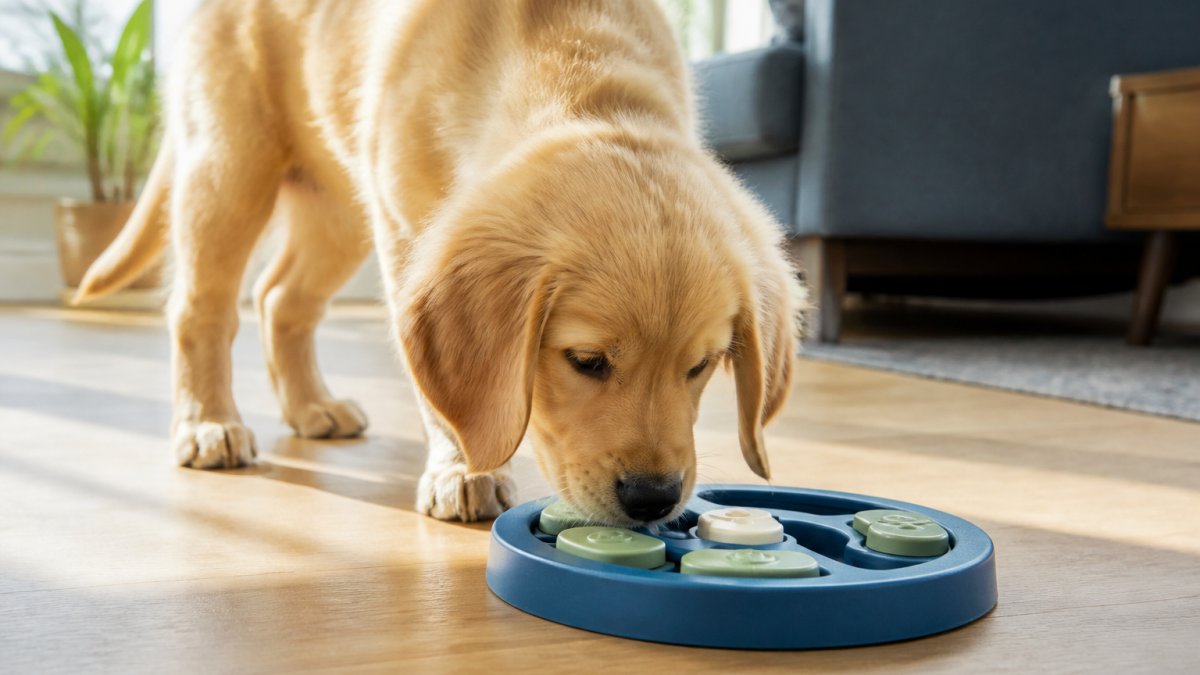
Here's what happens when puppies don't get enough physical exercise:
- They develop hyperactivity that no puzzle toy can fix
- Mental stimulation winds them up more without a physical release valve
- Behavioral problems escalate because energy has nowhere to go
The reverse is also true: a puppy who runs all day but never uses their brain becomes bored and destructive.
The key is your puppy's individual threshold.
Track which activities lead to settling and which leave them wired, then replicate the sweet spot consistently.
Mental Stimulation for Puppies: What Actually Works
Mental stimulation for puppies isn't about keeping them busy, it's about cognitive challenges that mimic their natural instincts: sniff, hunt, forage, and solve puzzles.
Problem-Solving and Cognitive Challenges
Problem-solving activities build confidence and focus: anything that requires your puppy to think through steps to get a reward.
Scent work is one of the most effective forms of mental enrichment.
Puzzle feeders and snuffle mats turn mealtime into a mental challenge, extending it from 30 seconds to 10-15 minutes of genuine cognitive engagement.

Interactive games like "find it" or "which hand" teach impulse control in quick 5-10 minute bursts of intense mental work.
Training Sessions as Mental Exercise
Training is one of the most underrated forms of mental stimulation. A 15-minute session exhausts a puppy's brain more than 30 minutes of free play because it requires focus and impulse control.
Short, frequent sessions work best: five 3-minute sessions beat one 15-minute marathon.
Focus on impulse-control commands: sit, wait, leave it, settle. These teach your puppy to manage their own energy and attention, which translates directly to calmer behavior.
How Much Exercise Does a Puppy Need Daily?
How much exercise does a puppy need daily? It depends on age, breed group, and temperament, but you need a starting framework. The most widely repeated guideline is five minutes of structured exercise per month of age, twice daily: a three-month-old gets roughly 15 minutes twice a day, a six-month-old about 30, and a twelve-month-old caps out around 60.
Treat that number as a floor, not a prescription. It was popularized as a rough guardrail against over-exercising growing joints, not a precise biological limit, two puppies of the same age can have wildly different needs.
Why Breed Group Changes the Math
This is what actually matters for a hyper puppy: a working or herding breed puppy and a companion breed puppy of the same age don't need the same outlet, or the same type of outlet.
- Herding and working breeds (border collies, Australian shepherds, Belgian Malinois, German shepherds): Bred to problem-solve and move for hours. They need the upper end of the age guideline plus a job, structured fetch with rules, herding-style games, or scent work layered on physical exercise.
- Sporting and hound breeds (Labradors, golden retrievers, beagles, pointers): Driven by retrieve and scent. Best with aerobic exercise plus nose work; a 30-minute sniff-heavy walk can tire a beagle more than a 30-minute run.
- Terrier breeds (Jack Russells, rat terriers, cairn terriers): Small but intense. They need short bursts of high-intensity activity plus digging or chasing substitutes. Under-exercised terriers are some of the most destructive puppies in shelters.
If you don't know your puppy's breed mix, a DNA test can clarify breed group, which clarifies exercise style. It's not a gimmick, it changes the plan.
Structured Exercise vs. Free Play
Exercise type matters as much as duration. Free play burns energy but doesn't build impulse control. Structured exercise, loose-leash walks, fetch with 'drop it' and 'wait' cues, or training games with clear start and stop signals, builds focus and arousal regulation.
A balanced daily routine for a moderately active puppy:
- Morning: 20-30 minutes of structured exercise (leashed walk, structured fetch, or a training walk)
- Midday: 10-15 minutes of mental enrichment (puzzle toy, snuffle mat, or a short training session)
- Afternoon: 20-30 minutes of structured exercise or a sniff-heavy walk
- Evening: 10-15 minutes of training or calm enrichment, then a settle session
Adjust based on behavior: still bouncing off the walls means more physical outlet or breed-appropriate work; overtired, anxious, or more wired after activity means less, not more.
The Age-Stage Caveat
Puppies under six months shouldn't do long-distance running, repeated jumping, or forced endurance work, their growth plates are still open, and repetitive high-impact activity is linked to joint problems later. Prioritize free play, short training sessions, sniff walks, and swimming. Save long runs for after growth plate closure, typically 12-18 months depending on breed size.
When to Add More
Owners often under-exercise high-energy puppies because the five-minute rule sounds authoritative. If your puppy is destructive, mouthy, or unable to settle after the routine above, the issue is usually insufficient physical outlet or breed-appropriate work, not a need for more puzzle toys. Increase structured exercise in five-minute increments and watch for the point where your puppy settles instead of spiraling.
Puppy Puzzle Toys: Building a Sustainable Enrichment Plan
Puzzle toys are tools, not solutions. They work best within a broader enrichment strategy matched to your puppy's breed-driven instincts, if a toy doesn't match how your puppy is wired to think, it won't hold their attention for five minutes.
Match the Enrichment to the Breed Drive
A puzzle that delights a beagle may bore a border collie, and one that challenges a Malinois may frustrate a pug. The right enrichment plan leans into breed instincts instead of fighting them.
- Scent-driven breeds (beagles, basset hounds, dachshunds, bloodhounds): Nose work is the highest-value enrichment. Snuffle mats, hidden-treat searches, and scatter feeding tap their strongest sense; a 15-minute scent session can do more for a hound than a 45-minute walk.
- Herding breeds (border collies, Australian shepherds, shelties): They want to control movement. 'Find it,' herding balls, and sequencing puzzles keep them engaged; trick training with chained behaviors is also high-value.
- Retrieving breeds (Labradors, goldens, Chesapeake Bay retrievers): Fetch with rules, retrieve-and-drop puzzles, and carry/deliver toys work best. They often solve a puzzle once and want to repeat it, so rotation matters.
- Terriers (Jack Russells, rat terriers, Westies): Digging substitutes, paw-operated treat dispensers, and short, high-intensity problem-solving fit their wiring. Long, slow puzzles lose them.
If you don't know your puppy's breed mix, observe their free-time choices: a puppy who noses everything is scent-driven, one who stares and stalks is herding-driven, one who carries everything is retrieve-driven.
A Sustainable Enrichment Rotation
A sustainable plan includes variety across categories, not just within one brand:
- Treat-dispensing toys that require problem-solving (sliding, tipping, or rolling mechanisms)
- Slow feeders that pace eating and extend mealtime
- Snuffle mats for foraging behavior
- Interactive toys that require your participation (tug, fetch, find-it)
Start with one or two toys and rotate every few days, puppies habituate quickly, and rotation keeps novelty high without constant buying. If your puppy solves a puzzle in under 30 seconds, it's too easy; if they give up after two minutes, it's too hard. The sweet spot is 5-10 minutes of engagement.
What to Look For in a Puzzle Toy
When evaluating a puzzle toy, whether from Chewzzle or any other maker, check these features:
- Adjustable difficulty: Multiple levels let the challenge grow with your puppy. A fixed-difficulty puzzle becomes a chew toy once solved.
- Dishwasher-safe parts: Enrichment toys get slobbery and food-caked. If you can't clean it easily, you'll stop using it.
- No small removable pieces: Anything swallowable is a hazard. Look for one-piece or securely-locking designs.
- Size-appropriate: A toy sized for a Labrador can be a choking hazard for a Chihuahua. Match the toy to your puppy's current size, not their expected adult size.
When Puzzles Stop Working
If your puppy loses interest in puzzle toys entirely, that's a signal, not a failure. Common causes:
- The puzzle is too easy. Your puppy has memorized the solution. Increase difficulty or rotate to a new puzzle.
- The reward isn't motivating. Try higher-value treats, or switch to a toy that dispenses a favorite food.
- The puppy is over-tired. An overtired puppy can't focus on problem-solving. Check sleep first.
- The puppy is over-aroused. If your puppy is already wired, adding a puzzle can make it worse. See the over-stimulation section below.
- The breed drive doesn't match the toy. A scent-driven puppy may never love a slider puzzle. Switch categories.
The goal isn't owning every puzzle on the market, it's a small, rotating library that matches your puppy's instincts and grows with their skills.
The Over-Stimulation Threshold: When Enrichment Backfires
More enrichment isn't always better.
Signs your puppy is over-stimulated:
- Hyperactivity that gets worse after enrichment sessions
- Inability to settle even after exercise and mental work
- Increased anxiety or destructive behavior
- Excessive panting or restlessness
Over-stimulation happens when puppies don't have time to process and recover; their nervous system gets stuck in an activated state.
This is especially true for anxious puppies or rescue dogs, where more enrichment can trigger more anxiety.
The threshold varies: some puppies handle 60 minutes of combined mental and physical activity daily, others max out at 30.
The fix: reduce enrichment volume and add structured rest.
Creating a Calmness Training Protocol for Your Puppy
Start with the settle command.
Here's a step-by-step approach:
- Choose a settling spot and place your puppy there
- Reward any moment of stillness (even 2-3 seconds)
- Gradually increase the duration before rewarding
- Add the "settle" command once your puppy understands the behavior
- Practice in different locations and situations
- Extend duration to 15-20 minutes
Train in short bursts: five 5-minute sessions beat one 25-minute session. Consistency matters more than duration.
Pair settling practice with enrichment: after a puzzle toy or training session, practice settling.
Many owners skip this step and wonder why their puppy never settles.
Is mental stimulation enough for hyper puppies?
Assess your current routine: are you covering all four areas?
Frequently Asked Questions
Is mental stimulation enough to tire out a hyper puppy?
Mental stimulation alone won't fully exhaust a hyper puppy. While cognitive challenges reduce boredom and destructive behavior, puppies also need physical exercise to burn energy and develop properly. The best approach combines both: mental enrichment activities like puzzle toys and training sessions paired with age-appropriate physical play. Most puppies benefit from multiple short sessions throughout the day rather than one long activity.
What's the difference between mental stimulation for puppies and training?
Training teaches specific behaviors and commands through repetition and reward, while mental stimulation encompasses any activity that challenges your puppy's brain, including problem-solving, foraging, and puzzle toys. Training is one form of mental exercise, but enrichment activities like sniff games and interactive toys provide cognitive engagement without formal instruction. Both reduce hyperactivity and support behavioral health when used together.
Can too much mental stimulation make a puppy more hyper?
Yes. Over-stimulation can increase restlessness and wired behavior if your puppy doesn't have adequate downtime to settle. Signs include excessive jumping, nipping, or inability to calm down after play. Puppies need a balance of active engagement and quiet rest periods. If your puppy seems more hyperactive after enrichment sessions, reduce the intensity or duration and ensure they have time to decompress. Calmness training helps them learn to settle after mental exertion.
How do I know if my puppy is getting enough mental stimulation?
A properly stimulated puppy shows improved focus, less destructive behavior, and better impulse control. Signs of under-stimulation include excessive chewing, boredom-related behaviors, and restlessness. If your puppy settles calmly after play and seems content during quiet time, they're likely getting adequate enrichment. However, if they're still hyperactive or destructive despite activities, they may need more varied cognitive challenges or additional physical exercise to match their energy level and breed-specific needs.