

How to Keep Puppy Busy Indoors: 7 Proven Strategies
Table of Contents
- Why Mental Stimulation Matters for Indoor Puppies
- Best Puzzle Toys for Puppies to Build Problem-Solving Skills
- Scent Work and Nose Games for Indoor Enrichment
- Training and Trick Learning as Mental Exercise
- How to Stop Puppy from Chewing Furniture with Redirected Play
- Rotating Toys and DIY Enrichment Activities
- Balancing Mental Stimulation and Physical Exercise
- Frequently Asked Questions
Last Updated: September 23, 2026
Why Mental Stimulation Matters for Indoor Puppies
Mental stimulation is just as important as physical exercise for puppies, and knowing how to keep puppy busy indoors is essential for their development. Without proper enrichment, puppies channel their energy into destructive behaviors like chewing furniture and digging at carpets.
A 15-minute puzzle toy session can exhaust a puppy as much as a 30-minute walk, making mental stimulation essential for indoor puppies' natural instincts to forage, hunt, and problem-solve.
Puppies lacking mental stimulation develop anxiety and behavioral issues. The solution is redirecting that energy into productive activities, not punishment.
Chewzzle puzzle toys, treat dispensers, and snuffling activities keep puppies busy indoors by mimicking natural behaviors and preventing boredom-related destruction.
Best Puzzle Toys for Puppies to Build Problem-Solving Skills
Puzzle toys force puppies to think, strategize, and work for rewards, with the best ones adjusting difficulty as puppies improve.
Interactive Puzzle Challenges
Interactive puzzles challenge puppies to unlock hidden treats by figuring out how buttons slide, compartments open, or layers rotate, building confidence and cognitive function.
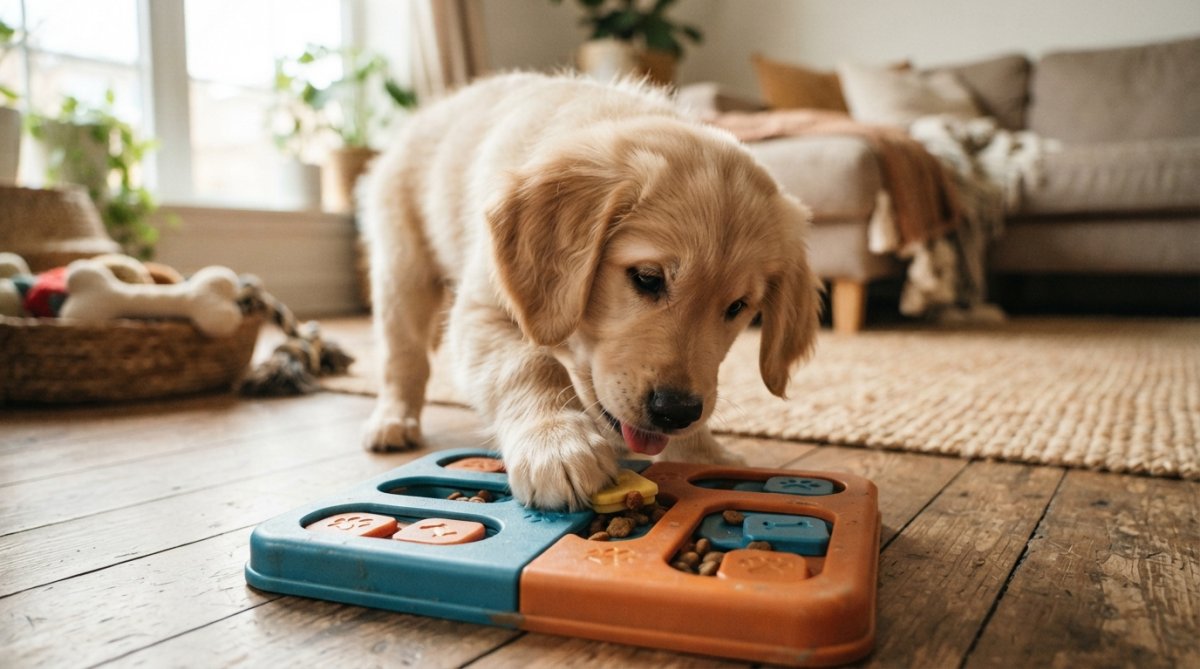
The Chewzzle SmartPaws Interactive Puzzle has adjustable difficulty levels, allowing puppies to progress from easier to harder configurations and strengthen problem-solving skills through trial and error.

Start with the easiest setting and let your puppy see the treat before hiding it. Once they understand the concept, increase difficulty.
Interactive puzzles build cognitive development, keep puppies engaged for 15-30 minutes, prevent frustration with adjustable difficulty, reduce destructive behavior, and strengthen your bond through guided play.
Slow Feeder Designs
Slow feeders prevent bloating and digestive issues by forcing puppies to work for each piece of kibble or treat, mimicking natural foraging behavior.
The Chewzzle PuzzleFeast Sliding Puzzle turns mealtime into a mental challenge, extending feeding time from seconds to several minutes.
Slow feeders prevent bloating, extend mealtime to 5-10 minutes, provide mental stimulation, teach patience and impulse control, and support healthier digestion.
Use slow feeders for part of your puppy's daily meals, filled with kibble or small treats, and supervise initial sessions.
Scent Work and Nose Games for Indoor Enrichment
Dogs' sense of smell is 10,000 to 100,000 times more sensitive than humans. Scent work taps into this natural ability and provides intense mental stimulation.
Nose games keep puppies focused and engaged by mimicking natural foraging behavior, with a 10-minute session tiring a puppy as much as a 30-minute fetch session.
The Chewzzle SnuffleSphere Foraging Ball lets you hide treats inside soft fleece for your puppy to search and uncover, engaging their natural sniffing instinct while keeping them busy indoors.

Simple scent games: hide treats under blankets, scatter kibble across a towel, hide treats in a muffin tin covered with tennis balls, or create a scent trail with treats.
Training and Trick Learning as Mental Exercise
Trick training is one of the best ways to keep puppy busy indoors, building focus, impulse control, and your bond while providing mental exhaustion.
How to Stop Puppy from Chewing Furniture with Redirected Play
Redirecting puppies' natural chewing urge saves your furniture and keeps them engaged.
Rotating Toys and DIY Enrichment Activities
Rotating toys maintains interest and extends toy life, but apartment dwellers and budget-conscious owners need different strategies based on their living situation and budget.
Budget-Friendly DIY Enrichment for Every Household
DIY enrichment activities cost nothing and work as well as commercial toys by tapping into natural foraging and problem-solving instincts.
Chewzzle SmartPaws Interactive Puzzle →
Apartment-Friendly Toy Rotation Without Noise Complaints
Apartment dwellers must manage noise from puzzle toys, fetch games, and tug-of-war. Strategic toy rotation addresses this constraint.
Store-Bought Puzzle Toys: When Commercial Options Make Sense
Store-bought puzzle toys offer durability, adjustable difficulty progression, and tested safety, advantages DIY activities lack, though they cost more.
Balancing Mental Stimulation and Physical Exercise
Mental stimulation and physical exercise work together, but the ratio depends on breed, age, and energy level. A Border Collie and Bulldog puppy have fundamentally different enrichment needs.
Understanding Your Puppy's Energy Level and Breed Type
Breed characteristics determine baseline enrichment needs. High-energy working breeds require more total stimulation than companion breeds. Mismatched enrichment leads to under-stimulation or over-stimulation.
Moderate-energy breeds (Golden Retriever, Cocker Spaniel, Beagle, Brittany Spaniel):
- Require 45-60 minutes of combined activity daily
- Mental and physical exercise can be roughly equal (50/50 split)
- Respond well to mixed enrichment: some physical play, some puzzle toys, some training
- Sample daily routine: 15-minute morning walk + 10-minute puzzle toy + 15-minute afternoon play + 10-minute training + 5-minute evening sniffing activity
Low-energy companion breeds (Bulldog, Pug, Cavalier King Charles Spaniel, Shih Tzu):
- Require 30-45 minutes of combined activity daily
- Mental stimulation can dominate (60-70% mental, 30-40% physical) because these breeds tire easily
- Prone to overheating and joint stress; prefer low-impact enrichment
- Sample daily routine: 10-minute morning walk + 10-minute puzzle toy + 10-minute afternoon play + 10-minute training + 5-minute licking mat activity
Age-Based Modifications for Growing Puppies
Puppies under 16 weeks have limited attention spans and developing joints. Puppies 16 weeks to 6 months can handle longer sessions. Adult dogs (1+ year) can sustain 20-30 minute enrichment blocks.
8-12 weeks old:
- Maximum 5-minute enrichment sessions (attention span is very short)
- Frequent short sessions throughout the day (5-6 sessions daily)
- Avoid repetitive jumping or hard impacts (joints are still developing)
- Focus on gentle puzzle toys, soft chewing, and basic scent games
- Total daily enrichment: 25-30 minutes spread across 5-6 sessions
12-16 weeks old:
- Extend to 8-10 minute sessions
- Reduce to 4-5 sessions daily
- Introduce slightly more complex puzzle toys
- Begin basic obedience training (sit, down, stay)
- Total daily enrichment: 35-45 minutes spread across 4-5 sessions
16 weeks to 6 months:
- Extend to 10-15 minute sessions
- Reduce to 3-4 sessions daily
- Introduce adjustable-difficulty puzzle toys
- Add scent work and hide-and-seek games
- Begin trick training beyond basic commands
- Total daily enrichment: 45-60 minutes spread across 3-4 sessions
Recognizing Under-Stimulation vs. Over-Stimulation
Both extremes create behavioral problems. Under-stimulated puppies are destructive and anxious. Over-stimulated puppies become hyperactive, reactive, and struggle to settle.
Signs of under-stimulation:
- Destructive chewing, digging, or scratching
- Excessive barking or whining
- Jumping on people or furniture
- Inability to focus during training
- Restlessness and pacing
Signs of over-stimulation:
- Hyperactivity that doesn't calm with rest
- Difficulty settling or sleeping
- Increased anxiety or reactivity to sounds
- Obsessive behaviors (spinning, repetitive movements)
- Aggression during play
Sample Daily Routines by Breed Type
High-energy puppy (e.g., Border Collie, 4 months old):
- 7:00 AM: 15-minute walk
- 9:00 AM: 10-minute puzzle toy session
- 12:00 PM: 15-minute play session (fetch or tug-of-war)
- 2:00 PM: 10-minute training session (new trick or command practice)
- 4:00 PM: 10-minute scent work or hide-and-seek
- 6:00 PM: 5-minute calm activity (licking mat or chew toy)
- Total: 65 minutes of structured enrichment
Moderate-energy puppy (e.g., Golden Retriever, 4 months old):
- 7:00 AM: 12-minute walk
- 10:00 AM: 8-minute puzzle toy session
- 1:00 PM: 12-minute play session
- 3:00 PM: 8-minute training session
- 5:00 PM: 5-minute calm activity
- Total: 45 minutes of structured enrichment
Low-energy puppy (e.g., Bulldog, 4 months old):
- 8:00 AM: 8-minute short walk
- 10:00 AM: 8-minute puzzle toy session
- 1:00 PM: 8-minute gentle play
- 3:00 PM: 8-minute training session
- 5:00 PM: 10-minute licking mat or slow feeder
- Total: 42 minutes of structured enrichment
Monitor your puppy's behavior and adjust based on what you observe. A well-stimulated puppy is calm, focused, and settles easily. Adjust activity duration and intensity based on your puppy's individual response, not just breed guidelines.
Frequently Asked Questions
Can mental stimulation really help reduce puppy barking and destructive behavior?
Yes. A bored puppy often barks excessively and chews furniture out of frustration. Mental stimulation through puzzle toys, scent work, and training redirects that restless energy into problem-solving and focus. Puzzle toys like the Chewzzle SmartPaws force your puppy to think rather than act on impulse, which naturally reduces anxiety-driven behaviors and destructive chewing.
What's the best way to keep a puppy busy while I'm working from home?
Use food-based enrichment toys that hold your puppy's attention for 20-45 minutes. The Chewzzle PuzzleFeast Sliding Puzzle or SnuffleSphere work well because they slow eating and require continuous problem-solving. Pair this with a short training session before you start work, then offer the puzzle toy as your puppy settles. Rotate toys every few days so novelty keeps engagement high.
How do I know if my puppy is bored or anxious?
Bored puppies are destructive and restless, they chew, dig, bark, and pace. Anxious puppies show similar signs but also whine, follow you constantly, or refuse to settle. Both need enrichment, but anxious puppies benefit especially from calming activities like snuffling and scent work, which engage the nose and lower stress. Start with puzzle toys that encourage natural foraging behavior.
Will puzzle toys actually slow down a fast-eating puppy, or will she just figure them out and gulp anyway?
Puzzle toys do slow eating because they force one treat at a time. The Chewzzle PuzzleFeast, for example, hides treats under sliding buttons, your puppy can only access one at a time, so a meal that normally takes 30 seconds takes 5-10 minutes. This pacing reduces gulping, bloating, and improves digestion. Most food-motivated puppies figure out the mechanism within a few tries but still work at the toy's pace.