

7 Mental Exercise Games for Dogs With Limited Mobility
Quick Summary
Mental exercise games give dogs with limited mobility a way to work their brains without heavy physical effort. Simple options include seated name games, scent games, cup games and food puzzles, each played in short sessions. Always check with your veterinarian before starting any new activity.
- Mental work tires a dog out without heavy movement.
- Keep sessions to five to ten minutes for a dog with limited mobility.
- Watch for panting that won't settle, limping or pulling away from the game.
- Scent games can be played at floor level with treats hidden a few feet away.
- Start food puzzles at Level 1 with visible kibble and increase difficulty gradually.
Table of Contents
- Why Mental Exercise Matters More When Movement Is Limited
- Safety First: What to Check Before Any Game
- Low-Movement Brain Games for Dogs You Can Do Seated or Lying Down
- Indoor Enrichment for Dogs on Crate Rest
- Scent Games for Dogs That Need Minimal Movement
- Food Puzzle Toys for Dogs: Step-by-Step Difficulty Levels
- Building a Daily Enrichment Plan and Watching for Fatigue or Frustration
- Start Your First Session Today With a Chewzzle Puzzle
- Frequently Asked Questions
7 Mental Exercise Games for Dogs With Limited Mobility
Last Updated: October 29, 2026
Why Mental Exercise Matters More When Movement Is Limited
Dogs with limited mobility still need to think. A dog that can't run, jump or walk far can get bored fast, and boredom often shows up as barking, chewing or pacing.
Many owners find that a tired brain helps a dog settle. A few minutes of sniffing or solving a puzzle can take the edge off a restless afternoon. Chewzzle makes puzzle toys and slow feeders.
Here's the thing most people miss: mental work is not a second-best option. The seven games below all work with a dog that can't do much physically.
- Mental work tires a dog out without heavy movement
- Boredom can lead to unwanted behaviors
- Short sessions fit a dog's comfort level
- Food and scent activities are easy to start
Safety First: What to Check Before Any Game
Before you start any game, check your dog's comfort. For guidance on which puzzle toys suit older dogs, see Which Puzzle Toys Work Best for Senior Dogs? Your veterinarian should approve any new activity, especially after an injury.
Watch for these signs during play:
- Panting that doesn't slow down
- Restlessness, pacing or whining
- Limping or stiff movement afterward
- Pulling away from the toy or game
Keep sessions short. Five to ten minutes is often enough for a dog with limited mobility. Stop when your dog loses interest, and always let your dog lie down or rest between tasks.
Remove any small pieces a dog could swallow, and supervise every game. A dog that chews plastic rather than solving it needs a close eye.
Low-Movement Brain Games for Dogs You Can Do Seated or Lying Down
These games ask very little of your dog's body. You can play them while sitting on the couch or lying on the floor.
- Name the toy. Place two or three familiar toys on the floor. Ask your dog to find one by name. Reward the right choice with a treat.
- Touch and target. Hold your hand out and ask your dog to touch it with its nose. Move your hand a short distance so your dog learns to follow it.
- Cup game. Put a treat under one of three cups. Shuffle them slowly and let your dog choose. Start with two cups if it feels too hard.
- Hide the treat in a towel. Roll a treat in a towel. Let your dog unroll it with its nose or paws.
Keep each game to a few minutes. Praise your dog for trying, even when it gets the answer wrong.
Indoor Enrichment for Dogs on Crate Rest
Some dogs must rest in a crate or small room after surgery or an injury. Crate rest can be hard on a dog's mind. A few simple ideas can make the time easier.
- Offer a food puzzle in the crate during quiet periods
- Hide a few treats around a blanket for a short sniffing session
- Rotate toys every day so they stay interesting
- Keep the crate in a spot where your dog can see family members
Your vet should tell you how much activity is allowed. Many owners find that short, calm sessions help a dog feel less frustrated. Stop any game that makes your dog stressed, sore or restless.
Scent Games for Dogs That Need Minimal Movement
Sniffing is one of the best natural activities for a dog. It uses a lot of mental energy and very little physical effort. A scent game can be played in a small space.
Try this simple game:
- Let your dog watch you place a treat on the floor a few feet away.
- Say a cue word, such as "find it."
- Let your dog sniff and find the treat.
- Reward with praise and another treat.
Once your dog gets the idea, hide treats under a cup, behind a pillow or inside a rolled blanket. Keep the hiding spots close, so your dog doesn't need to walk far.
Scent work can also calm a dog that is anxious or overexcited. A soft SnuffleSphere foraging ball hides kibble in plush folds for a low-movement sniffing activity.
Food Puzzle Toys for Dogs: Step-by-Step Difficulty Levels
Food puzzles turn mealtime into a game. The key is to treat difficulty as a dial you turn one notch at a time, not a switch.
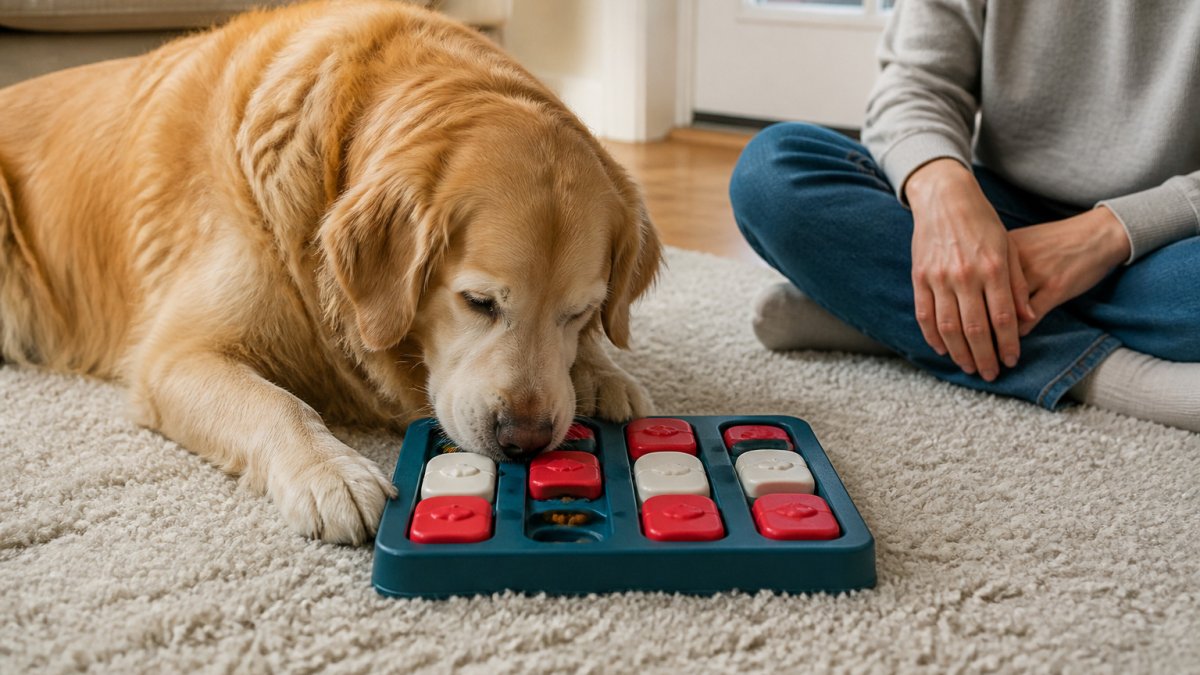
A note before you start: use a portion of your dog's normal kibble so the meal still counts, and adjust the rest of the bowl accordingly. If your dog is on a weight-management plan or a limited-ingredient diet, check with your veterinarian before adding extra treats to puzzle sessions.
Level 1: Beginner (visible food, minimal paw work)
- Setup: Choose a puzzle with wide, shallow compartments or a slow feeder with large ridges. Put two or three pieces of kibble in the easiest compartment and leave the cover partly open so your dog can see and smell the food.
- Play: Place the puzzle on a non-slip mat at floor level. Sit beside your dog and let it investigate. If your dog noses the food out, praise calmly and let it finish. Do not rearrange the puzzle mid-session.
- Duration: Two to four minutes, or until the visible food is gone.
- Easier variation: Scatter the kibble loosely around the puzzle so your dog gets a few instant wins before working the compartments.
- Harder variation: Close the easiest cover halfway so your dog has to nudge it, but keep at least one compartment open.
Level 2: Intermediate (covered food, some problem-solving)
- Setup: Use a puzzle where each button or slider hides one treat at a time. Load a small portion of kibble across the compartments and close the covers fully.
- Play: Set the puzzle down and let your dog work. Resist the urge to point or tap the covers; let your dog experiment with nose, paw, and mouth. If your dog stalls for more than about 30 seconds, open one cover slightly to restart momentum, then step back.
- Duration: Five to eight minutes, with a rest break if your dog lies down mid-session.
- Easier variation: Pre-open one or two covers so your dog gets an early reward and keeps trying.
- Harder variation: Mix kibble sizes or add a single higher-value piece in the hardest compartment to extend persistence.
Level 3: Advanced (multi-step, sequential problem-solving)
- Setup: Use a puzzle that requires a sequence, such as sliding a cover before turning a wheel. Load small treats so each step releases a little food.
- Play: Let your dog work through the sequence without help. Watch for the moment your dog pauses and re-approaches the puzzle; that is usually the sign it is learning the step rather than giving up. Browse the MindMaze IQ Puzzle for a multi-step challenge built for this level. Keep the session calm and quiet.
- Duration: Eight to ten minutes maximum, and split into two shorter sessions if your dog tires.
- Easier variation: Return to Level 2 for a day, then reintroduce the advanced puzzle with one step already solved.
- Harder variation: Rotate the order of compartments between sessions so your dog has to re-learn the sequence rather than memorizing one path.
If your dog chews plastic rather than solving the puzzle, switch to a sturdier toy or supervise closely. Remove any small pieces that could be swallowed, and inspect puzzles for cracks after each session.

The three difficulty levels can be compared at a glance, so you can match a puzzle to your dog's ability.
| Level | Setup | Session length |
|---|---|---|
| Level 1: Beginner | Wide, shallow compartments; food partly visible | Two to four minutes |
| Level 2: Intermediate | Covers fully closed; one treat per button or slider | Five to eight minutes |
| Level 3: Advanced | Multi-step sequence; small treats released per step | Eight to ten minutes maximum |
Building a Daily Enrichment Plan and Watching for Fatigue or Frustration
A daily plan can help organize enrichment. Short, predictable sessions spread across the day are one way to plan activities for a dog with limited mobility.
A Sample Daily Routine
This is a template, not a prescription. Adjust session length to your dog's comfort and follow your veterinarian's activity limits.
- Morning (2-3 minutes): A scent game at floor level. Let your dog watch you place a treat a few feet away, then cue "find it." Keep hiding spots close so your dog does not need to walk far.
- Midday (5-8 minutes): A food puzzle at the dog's resting spot. Use a portion of kibble and let your dog work at its own pace.
- Afternoon (2-4 minutes): A stationary trick such as touch and target, or a cup game played while your dog lies down.
- Evening (3-5 minutes): A calm sniffing session with treats hidden under a cup, behind a pillow, or inside a rolled towel. End the day with quiet praise rather than a high-energy game.
Between sessions, let your dog rest.
Watching for Fatigue
Watch for these signals during and after each session:
- Slower responses or a dog that stops mid-task and looks away
- Heavy panting that does not settle within a minute or two of stopping
- Lying down quickly or shifting weight off a limb
- Reluctance to re-engage with the puzzle or toy
If you see any of these, end the session, offer water, and let your dog rest. Do not restart the same activity that day.
Watching for Frustration
Frustration is different from fatigue and often looks like effort that is not working:
- Pawing at the toy repeatedly without progress
- Whining, barking, or vocalizing at the puzzle
- Walking away and then returning to the same spot
- Chewing the toy rather than solving it
When frustration appears, make the task easier rather than pushing through. Open a cover, move a hiding spot closer, or switch to a simpler game. A dog that ends a session successfully is more likely to try again tomorrow.
Adjusting the Plan Over Time
Reassess the routine every week or two. If your dog finishes sessions quickly and looks for more, add one step of difficulty or a few minutes. If your dog loses interest or seems sore afterward, scale back. The goal is a dog that is engaged and comfortable, not a dog that is worn out.
Start Your First Session Today With a Chewzzle Puzzle
Pick one game from this guide and try it today. A simple scent game or a cup game takes only a few minutes and needs nothing you don't already have.
When you're ready for something more structured, the Chewzzle ThinkDisc Puzzle Feeder at $19.99 has sliding covers and a turning center wheel.

Check with your veterinarian before starting any new activity, especially if your dog has a mobility problem. Then take it slow, keep sessions short and enjoy the time you spend together.
Frequently Asked Questions
How long should a mental enrichment session last for a dog with limited mobility?
Watch your dog's response during a session and end it if your dog loses interest.
Are puzzle toys safe for dogs with mobility problems?
The Chewzzle PuzzleFeast has a non-slip base. The product listing recommends supervising the first few sessions and supervising dogs who tend to chew plastic rather than solve it. Ask your veterinarian about activities appropriate for your dog.
Can scent games help a dog that cannot go for walks?
Scent games involve searching for treats. Keep hiding places close and make sure the activity is appropriate for your dog.
When should I stop a game if my dog has limited mobility?
Stop if your dog turns away from the game or seems uncomfortable. If you have concerns about your dog's mobility, contact your veterinarian.
