
Mental Stimulation for Rescue Dogs: A 2026 Guide
Table of Contents
- Why Mental Stimulation Matters for Rescue Dogs
- Signs of Boredom in Rescue Dogs
- Dog Decompression Techniques for the First 90 Days
- The Best Puzzle Toys for Anxious Dogs
- Scent Work, Snuffle Mats, and Foraging Games
- DIY Enrichment and Safety Rules for Homemade Toys
- How Much Mental Stimulation Does a Rescue Dog Need?
- Frequently Asked Questions
Last Updated: September 11, 2026
Why Mental Stimulation Matters for Rescue Dogs
Mental stimulation for rescue dogs means using problem-solving, scent, and foraging to tire a dog's brain rather than its body. A rescue that spent weeks in a kennel often arrives home with a nervous system stuck on high alert. At Chewzzle, we offer puzzle feeders and slow feeders designed to help your dog settle by giving them a rewarding game to focus on.
How Mental Fatigue Calms a Stressed Dog
Mental fatigue works differently from physical exhaustion. Twenty minutes of sniffing and problem-solving can leave a dog flatter than an hour of fetch, because scent work and puzzles draw on the same cognitive systems a dog would use to survive in the wild. A tired brain produces a calmer body.
Enrichment is not a treat you hand over; it is a decompression tool. Rescue dogs do not need more exercise first. They need more thinking.
What the Research Says About Cognitive Engagement
Canine cognition researchers have spent decades documenting how dogs solve problems, and the consistent finding is that cognitive engagement reduces repetitive, anxious behaviors. The American Kennel Club's guidance on canine enrichment treats puzzle play and scent games as core welfare needs rather than optional extras, and Tufts University's Cummings School of Veterinary Medicine has published extensively on how environmental stimulation shapes behavior in kenneled and rehomed dogs.
Signs of Boredom in Rescue Dogs
The clearest signs of boredom in rescue dogs are destructive chewing, pacing, excessive barking, and shadowing a person from room to room. These look like disobedience but are almost always under-stimulation.
Destructive Behavior, Pacing, and Other Red Flags
Watch for these patterns in the first weeks after adoption:
- Chewing furniture, baseboards, or door frames when left alone
- Pacing a fixed route through the house, especially in the evening
- Whining or barking at nothing in particular
- Digging at carpets, cushions, or the yard
- Staring at a wall or a door for long stretches
These behaviors often intensify in the evening, when a dog's energy has nowhere to go. A rescue that seems "fine" all day can fall apart at 7 p.m., not a training failure but a schedule failure.
Dog Decompression Techniques for the First 90 Days
Dog decompression techniques are low-pressure routines that let a newly adopted dog settle before you ask anything of it. The goal in the first 90 days is not obedience but a nervous system that stops scanning for threats.
The 3-3-3 Rule and What It Means for Enrichment
The 3-3-3 rule is a common rescue-adoption guideline: roughly three days to stop feeling overwhelmed, three weeks to settle into routine, and three months to feel genuinely at home. Treat it as a pacing guide, not a deadline.
Here is how enrichment should scale across that window:
| Phase | Typical Timeline | Enrichment Focus | What to Avoid |
|---|---|---|---|
| Decompress | First 3 days | Quiet room, snuffle mat, lick mat | New people, dog parks |
| Settle | Weeks 1-3 | Solo puzzle feeders, short scent games | Group play, long outings |
| Build | Months 1-3 | Training sessions, hide-and-seek, impulse control games | Off-leash freedom |
Most adopters get this wrong: they buy a puzzle on day one, hand it to a shut-down dog, and conclude enrichment does not work when the dog ignores it. A decompressing dog often will not eat, let alone solve a puzzle. Wait until the dog eats reliably before introducing anything with a learning curve.
The Best Puzzle Toys for Anxious Dogs
The best puzzle toys for anxious dogs reward effort without punishing failure. Start at the easiest setting and let the dog win repeatedly before raising it. Most adopters buy for the dog they hope to have in three months rather than the one in front of them today.
Matching the Puzzle to Your Dog's Confidence Level
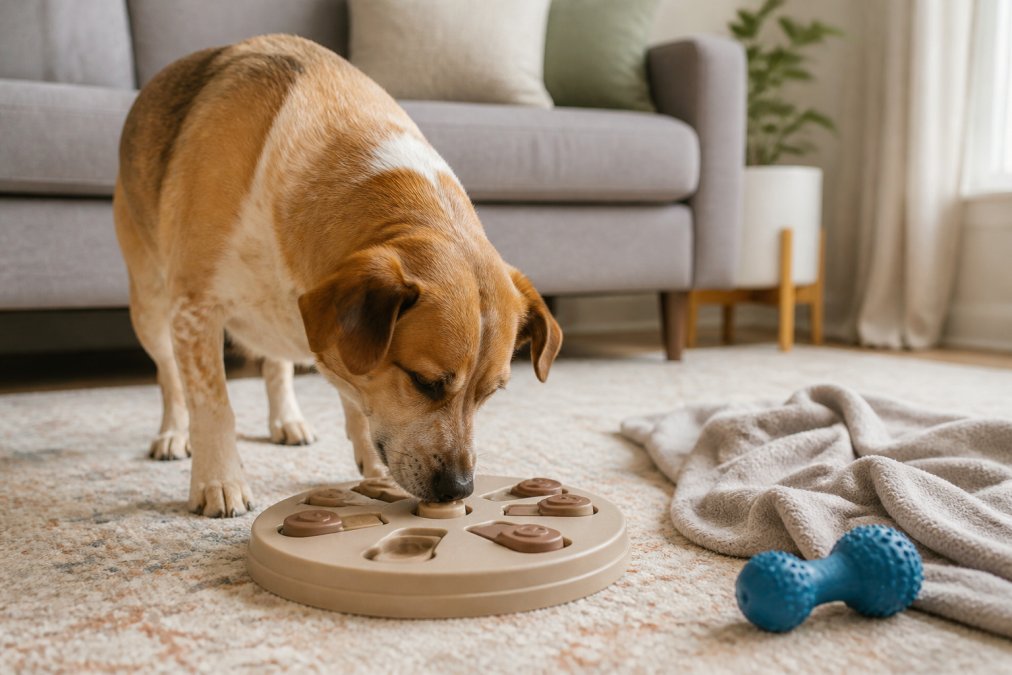
Confidence, not size or breed, should drive your choice. A nervous dog needs a puzzle it can solve in under a minute; a bold, food-obsessed dog needs something that stalls it for ten minutes. Guess wrong either way and the toy gets abandoned, teaching a rescue that new objects are not worth approaching.
Work down this ladder and stop where your dog succeeds roughly eight times out of ten:
- Shy or shut-down rescues: Begin with a snuffle mat or a lick mat, where food is scattered or smeared rather than locked behind a mechanism. There is no wrong answer, so there is nothing to fail.
- Dogs that will take food from a hand but freeze near objects: A flat scatter feed on a towel, then a snuffle mat. Movement and scent do the work; the dog never has to manipulate anything.
- Moderately confident dogs: A sliding-cover puzzle with a few treats left partly visible. The dog can see the payoff, which lowers the cost of trying.
- Bold, fast eaters: A multi-stage puzzle with hidden compartments and a turning element, where the reward is genuinely concealed.
The Mechanics That Separate a Good Puzzle From a Bad One
Four design variables determine whether a puzzle tires a dog or just frustrates it:
- Number of steps to reward. One-step puzzles (lift a flap) build confidence. Three-step puzzles (slide, then lift, then rotate) build duration. Do not jump from one to three.
- Visibility of the reward. Visible treats teach the dog that effort pays. Fully hidden treats test persistence. Alternate between the two rather than always hiding.
- Resistance of the mechanism. A lid a dog can nudge open with its nose is easier than one requiring a paw press, which is easier than a lift-and-turn. Stiff mechanisms are the most common reason a rescue gives up.
- Food value. Kibble works for an easy puzzle. For a hard puzzle, most trainers step up to a higher-value treat so the payoff justifies the effort. Boring kibble in a hard puzzle is a recipe for a dog that walks away.
A Progression You Can Actually Follow
Trainers typically move a dog up one difficulty rung only after it clears the current rung in under 30 seconds, three sessions in a row. That is a rough benchmark, not a rule, some dogs plateau for weeks, and that is fine.
- Week 1: Snuffle mat or scatter feed. Goal is eating, not solving.
- Week 2: Single-step sliding puzzle with visible treats.
- Weeks 3-4: Two-step puzzle, still with some visible treats.
- Month 2 onward: Multi-stage puzzle with hidden compartments, rotating in a higher-value treat.
Rotate two or three puzzles rather than leaving one out permanently. A puzzle a dog has memorized becomes a bowl with extra steps.
What to Avoid
- Do not leave a new puzzle with a dog unsupervised until you have watched it solve the puzzle at least twice. The failure mode is not the puzzle breaking, it is the dog chewing the puzzle itself.
- Do not use a puzzle as a substitute for a meal. Use it as the meal, portioned out, so you are not adding calories on top of a full bowl.
- Do not raise difficulty after a bad session. If the dog walked away, drop back a rung next time rather than pushing forward.
No puzzle is indestructible, and a determined chewer will test the edges. Durable, non-toxic materials and supervised first sessions matter more than any difficulty rating on the box.
Scent Work, Snuffle Mats, and Foraging Games
Scent work and foraging games are the highest-value enrichment for a rescue, because they tap directly into foraging behavior the dog was born with. A snuffle mat mimics the search for scattered food; nose work asks the dog to find a hidden target by smell alone.
Try these, in order of difficulty:
- Scatter a handful of kibble across a snuffle mat and let the dog root it out.
- Hide treats under three upturned cups and let the dog choose.
- Run a simple hide-and-seek: have one person hold the dog while another hides, then release.
- Introduce a scent box with a few cardboard tubes and a treat in one.
- Graduate to a formal nose work game with a named target odor.
Sensory stimulation of this kind is genuinely tiring: ten minutes of sniffing burns more mental energy than most dogs get from an afternoon of passive backyard time.
DIY Enrichment and Safety Rules for Homemade Toys
Homemade enrichment works, but safety rules are not optional. The most common DIY injuries come from toys a dog can shred and swallow, and rescue dogs are higher-risk, because you often do not know their chewing history or whether they have had to scavenge or compete for food.
The Ingestion and Choking Risks Most Guides Skip
A dog with an unknown history may treat a homemade toy as food rather than a puzzle, which changes the risk profile. Watch for these failure modes:
- Shredded fabric and stuffing. A dog that pulls a towel apart can swallow strands that ball up in the gut. Use tightly woven fabric and retire it the moment a tear appears.
- Cardboard and paper. Small amounts are usually fine, but a dog that eats cardboard rather than tearing it can create a blockage. If your rescue swallows rather than shreds, skip cardboard entirely.
- Elastic, string, and ribbon. These are the highest-risk items in any DIY toy. They can wrap around the tongue or intestine. Never leave them in a toy a dog can reach.
- Cooked bones. They splinter. Cooked poultry bones in particular are a well-known choking and perforation risk.
- Small glued or stapled parts. Staples work loose. Tape gets eaten. If it is not a single piece of safe material, do not use it.
- Peanut butter and xylitol. Check the label. Xylitol is toxic to dogs and appears in some reduced-sugar nut butters. Choose a plain, unsalted, xylitol-free option.
A simple rule: if you would not let a toddler mouth it unsupervised, do not build a dog toy out of it.
Budget-Friendly Setups That Cost Almost Nothing
These are the workhorses of low-cost enrichment. Rotate them so no dog sees the same setup twice in a week.
- Muffin tin with tennis balls over treats. Put a treat in each cup, drop a ball on top. The dog lifts or noses the balls aside. Works for almost any confidence level.
- Cardboard box with kibble inside. Let the dog tear it open. Best for dogs that shred rather than swallow.
- Rolled towel with food in the folds. Start loose, roll tighter as the dog gets better. This is the cheapest difficulty dial you own.
- Frozen stuffed toy. Soak kibble or a safe stuffer, freeze overnight. The thaw time adds several minutes of problem-solving and stretches one treat into a long activity.
- Scatter feed in grass. Toss kibble into a lawn and let the dog hunt. Free, and it doubles as scent work.
Running DIY Enrichment in a Multi-Dog Household
Two rescues with different confidence levels and food drives cannot share one enrichment setup without a plan.
- Separate the sessions, not just the toys. Feed each dog its DIY puzzle in a different room or behind a baby gate. This prevents resource guarding before it starts and lets a slow, cautious dog work without a faster dog hovering.
- Match the puzzle to the dog, not the household. A bold dog gets the tightly rolled towel; a shy dog gets the loose one. Do not average the difficulty across dogs.
- Never leave two dogs alone with food-bearing toys. Even dogs that get along fine over a water bowl can guard a high-value puzzle.
- Rotate on a schedule. Assign each dog a different setup each day so the novelty stays high and no dog learns to expect, and defend, a specific toy.
- Watch the slow eater. In a multi-dog home, a dog that eats slowly often gets its food stolen. Puzzle feeding in a closed room solves this.
When to Call Your Vet
If you suspect your dog swallowed a foreign object, string, fabric, a piece of a toy, do not wait for symptoms. Repeated vomiting, drooling, refusing food, pacing, or a hard or painful abdomen are emergencies, not wait-and-see situations.
How Much Mental Stimulation Does a Rescue Dog Need?
Most rescue dogs need two to three short enrichment sessions a day, roughly 10 to 20 minutes each, plus mealtime delivered through a slow feeder or puzzle. Total mental work matters more than any single long session.
Physical exercise and mental enrichment are not interchangeable. A high-energy dog that gets two hours of running and no thinking still chews the couch. Cutting down on physical exercise and adding puzzle sessions can often lead to a calmer dog.
Signs you have the balance right: the dog settles after a session, eats at a normal pace, and greets you without the frantic edge. Signs you have overshot: the dog disengages, walks away from the puzzle, or gets more agitated. Drop the difficulty and shorten the session.
For senior or mobility-impaired rescues, keep the same frequency but swap movement for scent. A snuffle mat and a few hidden treats deliver the same cognitive engagement without asking stiff joints to work.
Rescue dogs arrive with a history you cannot see, and the fastest way to help them settle is to give their minds something to do. Chewzzle builds interactive puzzle toys and slow feeders for exactly that transition, with durable, non-toxic materials that mimic natural foraging and turn mealtime into a rewarding game. Start with the ThinkDisc Puzzle Feeder for a nervous newcomer, or move up to the SmartPaws Interactive Puzzle for a dog that has already outsmarted everything else. Add to cart and give your rescue the job it has been waiting for.

Frequently Asked Questions
How much mental stimulation does a rescue dog need daily?
Most rescue dogs do well with 15 to 30 minutes of focused mental stimulation per day, split into two or three short sessions. A 10-minute puzzle session can tire a dog as much as a 30-minute walk because problem-solving burns more energy than repetitive movement. Start with one easy puzzle and build up. Watch for signs your dog is overwhelmed, like walking away or ignoring the toy, and scale back if that happens.
What are the most common signs of boredom in rescue dogs?
Destructive chewing, excessive barking, pacing, digging, and following you from room to room are the classic signs of boredom in rescue dogs. Some dogs also start counter-surfing or raiding trash cans. These behaviors often spike in the first few weeks after adoption, when a dog has energy to burn but no outlet. If your dog destroys items only when left alone, that points more toward separation anxiety than boredom, so the response should be different.
Can puzzle toys really help a rescue dog with anxiety?
Puzzle toys give anxious dogs a job to do, which shifts focus away from stress triggers and toward problem-solving. The repetitive motion of nosing kibble out of a slow feeder or sliding a cover aside can also have a calming effect, similar to how licking and chewing soothe dogs. For best results, pair puzzle time with a predictable routine and a quiet space. Severe anxiety still needs a vet or a certified behavior consultant.
How do I introduce a puzzle toy to a dog that has never seen one?
Start with the easiest setting and let your dog win. Put a few high-value treats on top of the puzzle so they get an instant reward without solving anything. Once they are confidently eating from it, move to one sliding cover or one compartment. Sessions should stay under 10 minutes at first. If your dog gives up or walks away, make it easier next time. Confidence builds through repeated small wins, not through hard challenges.