

Puppy Ball Launchers: Benefits for Training and Enrichment
Last Updated: November 6, 2026
Quick Summary
A ball launcher is a device that catches a tennis ball your dog drops into it and throws it across the yard or room, so your puppy can chase and return it. It gives busy owners a repeatable game that works both the body and the brain. Start with short, low-distance sessions once your puppy is old enough.
- Fetch works the body through running and turning, and the brain through focus and self-control.
- Puppies under 4 months should skip the launcher and focus on recall and drop-it games.
- Play on grass, turf, or rubberized mats rather than slick concrete, tile, or hardwood.
- Keep sessions to 3 to 5 minutes of launches followed by 5 minutes of rest, 2 to 4 times a day.
- End the session if your puppy limps, pants without settling, or shows frantic overarousal.
Table of Contents
- Why Fetch Matters for Puppy Exercise and Mental Stimulation
- Is Your Puppy Ready? Age, Development and Physical Safety
- How to Train a Dog to Use a Ball Launcher, Step by Step
- Puppy Fetch Training: Safe Session Length, Rest and Overarousal
- Safe Fetch Games for Puppies: Setup, Distance and Troubleshooting
- Start Your Puppy's First Launcher Session with Chewzzle
- Frequently Asked Questions
If you have a puppy with more energy than you have time for, an automatic ball launcher can be a real help.
Here's the core of how it works. The dog drops the ball into the launcher's opening, the unit sends the ball out, and the dog goes after it.
Key parts you'll notice on most launchers:
- A ball chamber that holds the ball until the launch
- A launch mechanism that sends the ball a set distance
- A power source, often a rechargeable battery
- A base or stand that keeps the unit steady on the floor
The Chewzzle Smart Ball Launcher is an automatic ball launcher for small to medium dogs. You can view the Chewzzle Smart Ball Launcher here to see the full specs.

A common mistake is treating any launcher as a babysitter. A launcher gives your dog a game, but it doesn't teach the game by itself.
Why Fetch Matters for Puppy Exercise and Mental Stimulation
Fetch does two jobs at once. It gets a puppy moving, and it asks the puppy to think. Chasing a ball works the body. Deciding to bring it back, and then letting go, works the mind.
Physical exercise matters for growing pups, but mental stimulation matters just as much. A bored puppy is more likely to chew furniture, dig, or bark. Repeated fetch gives the brain a steady job, which often means less trouble around the house later.
What a fetch session can cover:
- Burning energy through short sprints and turns
- Building focus as the dog watches the ball and waits for the launch
- Practicing self-control when the dog learns to release the ball
- Teaching patience between rounds
Keep sessions short. For most puppies, several brief rounds spread through the day beat one long, exhausting marathon. Stop before your pup gets sloppy or overexcited.
Is Your Puppy Ready? Age, Development and Physical Safety
Puppies are still growing, and their growth plates stay open for months, so the timing of launcher play matters. If you're unsure whether extra activity is safe yet, read whether mental stimulation is enough for a hyper puppy.
Use this rough developmental map as a starting point, then confirm timing with your veterinarian, who knows your puppy's breed, size, and health history:
- Under 4 months: Skip the launcher. Focus on name recognition, recall, and hand-fed drop-it games on carpet or grass. Bones and joints are still forming, and attention spans are measured in seconds.
- 4 to 6 months: Short, low-distance launches (the shortest setting) on grass or a rubberized mat. Two to three minutes per session, one puppy at a time, with a human standing at the launcher.
- 6 to 12 months: Gradually extend distance and session length as coordination improves. Avoid stairs, slick floors, and steep terrain. Large-breed puppies mature slower than small breeds, so a 10-month-old Great Dane may still need the 6-month protocol.
- 12 months and up: Most puppies can handle normal launcher play, but keep sessions structured and watch for cumulative soreness the next day.
Signs your puppy is ready to start:
- Walks and trots without wobbling or crossing over
- Chases a rolled ball and picks it up without hesitation
- Can wait two to three seconds for a launch without frantic jumping
- Recovers normal breathing within a minute or two of stopping
Signs to slow down or stop:
- Limping, stiffness, or reluctance to rise after play
- Panting that does not settle within several minutes
- Skipping the ball, losing interest, or lying down mid-session
- Any yelp, yip, or change in gait
Surface and distance rules for growing puppies:
- Play on grass, turf, or a rubberized mat. Concrete, tile, and hardwood offer poor traction and increase slip risk on turns.
- Start at the shortest launch distance and increase only after several successful sessions at the current setting.
- Keep the play area free of stairs, drop-offs, furniture corners, and fence lines.
Watch out: if your puppy limps, favors a leg, or seems sore the day after a session, stop launcher play and call your veterinarian before resuming. Growing-joint injuries are easier to prevent than to treat.
Puppies who startle at noise need a slower ramp. Run the launcher empty a few times at a distance, pair the sound with treats, and only then introduce a ball.
How to Train a Dog to Use a Ball Launcher, Step by Step
Training a dog to use a launcher takes patience, but the steps are simple. Use treats and praise to mark each good move. The goal is for your dog to learn that dropping the ball in leads to a fun chase.
Introducing the Launcher Gradually
Start with the launcher turned off or set to its shortest distance. Let your puppy sniff it, walk around it, and get comfortable with its shape and smell.
Next, turn the launcher on and let it launch a ball while your puppy watches from a short distance. Reward calm attention. If your pup startles, pause, reward calm behavior, and try again later.
Once your puppy is relaxed around the launcher, move to the drop step. Hold a ball near the opening, and reward your pup for touching or nudging the ball in. Build up slowly over several days.
Teaching Drop-It and Returning the Ball
Drop-it is the skill that makes the whole game work. Use a simple cue like "drop" or "out" and trade the ball for a treat the moment your puppy opens its mouth.
Teaching the return works the same way. After your puppy fetches the ball, call them back, and reward them when they bring it to you and let it go.
If your puppy keeps grabbing the ball and running off, go back a step. Make the drop easier by using a shorter launch distance, and reward the moment the ball goes in.
Puppy Fetch Training: Safe Session Length, Rest and Overarousal
Fetch can get intense fast. Some dogs become so excited that they stop thinking clearly and start chasing compulsively.
Here's a simple structure to try:
- Play time: 3 to 5 minutes of launches
- Rest time: 5 minutes of calm, quiet activity
- Repeat: 2 to 4 cycles per day, depending on your pup
Watch your puppy for signs of overarousal: frantic barking, ignoring your cues, or circling the launcher. When you see these, end the session and let your dog settle.
Another option is to pair fetch with slower enrichment, such as the Chewzzle TreatDrop Ball, which releases treats gradually as your dog plays.

Here is a quick reference for the session structure the article recommends, so you can plan play and rest around your puppy's energy.
| Session element | Recommended amount | Purpose |
|---|---|---|
| Play time | 3 to 5 minutes of launches | Burns energy without overdoing it |
| Rest time | 5 minutes of calm activity | Lets your puppy settle |
| Cycles per day | 2 to 4, depending on the pup | Builds fetch in short doses |
| Overarousal signs | Frantic barking, ignoring cues, circling | Signal to end the session |
Safe Fetch Games for Puppies: Setup, Distance and Troubleshooting
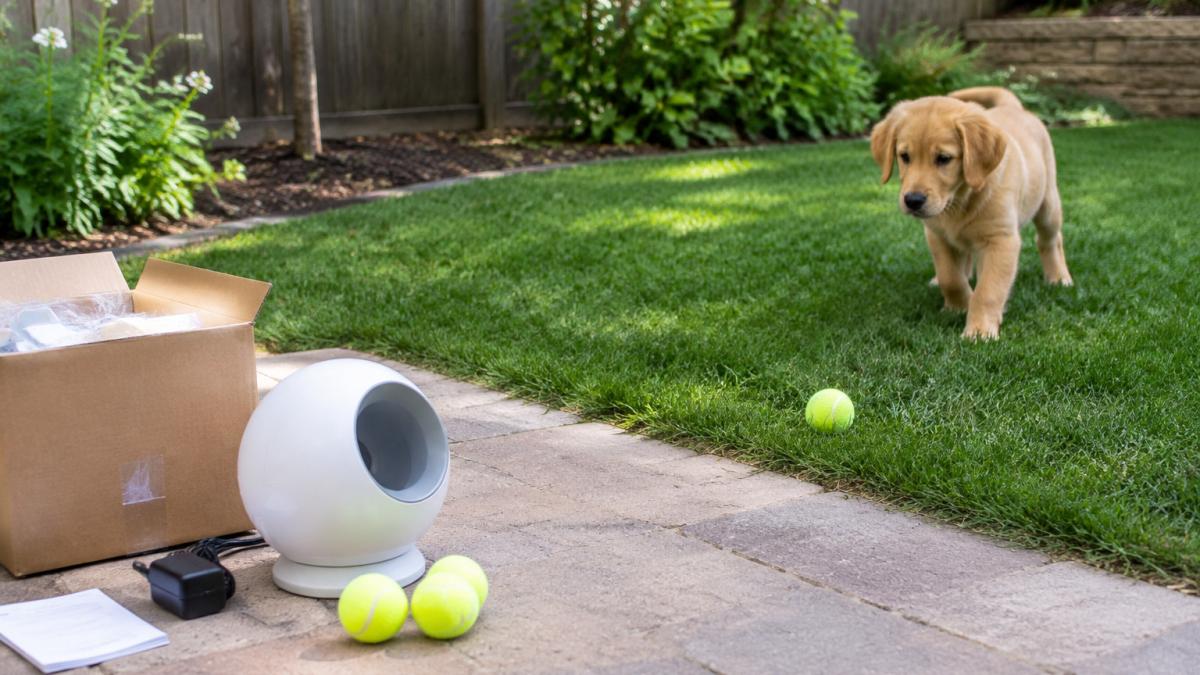
Setup decides most of the outcome. Put the launcher on a flat, stable surface with the launch opening pointed into open space, not toward a fence, wall, or stairwell.
If your puppy is new to fetch games and wants more ideas, explore 5 Best Enrichment Games for Puppy Socialization. It covers low-pressure games that build confidence around people and other dogs.
Troubleshooting the real failure points:
- Puppy is afraid of the launch sound. Move the launcher to the far side of the yard, run it empty while you feed treats, and let the puppy approach on its own. Repeat over several days before adding a ball. Never force the puppy toward the machine.
- Puppy chases but will not bring the ball back. Practice recall and drop-it separately, then reward the puppy for bringing the ball anywhere near you, not just to the launcher. Use a second identical ball to trade, and reward the moment the first ball leaves the puppy's mouth.
- Puppy drops the ball beside the opening instead of in it. Mark and reward any ball that touches the opening, then shape closer and closer. A treat placed just inside the opening can help the puppy target the drop.
- Puppy bites or paws at the launcher in frustration. This is overarousal, not naughtiness. End the session, let the puppy settle, and shorten the next session.
- Ball jams or does not launch. Check ball size and condition first; cracked or wet tennis balls are the most common cause. Dry the ball, remove debris from the chamber, and confirm the battery is charged.
- Puppy loses interest after two or three launches. That is normal for many puppies under 6 months. End on a success and try again later; forcing more repetitions builds aversion, not enthusiasm.
Measuring progress so you know when to advance:
- Drops the ball into the opening without a treat lure
- Returns to the launcher after each launch without being called
- Waits calmly for the launch instead of jumping at the machine
- Completes a five-minute session and settles afterward
If your puppy shows low toy interest, sound sensitivity, or a tendency to guard the ball, a launcher may not be the best fit.
Start Your Puppy's First Launcher Session with Chewzzle
Your first session should be short, calm, and fun. Set up the launcher on the shortest distance, have treats ready, and follow the gradual steps from earlier.
The Chewzzle Launch & Learn Puppy Trainer is built for this stage. It's a reward-based ball launcher designed to teach focus and self-play, and it's made for small to medium dogs. For puppies still learning to fetch, it's a strong starting point.

Ready to make fetch a daily habit? Add the Chewzzle Launch & Learn Puppy Trainer to your cart and start your puppy's first session tonight.
Frequently Asked Questions
Are ball launchers good for dogs?
For many dogs, yes. A ball launcher provides repeatable fetch without the owner throwing every ball, which supports both physical exercise and mental stimulation. Chewzzle's Smart Ball Launcher is built for small to medium dogs up to about 40 lbs and offers three throw distances, from short indoor launches to longer backyard throws. It works best when sessions are short and supervised, and when the dog rests between rounds so play stays rewarding rather than overexciting.
At what age can a puppy use an automatic ball launcher?
Puppies generally need to be old enough to chase and retrieve reliably before a launcher adds value, and their joints and growth plates are still developing, so avoid long, repetitive, high-impact sessions. Many owners start with the Chewzzle Launch and Learn Puppy Trainer, which is designed to teach focus and self-play through reward-based training. Keep early sessions very short, watch for signs of fatigue, and check with your veterinarian if you have questions about your puppy's development.
How long should a puppy play fetch?
Short, frequent sessions work better than long ones. For young puppies, a few minutes of launcher play followed by a rest period is a sensible starting point, with total daily fetch kept modest. Stop before your puppy becomes frantic, overheated or unable to settle, since overarousal can make calming down harder. Build duration gradually as your puppy's stamina and focus improve, and always allow plenty of sleep, which puppies need for healthy growth.
Can a ball launcher help prevent destructive chewing?
A launcher can reduce boredom-driven chewing by giving a puppy an outlet for energy and a task to focus on. It does not replace supervision, appropriate chew toys or management such as blocking access to furniture. Pairing launcher sessions with puzzle play, such as Chewzzle's TreatDrop Ball, can add more mental work to a daily routine. If chewing continues or seems tied to anxiety, consult a veterinarian or a certified professional dog trainer for individual guidance.
