

5 Best Enrichment Games for Puppy Socialization
Table of Contents
- Why Enrichment Games Matter for Puppy Socialization
- How Puppy Socialization Games Build Confidence and Social Skills
- Indoor Games for Puppies That Develop Problem-Solving Skills
-
Top 5 Interactive Dog Toys for Mental Stimulation
- 1. Chewzzle Launch & Learn Puppy Trainer: Fetch-Based Focus Training
- 2. Chewzzle SmartPaws Interactive Puzzle: Problem-Solving Through Treat Dispensing
- 3. Chewzzle PuzzleFeast Sliding Puzzle: Nose Work and Impulse Control
- 4. Chewzzle MindMaze IQ Puzzle: Adjustable Difficulty for Growing Pups
- 5. Chewzzle SmartBounce Rolling Ball: Chase and Chase Instinct Development
- Puppy Enrichment Activities by Developmental Stage
- Safety Tips and Supervision Protocols for Puppy Games
- Troubleshooting Common Game Failures and Disengagement
- Frequently Asked Questions
Last Updated: October 9, 2026
Why Enrichment Games Matter for Puppy Socialization
Enrichment games aren't just about keeping puppies busy. They build confidence, teach problem-solving, and develop healthy social behaviors during critical developmental windows.
Socialization and enrichment work together: puzzle-solving builds patience and persistence, while scent work develops focus and trust in the handler.
Enrichment games for puppy socialization can accelerate development. Puppies introduced to puzzle toys during critical developmental stages may show better impulse control, less anxiety in new situations, and stronger handler bonds.
How Puppy Socialization Games Build Confidence and Social Skills
Games that challenge a puppy's mind create safe opportunities for small victories. Extracting a treat from a puzzle toy is a solved problem, and that success builds confidence.
Confidence comes from repeated, positive experiences with novelty and mild challenge, exactly what enrichment games provide.
The benefits extend beyond socialization.
Scent work games tap into a puppy's innate foraging behavior. This enrichment is particularly powerful for anxious or shy puppies because it gives them a job and channels nervous energy into productive behavior.
Indoor Games for Puppies That Develop Problem-Solving Skills
Indoor enrichment is essential in early weeks when outdoor socialization is limited by vaccination schedules. Games played indoors during this period set the foundation for cognitive development and impulse control.
Hide-and-Seek with Treats and Toys
Start simple: hide a treat under a cup or in your closed fist and let your puppy figure it out. This teaches problem-solving and persistence. As your puppy improves, hide treats around a room or inside a towel roll.
The real value is the repeated experience of trying, failing, and succeeding. Puppies learn that effort pays off, a mindset that transfers to social situations, since a puppy comfortable with mild frustration handles new dogs and people with less reactive anxiety.
Scent Work Games for Foraging Behavior
Puppies are born sniffers. Scent work games activate foraging instincts and provide intense mental engagement. Hide kibble in a snuffle mat, scatter treats in grass, or place treats in boxes or under blankets.
Scent work is valuable for puppies who need confidence. Unlike games requiring physical agility, nose work succeeds on the puppy's terms, a shy puppy can engage at their own pace, and success builds trust in their own abilities.
Tug Games with Positive Reinforcement
Tug isn't forbidden, it's excellent enrichment when played with clear rules. Tug teaches bite inhibition, impulse control, and positive interaction with humans. The key is structured play: you initiate, you control the rules, and you end on a positive note.
Tug builds confidence differently than puzzle toys: it's interactive and social. A puppy that wins at tug (within your boundaries) learns they're capable, and that their handler is a safe, predictable play partner.
Top 5 Interactive Dog Toys for Mental Stimulation
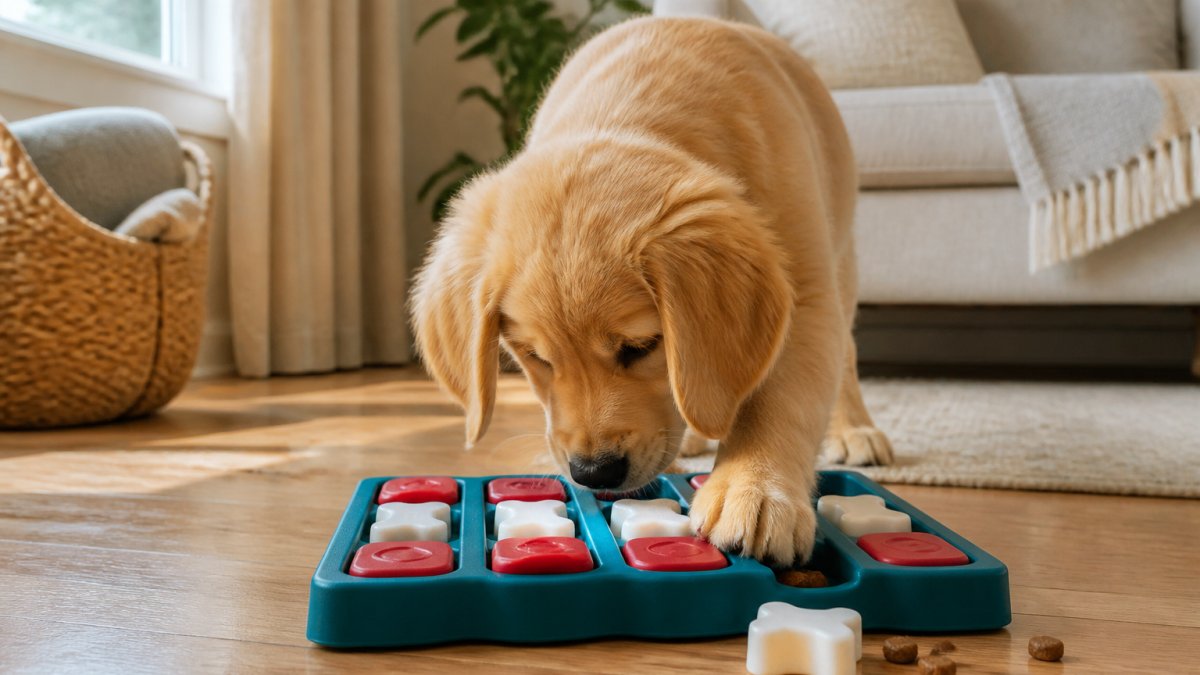
| Toy Name | Price | Best For | Key Benefit |
|---|---|---|---|
| Chewzzle Launch & Learn Puppy Trainer | $69.99 | Fetch-based training & focus | Automatic reward launcher builds self-play |
| Chewzzle SmartPaws Interactive Puzzle | $39.99 | Problem-solving & impulse control | Scalable difficulty for growing pups |
| Chewzzle PuzzleFeast Sliding Puzzle | $49.99 | Fast eaters & nose work | One-treat-at-a-time pacing |
| Chewzzle MindMaze IQ Puzzle | $29.99 | All-around mental enrichment | Adjustable difficulty keeps engagement fresh |
| Chewzzle SmartBounce Rolling Ball | $19.99 | Chase instinct & independent play | Automatic motion encourages active engagement |
1. Chewzzle Launch & Learn Puppy Trainer: Fetch-Based Focus Training
The Chewzzle Launch & Learn transforms fetch into a structured training tool.

What makes it exceptional for socialization: it teaches self-play and independent problem-solving. A puppy that entertains itself with focused, repetitive activity is learning impulse control, a skill that transfers to social situations with distractions.
The automatic reward mechanism mimics positive reinforcement without constant handler involvement, which is crucial for puppies learning to manage their own behavior. At $69.99, it's an investment for puppies needing structure and focus training.
2. Chewzzle SmartPaws Interactive Puzzle: Problem-Solving Through Treat Dispensing
The SmartPaws Interactive Puzzle is the workhorse of enrichment toys. Fill it with kibble or treats, and your puppy works out how to access each reward.

For socialization, it excels because it teaches patience and problem-solving under mild frustration, persisting when something isn't immediately accessible, a foundational skill for confident social interaction.
The real advantage is scalable difficulty: start with the puzzle partially open so treats are visible, then increase the challenge.
3. Chewzzle PuzzleFeast Sliding Puzzle: Nose Work and Impulse Control
The PuzzleFeast Sliding Puzzle solves a specific problem: puppies that inhale food in seconds.
This toy is exceptional for impulse control. Your puppy learns that rushing doesn't work, they must slow down and solve each step.
The non-slip base keeps it planted, and it suits all sizes, smaller puppies use their nose, larger ones a paw. At $49.99, it offers durability and impulse-control benefits.
4. Chewzzle MindMaze IQ Puzzle: Adjustable Difficulty for Growing Pups
The MindMaze IQ Puzzle is built for puppies ready for a real cognitive challenge.
For socialization, this toy teaches persistence and focus, the exact traits that make a puppy confident in social situations.
The adjustable difficulty is the key feature: you increase the challenge at your own pace instead of replacing the toy monthly. At $29.99, it offers a growing challenge for your puppy.
5. Chewzzle SmartBounce Rolling Ball: Chase and Chase Instinct Development
The SmartBounce Rolling Ball moves unpredictably, triggering your puppy's chase instinct. The automatic rolling action keeps puppies engaged even when you're busy, and the rotating chew surface adds another layer of engagement.
For socialization, chase games develop impulse control during high-energy play.
The USB rechargeable design means no batteries, and at $19.99 it's an accessible option. Best for small to medium dogs, it works well alongside puzzle-based games.
Puppy Enrichment Activities by Developmental Stage
Enrichment needs change as puppies grow. A game perfect for an 8-week-old may be boring or too hard for a 6-month-old. Matching enrichment to developmental stage keeps your puppy appropriately challenged.
8-12 Weeks: Gentle Introduction to Puzzle Toys
At this stage, puppies are still learning how to learn. Attention spans are short and they tire quickly, so start with simple, low-frustration games.
Use toys with large, easy-to-access compartments, the SmartPaws Interactive Puzzle works if started partially open.
At this age, enrichment also tires puppies mentally so they're calmer during socialization outings, with fewer impulses to chase or jump on other dogs.
3-6 Months: Building Confidence Through Interactive Games
By 3 months, puppies have longer attention spans and are ready for complex challenges. The PuzzleFeast Sliding Puzzle and MindMaze IQ Puzzle become engaging now.
This is also the ideal window for scent work games, since puppies now have stronger scent discrimination.
Interactive games with you, tug, fetch with the Launch & Learn, hide-and-seek, build your bond while teaching impulse control and focus.
6+ Months: Advanced Problem-Solving and Group Play
By 6 months, puppies are ready for genuinely challenging enrichment: multi-step puzzles, complex scent work, and interactive play requiring real concentration. Introduce the Launch & Learn at full capacity, raise puzzle difficulty settings, and make hide-and-seek more complex.
At this stage, enrichment channels a growing dog's energy into productive behavior and prevents boredom-related destruction. A 6-month-old without adequate enrichment may find their own entertainment, often chewing furniture or developing anxiety.
Group play becomes more meaningful now. Puppies that built problem-solving skills and impulse control through individual enrichment are better equipped to play appropriately with peers, calmer, more focused, and less likely to play rough.
Safety Tips and Supervision Protocols for Puppy Games
Enrichment games are safe when supervised and matched to your puppy's chewing style and developmental stage.
Always supervise the first few sessions with a new toy. Some puppies solve puzzles; others try to destroy them.
Match durability to chewing intensity. A puppy that shreds toys needs durable materials like the natural rubber ChewClean Treat Ball. A puppy that noses and paws can handle the plastic SmartPaws.
Never leave puzzle toys unattended if your puppy might ingest plastic pieces.
Check toys regularly for damage, sharp edges, cracked plastic, or missing pieces are hazards. Remove damaged toys.
Troubleshooting Common Game Failures and Disengagement
Not every puppy engages with every toy immediately. Disengagement usually signals one of a few problems.
Your puppy ignores the toy. The challenge level is wrong, too easy means instant disinterest, too hard means giving up.
Your puppy destroys the toy instead of solving it. This is a chewing preference, not a failure, some puppies are natural chewers. For chewers, the TreatDrop Ball or ChewClean Treat Ball beat puzzle toys.

Your puppy loses interest after a few minutes. Puppies have short attention spans.
Your puppy shows frustration or anxiety with the toy. If your puppy whines, paws frantically, or shows stress signals, the toy is too challenging.
Building confident, well-socialized puppies with the 5 best enrichment games for puppy socialization requires more than exposure to other dogs. The toys covered here, from the Launch & Learn for fetch-based focus training to the PuzzleFeast for impulse control, each target specific developmental skills.
Frequently Asked Questions
How do enrichment games help with puppy socialization?
Enrichment games build confidence and social skills by exposing puppies to new challenges, sounds, and experiences in a positive, rewarding context. Games like hide-and-seek and scent work encourage puppies to explore their environment, interact with their owners, and develop problem-solving abilities. This positive engagement during critical socialization windows (8-16 weeks) helps puppies form secure attachments and reduces anxiety around new people and situations.
What are the best indoor games for puppies that develop mental stimulation?
Indoor games for puppies should focus on mental challenge rather than just physical activity. Hide-and-seek with treats, scent work games, and interactive puzzle toys like the Chewzzle SmartPaws or MindMaze stimulate cognitive development and problem-solving. These games encourage foraging behavior and impulse control while keeping puppies engaged during times when outdoor play isn't possible. Rotating games prevents boredom and keeps your puppy mentally sharp.
At what age can I start using interactive dog toys for mental stimulation?
You can introduce interactive dog toys for mental stimulation as early as 8 weeks, starting with simple, low-difficulty options like treat-dispensing balls. The Chewzzle TreatDrop Ball or RollFeast are excellent starting points for young puppies. As your puppy grows (3-6 months), gradually introduce more complex puzzles like the SmartPaws or PuzzleFeast. Always supervise early sessions and choose toys sized appropriately for your puppy's mouth and strength.
How long should puppies play enrichment games each day?
Puppies should engage in enrichment activities for 10-20 minutes per session, 2-3 times daily, depending on age and energy level. Younger puppies (8-12 weeks) tire quickly and benefit from shorter, frequent sessions. Older puppies (4-6 months) can handle longer play periods. Monitor your puppy for signs of fatigue or frustration, and always follow enrichment play with a calm period to help your puppy wind down and process what they've learned.
Will puzzle toys actually work for fast eaters, or will my puppy just figure them out immediately?
Most food-motivated puppies will figure out simple puzzle toys within a few minutes, especially if you start with buttons or compartments slightly open so they can see the treat. This is exactly what you want, early success builds confidence. The Chewzzle PuzzleFeast is specifically designed for fast eaters because it dispenses only one treat at a time, forcing your puppy to solve multiple puzzles to finish a meal. Even if your puppy solves it quickly, the extended mealtime (several minutes instead of seconds) significantly reduces gulping and bloating.