

Signs of Dog Bloat from Fast Eating: What to Watch For
Table of Contents
- Understanding Canine Bloat and Fast Eating
- Signs of Bloat in Dogs: The Early Warning Signals
- Dog Retching but Not Vomiting: A Critical Sign
- How to Slow Down a Dog Eating: Prevention and Management
- Using a Slow Feeder for Dogs to Reduce Bloat Risk
- Emergency Action Checklist: What to Do Right Now
- Bloat Versus Simple Overeating: How to Tell the Difference
- Frequently Asked Questions
Last Updated: October 7, 2026
Understanding Canine Bloat and Fast Eating
Canine bloat, or gastric dilatation-volvulus (GDV), is a life-threatening condition where the stomach fills with gas and may twist, cutting off blood flow. Recognizing the signs of dog bloat early is critical, as a dog can go from normal to critical in hours.
Fast eating is a major risk factor. Dogs that gulp food without chewing swallow air along with kibble. That air builds up, the stomach expands, and sometimes it twists, cutting off blood flow.
The good news: you can prevent bloat by slowing down how fast your dog eats.
This guide covers the warning signs to recognize, how to tell bloat from simple overeating, and practical steps to protect your dog.
Signs of Bloat in Dogs: The Early Warning Signals
The first hours after bloat starts are critical. The signs of dog bloat can be subtle. Some dogs show all of them. Others show just one or two. Trust your instincts.
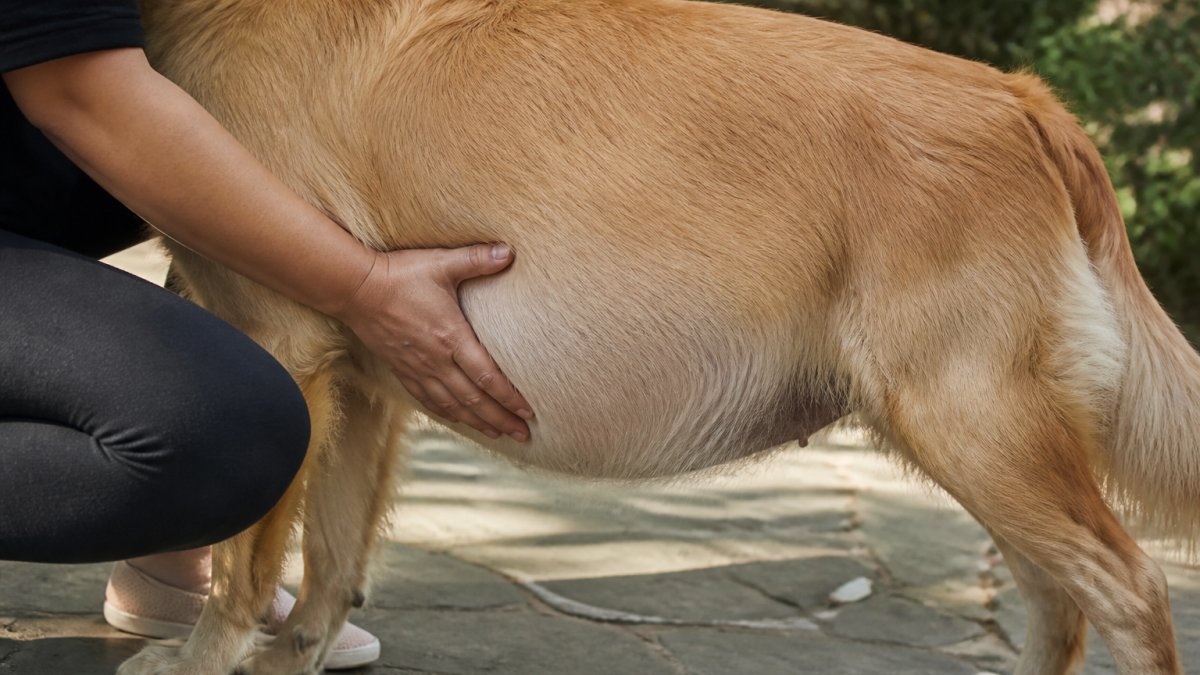
Abdominal Distension and Hard Belly
A swollen or distended abdomen is the most obvious sign. The belly looks puffy or tight. It may feel hard when you touch it.
This distension happens because gas fills the stomach, expanding it beyond its normal size.
Press gently on your dog's side. A normal belly feels soft and gives a little; a bloated belly feels tight and doesn't indent easily.
Restlessness, Pacing, and Inability to Get Comfortable
Dogs with bloat can't settle down. They pace, whine, shift their weight, and may lie down only to jump up again within seconds.
This restlessness comes from abdominal pain: the expanding stomach stretches the tissues around it, and your dog is trying to find a position that feels better.
Watch for pacing in circles, frequent position changes, and an anxious demeanor, sometimes with excessive drooling.
Drooling, Panting, and Breathing Changes
Excessive drooling or salivation often appears early, with your dog's mouth wetter than usual.
Panting and difficulty breathing come next. The expanding stomach pushes against the lungs and diaphragm, so your dog works harder to breathe, with rapid, shallow breaths and a heaving chest.
These breathing changes are serious. They mean the condition is progressing.
Dog Retching but Not Vomiting: A Critical Sign
Dog retching but not vomiting is a hallmark sign of bloat. Your dog gags or heaves, but nothing comes out.
Retching without vomiting happens because the twisted stomach blocks the passage. Food and liquid can't come up.
This is one of the most important warning signs. If your dog is retching and nothing is coming up, bloat is likely.
Some owners confuse this with choking.
How to Slow Down a Dog Eating: Prevention and Management
Slowing down mealtime is one of the few bloat-related changes an owner can make at home, but it helps to understand what it can and cannot do. Fast eating is commonly discussed as a risk factor for bloat, not a proven sole cause. A dog that wolfs down kibble swallows air along with food, and that air contributes to gastric distension; in some dogs, distension progresses to volvulus, where the stomach rotates and traps gas and fluid.
Risk Factors That Change the Picture
Before assuming fast eating is the whole story, consider the factors veterinarians most often discuss with owners:
- Breed and body shape. Deep-chested, narrow-waisted breeds, Great Danes, Standard Poodles, Weimaraners, German Shepherds, Boxers, and similar builds, carry higher reported risk. A deep chest gives the stomach more room to rotate.
- Age. Risk tends to rise in middle-aged and older dogs, though GDV can occur in young dogs too.
- Family history. A first-degree relative with a history of bloat is a commonly cited risk factor, which suggests some genetic component.
- Eating speed and meal size. Large single meals eaten rapidly are frequently discussed as contributing factors.
- Stress and environment. Anxious dogs, dogs fed in competitive multi-dog settings, and dogs whose routines change abruptly are often mentioned in the same conversation.
- Activity around meals. Vigorous exercise immediately before or after a large meal is commonly flagged, though the evidence is not as strong as once believed.
None of these factors proves a dog will bloat, and none rules it out. They are context for deciding how aggressively to manage mealtime.
Practical Strategies to Slow Eating
These approaches are most often recommended, roughly in order of how much they change eating speed:
- Use a slow feeder or puzzle toy. These force the dog to work for each bite. A meal that took 30 seconds can stretch to 5-10 minutes. This is the single biggest lever for most fast eaters.
- Feed smaller portions more often. Splitting two large meals into three or four smaller ones reduces the volume in the stomach at any one time.
- Hand-feed or scatter-feed. Tossing kibble across a yard or floor turns one gulp into a search. It is messy but effective.
- Separate multiple dogs at mealtime. Competition is one of the most reliable triggers for speed eating. Feed in separate rooms or behind closed doors.
- Add water to kibble. Moistened food is heavier and harder to gulp in bulk. Some dogs find it more satisfying, which can reduce the frantic pace.
- Wait after meals before exercise. A common guideline is to wait at least 30 minutes after a meal before vigorous activity, longer for high-risk breeds.
The most effective home approach combines a slow feeder with smaller, more frequent meals and a calm, separated feeding environment, addressing speed, volume, and stress at once, which no single change can do.

Using a Slow Feeder for Dogs to Reduce Bloat Risk
A slow feeder for dogs is a bowl or puzzle toy designed to make eating take longer.
Slow feeders come in different styles:
- Puzzle feeders with compartments, Your dog nudges covers aside to reach food in hidden pockets.
- Maze-style bowls, Ridges and barriers force your dog to navigate around obstacles to reach kibble.
- Treat-dispensing balls, Your dog rolls the ball to release food one piece at a time.
- Sliding puzzle boards, Your dog slides buttons to uncover treats underneath.
The Chewzzle ThinkDisc Puzzle Feeder combines multiple puzzle elements in one tool.
For dogs that need something simpler, the Chewzzle RollFeast Treat Ball dispenses kibble as your dog rolls and nudges it.

If your dog is a serious fast eater, the Chewzzle PuzzleFeast Sliding Puzzle offers real mental work.
Start with whichever tool matches your dog's skill level.
Emergency Action Checklist: What to Do Right Now
If you suspect bloat, this is a medical emergency. Minutes matter.
Immediate steps:
-
Call your emergency vet right now, Don't wait. Describe the symptoms. Tell them you think it's bloat. They'll tell you to come in immediately.
-
Keep your dog calm, Don't let them run or play. Keep them quiet while you prepare to leave.
-
Note the time, Write down when symptoms started. Your vet needs to know how long the stomach has been distended.
-
Do not give food or water, Your dog's stomach may need surgery. An empty stomach is safer for anesthesia.
-
Transport carefully, Get to the vet as fast as safely possible. If it's a long drive, call ahead so they're ready.
-
Bring your dog's medical records, Your vet will need to know your dog's age, weight, and any previous health issues.
At the vet:
The vet will take X-rays to confirm bloat and check for twisting. If it's twisted (GDV), surgery is the only option; if it's dilatation without twisting, the vet may decompress the stomach with a tube.
Do not delay hoping it will resolve on its own. Bloat does not resolve without treatment. The longer you wait, the worse the outcome.
Bloat Versus Simple Overeating: How to Tell the Difference
This is the question most owners actually have. A dog that ate too fast, has a tight-looking belly, and is pacing could have simple overeating, or early-stage GDV. The two look similar in the first 30 to 60 minutes, which is exactly why home diagnosis is unreliable.
Symptom-by-Symptom Comparison
| Symptom | Simple Overeating | Bloat / GDV |
|---|---|---|
| Belly appearance | Puffy, soft, may look full | Tight, hard, drum-like, often visibly distended |
| Belly feel | Gives slightly when pressed | Firm, does not indent easily |
| Retching | May vomit food or foam once or twice | Repeated unproductive retching, nothing comes up |
| Behavior | Uncomfortable but can usually settle | Restless, paces, cannot lie down for more than a few seconds |
| Breathing | Normal or mildly panting | Rapid, shallow, labored; chest may heave |
| Drooling | Minimal | Often heavy, sometimes with foam |
| Gums | Pink and normal | May become pale, gray, or tacky as shock develops |
| Timeline | Improves over 1-3 hours | Worsens over minutes to hours |
| Response to rest | Settles down | Does not settle regardless of position |
Why You Cannot Rule Out GDV at Home
The overlap between the two conditions is the problem. A dog in early-stage GDV may still have a somewhat soft belly, vomit once, and stay alert, so owners who wait for every symptom on the GDV side of the table can lose critical time.
There is no at-home test that distinguishes the two. Abdominal radiographs (X-rays) are the standard way veterinarians confirm whether the stomach has twisted, and even those require a trained eye. Palpation alone is not reliable.
The Fast-Eating Connection
Fast eating is relevant here because it often produces the ambiguous picture owners are trying to interpret. A dog that inhaled a bowl of kibble in under a minute and now has a distended belly leaves a real question.
If you are unsure, err toward calling. A veterinary clinic would rather see a dog that turns out to have simple overeating than a dog that arrives too late for GDV surgery.
Frequently Asked Questions
Can eating too fast cause bloat in dogs?
Yes. When dogs eat rapidly, they swallow large amounts of air along with food, which can lead to gastric dilatation-volvulus (GDV), or bloat. Fast eating also increases the volume of food in the stomach quickly, stretching it and trapping gas. Large-breed and deep-chested dogs are at higher risk. Using a slow feeder for dogs or feeding smaller portions throughout the day can reduce this risk significantly.
What should I do if my dog is retching but nothing comes up?
Unproductive retching, attempts to vomit with no food or liquid coming out, is a critical warning sign of bloat and requires immediate veterinary attention. This symptom often indicates the stomach is distended and the dog is in distress. Do not wait or monitor at home. Contact an emergency veterinary clinic right away, as GDV can be life-threatening within hours. Time is essential for treatment.
How can I tell the difference between bloat and a full stomach?
A dog with a full stomach may seem sluggish or have a rounded belly, but the abdomen feels soft. Bloat causes a hard, drum-like, distended abdomen that feels tight to the touch. Bloated dogs also show signs of distress: restlessness, pacing, inability to get comfortable, excessive drooling, rapid or shallow breathing, and abdominal pain. A full stomach does not cause these behavioral or physical distress signs. When in doubt, contact your vet.
Can a slow feeder prevent bloat in dogs?
A slow feeder for dogs significantly reduces bloat risk by pacing food intake and limiting how much air a dog swallows during eating. Products like the Chewzzle ThinkDisc Puzzle Feeder or Chewzzle PuzzleFeast Sliding Puzzle turn a meal that normally takes seconds into a 5-10 minute activity, allowing the stomach to process food gradually. While slow feeders cannot guarantee prevention, especially in high-risk breeds, they are one of the most effective management tools available.