

Slow Feeder Dog Bowl for Flat Faced Dogs: 2026 Review
Table of Contents
- Why Flat-Faced Dogs Need a Different Slow Feeder
- Quick Comparison: Slow Feeder Dog Bowl Options for Flat-Faced Dogs
- What to Look For in a Slow Feeder Dog Bowl for Flat Faced Dogs
- How to Stop Dog Eating Too Fast: Feeding Strategies That Work
- Benefits of Interactive Dog Feeding for Brachycephalic Breeds
- Preventing Bloat in Flat-Faced Breeds: What Every Owner Should Know
- Cleaning, Materials, and Everyday Maintenance
- Conclusion
- Frequently Asked Questions
Last Updated: September 17, 2026
Why Flat-Faced Dogs Need a Different Slow Feeder
Brachycephalic dogs, French Bulldogs, Pugs, Boston Terriers, cannot eat from a standard slow feeder dog bowl for flat faced dogs without struggling. Their shortened muzzles and compressed airways change how they take in food, and a deep, narrow bowl makes a hard job harder. At Chewzzle, our feeder range is designed with your dog's needs in mind.
How Brachycephalic Anatomy Changes Mealtime
A flat-faced dog's skull is shortened front to back, compressing the nasal passages and soft palate. With less muzzle clearance, the dog cannot push its face deep into a bowl to reach kibble at the bottom, and it takes in more air while eating because the airway is narrower.
American Kennel Club breed health resources
Quick Comparison: Slow Feeder Dog Bowl Options for Flat-Faced Dogs
The best slow feeder dog bowl for flat faced dogs is shallow and wide-rimmed, with an ergonomic tilt, a non-slip base, and food-grade material that rinses clean. Depth decides it: if your dog cannot reach the food without pressing its nose flat against plastic, the bowl is wrong.
| Option | Price | Design | Best For |
|---|---|---|---|
| Chewzzle ThinkDisc Puzzle Feeder | $19.99 | Shallow troughs, sliding covers, non-slip base | Small and medium flat-faced dogs |
| Chewzzle TreatDrop Ball | $14.99 | Textured silicone, treat-leaking | Gentle to moderate chewers |
| Chewzzle MindMaze IQ Puzzle | $29.99 | Adjustable difficulty, BPA-free plastic | All sizes, food-motivated dogs |
| Chewzzle PuzzleFeast Sliding Puzzle | $49.99 | One-treat-at-a-time sliding buttons | Fast eaters who need pacing |
| Chewzzle SnuffleSphere Foraging Ball | $29.99 | Plush fleece, foraging design | Anxious dogs, snuffle work |
What to Look For in a Slow Feeder Dog Bowl for Flat Faced Dogs
Four features decide whether a slow feeder works for a short-snouted dog: shallow depth, wide rim, stable base, and safe material. What matters is matching the bowl to your breed's muzzle length and chest width, not just the label "flat-faced."

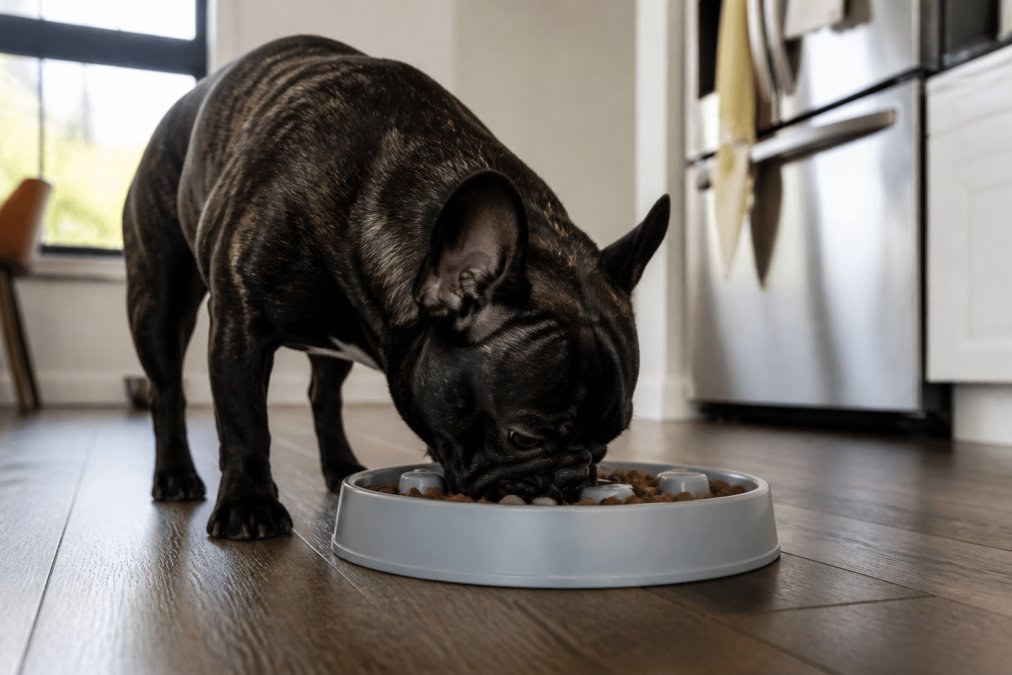
Shallow Design and Muzzle Clearance
Shallow design is non-negotiable for brachycephalic breeds. A bowl deeper than roughly the length of your dog's muzzle forces the dog to angle its head down and press its face into the base, restricting air intake and encouraging gulping.
Breed-by-Breed Sizing Matrix
"Flat-faced" is a category, not a measurement. A Pug and a Boston Terrier have different muzzle lengths and chest widths, and a bowl that fits one can be too deep or narrow for the other. Use the table below as a starting point, then confirm with the muzzle-length test above.
| Breed | Typical muzzle length (nose to eye line) | Recommended interior depth | Recommended bowl width | Notes |
|---|---|---|---|---|
| Pug | Short, often under 1 inch of usable clearance | 1 inch or less | 8-10 inches across | Deep chest folds; wide rim prevents face-pressing |
| French Bulldog | Short, roughly 1 inch | 1-1.5 inches | 9-11 inches across | Broad chest; needs a stable, low-profile base |
| Boston Terrier | Slightly longer than Pug or Frenchie | 1.5-2 inches | 8-10 inches across | Can often handle a shallow maze pattern |
| Shih Tzu | Longer muzzle than the others, but still compressed | 2 inches or less | 7-9 inches across | Long coat can drag in food; a raised rim helps |
Ergonomic Tilt and Non-Slip Bases
An ergonomic tilt raises the food toward the dog's mouth instead of making the dog reach down. For flat-faced breeds, that angle reduces how far the neck bends and keeps the airway more open during eating.
Material and Rim Shape
Food-grade, BPA-free plastic and stainless steel are the most common choices. Stainless steel resists scratches and odors but can be noisy on hard floors; food-grade plastic is quieter and lighter but should be replaced if deep scratches trap residue. Silicone is gentlest on a flat-faced dog's mouth but needs frequent inspection for cracks.
How to Stop Dog Eating Too Fast: Feeding Strategies That Work
The most effective way to stop dog eating too fast is to make the food physically harder to reach in large mouthfuls. Slow feeders spread food across ridges and compartments so each bite takes effort; pair that with a few habit changes and most fast eaters slow down within a week.
Start with these steps:
- Split the daily ration into three or four smaller meals instead of one or two
- Use a shallow slow feeder or puzzle toy for at least one meal per day
- Scatter part of the kibble on a snuffle mat or towel for foraging
- Avoid free-feeding, which lets a fast eater graze and gulp unpredictably
- Stay nearby during the first few sessions so you can adjust difficulty
Benefits of Interactive Dog Feeding for Brachycephalic Breeds
Interactive feeding turns a two-minute meal into several minutes of problem-solving, delivering benefits beyond digestion. Dogs that work for food show more focus and less boredom-driven behavior between meals.
- Slower eating pace, which reduces swallowed air
- Mental stimulation that tires a dog out in a healthy way
- Reduced anxiety for rescue dogs who pace or whine around mealtime
- Mealtime enrichment that breaks up a long day alone
Preventing Bloat in Flat-Faced Breeds: What Every Owner Should Know
Preventing bloat in flat-faced breeds starts with eating speed, because fast eating is linked to gastric torsion, a life-threatening twisting of the stomach. Brachycephalic dogs already carry higher airway risk, so reducing swallowed air at mealtime is worth the effort.
Bloat prevention comes down to a few consistent habits:
- Feed smaller meals more often rather than one large meal
- Use a slow feeder to pace each meal
- Keep vigorous exercise away from the hour before and after eating
- Watch for retching without vomiting, a swollen abdomen, or restlessness
Cleaning, Materials, and Everyday Maintenance
Cleaning is where most slow feeders lose their appeal. Deep channels and narrow grooves trap kibble dust and saliva, and if a bowl takes ten minutes to scrub, owners stop using it, a design failure, not a discipline problem. The real question is which designs are actually cleanable, and how to tell before you buy.
Why Maze Patterns Are the Hardest to Clean
A slow feeder with tall ridges and tight channels slows eating effectively, but those channels hide residue. Kibble dust mixes with saliva and hardens in corners a sponge cannot reach, becoming a bacterial reservoir and odor source even if the bowl looks clean from above.
Best-for-Easy-Cleaning Design Checklist
When comparing slow feeders, use these criteria to predict how easy each one will be to maintain:
- Open troughs over closed channels. If you cannot see the bottom of every compartment from above, residue will hide there.
- No dead-end corners narrower than a sponge. A channel should be wide enough to wipe with a finger or a standard sponge.
- Removable or separable parts. A bowl that comes apart cleans far better than a single molded piece with internal cavities.
- Dishwasher-safe labeling. Check the manufacturer's instructions; not all food-grade plastics survive a heated dry cycle.
- Smooth interior surfaces. Textured or matte interiors trap more residue than glossy ones.
Material Trade-Offs for Maintenance
| Material | Cleaning ease | Durability | Best for |
|---|---|---|---|
| Stainless steel | High, non-porous, resists odors | High | Owners who want the lowest-maintenance option |
| Food-grade plastic (BPA-free) | Moderate, can scratch over time | Moderate | Lightweight, quiet bowls for tile floors |
| Silicone | Moderate, flexible but can hold odors | Lower, check for cracks | Gentle mouths, snuffle-style feeders |
Stainless steel and food-grade plastic both hold up well; silicone is gentler on a flat-faced dog's mouth but needs more frequent inspection. Any piece that develops a split, crack, or loose part should be replaced rather than repaired, because those openings trap food and are hard to dry.
A Realistic Cleaning Routine
- Rinse after every meal to stop residue from hardening.
- Wash with warm water and mild soap at least weekly, or more often if the bowl has deep channels.
- Use a small bottle brush for any channel narrower than a sponge.
- Check textured surfaces and seams for trapped food and wear.
- Dry fully before refilling; trapped moisture encourages odor and bacterial growth.
Conclusion
Flat-faced dogs need a feeder built around a short muzzle, not a standard bowl with taller ridges. Getting the depth, tilt, and material right turns mealtime from a struggle into something your dog can enjoy. At Chewzzle, our slow feeders and puzzle toys pace eating, support digestion, and keep flat-faced breeds engaged. Explore the Chewzzle slow feeder range and find the design that matches your dog's muzzle and eating style.
Frequently Asked Questions
Why do flat-faced dogs need special slow feeder bowls?
Flat-faced dogs have shortened snouts and narrow airways, which makes it hard for them to reach food at the bottom of a deep bowl. When they try, they swallow air along with their kibble. That trapped air causes regurgitation and adds pressure to an already sensitive digestive system. A shallow, wide-rimmed slow feeder dog bowl lets them eat without pressing their face into a narrow space, slowing their pace and reducing air intake.
Are puzzle feeders safe for dogs with short snouts?
Yes, as long as the design accounts for muzzle clearance. Look for feeders with shallow troughs, wide-rim covers, and no deep wells that force your dog to jam their face into a tight space. Sliding puzzles like the Chewzzle ThinkDisc ($19.99) or PuzzleFeast ($49.99) work well because the food sits close to the surface. Supervise the first few sessions so you can see whether your dog reaches the food comfortably.
How can I prevent my flat-faced dog from swallowing too much air while eating?
The biggest fix is slowing the meal down. A dog that inhales food in under a minute takes in a large volume of air with every gulp. Use a slow feeder dog bowl with a shallow, maze-like pattern that forces your dog to work for each piece. Split meals into two or three smaller servings. You can also scatter kibble on a snuffle mat or use a foraging ball like the Chewzzle SnuffleSphere ($29.99) to spread eating across several minutes.
What are the signs of bloat in flat-faced dog breeds?
Watch for a distended, tight abdomen, unproductive retching, pacing, drooling, and restlessness. Flat-faced breeds face higher risk because their anatomy already makes breathing and digestion harder. Bloat and gastric torsion progress quickly and are emergencies. If you see these signs, go to a veterinarian immediately. Preventing bloat in flat-faced breeds starts with slower meals, smaller portions, and avoiding strenuous exercise right after eating.
What are the best materials for dog bowls for brachycephalic breeds?
Food-grade, BPA-free plastic and natural rubber are the most common safe choices. Both are lightweight, easy to rinse, and gentle on a short snout. Stainless steel works for flat bowls but rarely appears in puzzle-style feeders because it is harder to mold into shallow channels. Check that the feeder is labeled non-toxic and dishwasher safe if you want quick cleanup. The Chewzzle line uses BPA-free plastic and natural rubber across its slow feeders.