

Best Dog Enrichment Tools 2026: Top Picks & Guide
Table of Contents
- Why Dog Enrichment Tools Matter in 2026
- Quick Comparison: Best Dog Enrichment Tools
- Interactive Dog Toys for Mental Stimulation
- How to Use Puzzle Feeders for Dogs
- Mental Stimulation Games for Puppies
- Enrichment for Senior Dogs and Anxious Rescues
- Safety, Materials, and Eco-Friendly Choices
- Conclusion
- Frequently Asked Questions
Last Updated: September 10, 2026
Why Dog Enrichment Tools Matter in 2026
Dog enrichment tools are interactive toys and feeders designed to engage a dog's brain through problem-solving, foraging, and scent work rather than simple play alone. A tired dog isn't always a satisfied dog. Physical exercise burns energy, but mental stimulation builds focus, reduces boredom-based destruction, and supports long-term behavioral health.
The core problem is simple: a bowl of kibble disappears in seconds, leaving a dog's mind unoccupied for the rest of the day. Puzzle feeders, snuffle mats, and treat-dispensing balls turn that same meal into ten or fifteen minutes of genuine cognitive work. Many behavior-focused veterinarians note that this kind of mental fatigue can help settle a restless dog.
Below, we break down the best dog enrichment tools for 2026 by category, with real prices, honest trade-offs, and practical guidance for puppies, seniors, and anxious rescues.
Quick Comparison: Best Dog Enrichment Tools
Here's how Chewzzle's lineup stacks up across price and purpose so you can match a tool to your dog's specific need.
| Tool | Price | Best For | Key Feature |
|---|---|---|---|
| SmartPaws Interactive Puzzle | $39.99 | Puppies, training | Scalable difficulty levels |
| ThinkDisc Puzzle Feeder | $19.99 | Fast eaters | Sliding covers, turning wheel |
| PuzzleFeast Sliding Puzzle | $49.99 | Bored indoor dogs | One-treat-at-a-time pacing |
| SnuffleSphere Foraging Ball | $29.99 | Anxious dogs | Mimics natural foraging |
| MindMaze IQ Puzzle | $29.99 | Smart, persistent dogs | Adjustable treat placement |
| TreatDrop Ball | $14.99 | Gentle chewers | Textured dental silicone |
| RollFeast Treat Ball | $9.99 | Small/medium dogs | Roll-to-dispense slow feeder |
| ChewClean Treat Ball | $9.99 | Aggressive chewers | Natural rubber, dental grooves |
| SmartBounce Rolling Ball | $19.99 | Independent play | USB-rechargeable motion |
| Smart Ball Launcher | $74.99 | High-energy fetch dogs | Three adjustable distances |
Interactive Dog Toys for Mental Stimulation
The best interactive dog toys for mental stimulation force a dog to think, not just chase. That distinction matters: a ball that rolls on its own provides physical exercise, while a puzzle that hides food requires problem-solving, which is what actually builds cognitive enrichment. A useful way to sort the category is by the mechanism a dog has to defeat, because the mechanism, not the price, determines how long the toy stays interesting.

The four mechanisms you'll see in 2026
- Sliding and lifting puzzles. The dog paws a cover aside or lifts a flap to expose food. Easiest to teach, best for puppies and first-timers.
- Latching and lever puzzles. The dog must press, pull, or rotate a mechanism in a specific direction. Harder, and the one most likely to frustrate a dog who hasn't done sliding puzzles first.
- Rolling and tumbling dispensers. The dog pushes the toy and kibble falls through internal baffles. Physical and mental at once, but the noise of a hard plastic ball on hardwood can be a dealbreaker for sound-sensitive dogs.
- Electronic and motion toys. A rechargeable motor moves the toy on its own. Great for independent play, but the whirring motor and unpredictable movement raise arousal rather than lower it, the opposite of what an anxious dog needs.
A common mistake is buying one toy and expecting it to work forever. Dogs habituate fast. Rotating three or four tools through the week keeps each one novel, and that novelty is where the enrichment lives. A simple rotation schedule: two puzzle feeders, one snuffle-style forager, and one chew or tug item in play at a time, swapped every three to four days.
Puzzle Feeders and Slow Feeders
Puzzle feeders and slow feeders are the workhorses of any enrichment routine. They combine mealtime with mental work, which is efficient for busy owners and genuinely satisfying for dogs.
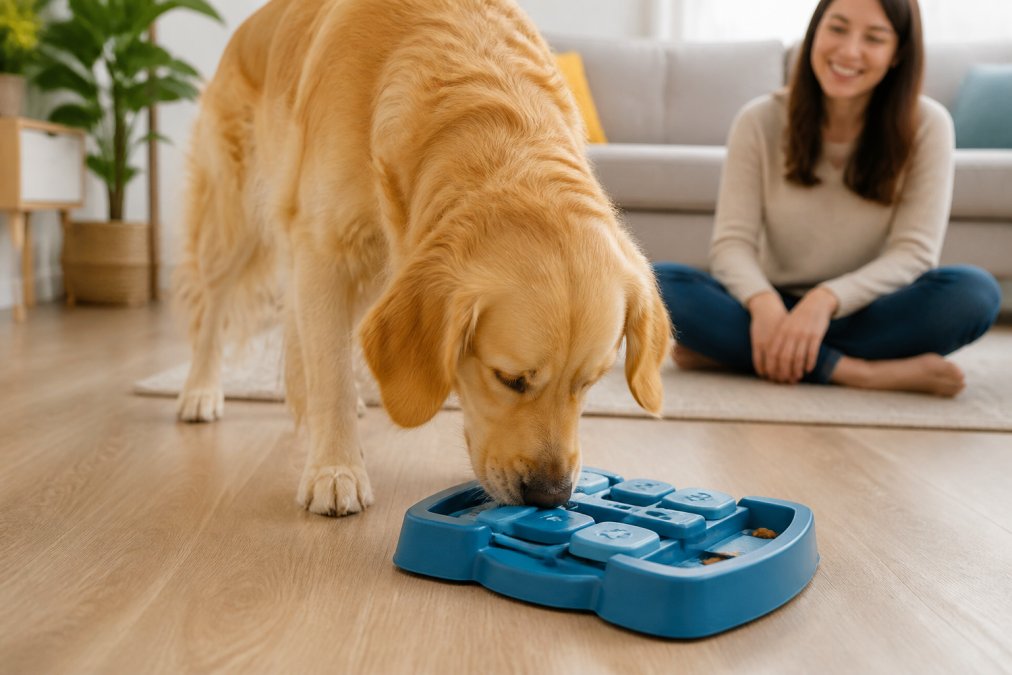
The Chewzzle ThinkDisc Puzzle Feeder ($19.99) hides kibble under sliding paw-shaped covers and a turning center wheel, so a bowl that used to vanish in seconds takes several minutes. For dogs who clear a bowl instantly, the Chewzzle PuzzleFeast Sliding Puzzle ($49.99) reveals only one treat at a time, pacing a full meal across a longer session. The Chewzzle MindMaze IQ Puzzle ($29.99) sits between them: adjustable treat placement lets you start easy and tighten the challenge as the dog improves, which is the single most useful feature to look for if you only want to buy one puzzle.

Treat-Dispensing Balls and Chew Toys
Treat-dispensing balls add motion to the equation. The dog rolls, nudges, and paws until kibble falls out, which taps into natural foraging behavior.
The Chewzzle RollFeast Treat Ball ($9.99) is a solid entry point for small and medium dogs, while the Chewzzle ChewClean Treat Ball ($9.99) is built from natural rubber with textured grooves that massage gums during play. For dogs who destroy softer toys, that natural rubber construction is the difference between a toy that lasts months and one that lasts an afternoon.
A gap most guides skip: silent enrichment for sound-sensitive dogs
Most "interactive" toys are loud. Hard plastic puzzle pieces clatter, treat balls thump across hardwood, and electronic toys hum. For a dog with noise sensitivity, common in senior dogs, rescues, and herding breeds, that noise can turn enrichment into a stressor. The fix is to favor tools that make almost no sound:
- Snuffle mats and foraging balls (like the Chewzzle SnuffleSphere, $29.99), fabric-on-floor, essentially silent.
- Silicone or rubber licking mats, no moving parts, no clatter.
- Cardboard-and-towel DIY puzzles, free, quiet, and disposable.
- Frozen stuffed rubber toys, the licking itself is a calming behavior, and there's no rattle.
Run these on a rug or carpet rather than bare hardwood to further dampen any sound. If your dog startles at the first clatter of a plastic puzzle, don't push through it, switch to a silent format for a few weeks, then reintroduce the puzzle on a soft surface.
How to Use Puzzle Feeders for Dogs
Using a puzzle feeder correctly takes about five minutes of setup and a little patience on the first session. The goal is a dog who solves the puzzle confidently, not one who gives up and walks away frustrated.
- Start with the puzzle partly open so your dog can see and smell the food
- Place a few high-value treats in the easiest compartment
- Let your dog investigate without your hands guiding the toy
- Praise the first success, then let them work the rest out alone
- Increase difficulty only after your dog solves the current setup reliably
- Switch to a different tool every few days to keep the challenge fresh
- Clean the feeder after each use with warm water and mild soap
Expected result: Most food-motivated dogs solve the first compartment within a few minutes. If your dog ignores it entirely, try a stronger-smelling treat before assuming puzzles aren't for them.
Mental Stimulation Games for Puppies
Mental stimulation games for puppies should be short, easy to win, and tied to positive reinforcement. A puppy's attention span is measured in minutes, and a puzzle that's too hard teaches frustration instead of focus.
The Chewzzle SmartPaws Interactive Puzzle ($39.99) is designed with scalable difficulty, which suits a puppy. For scent-based work, the Chewzzle SnuffleSphere Foraging Ball ($29.99) lets a puppy nose through soft fleece to find hidden kibble, mimicking the instinct to search and explore.

Keep sessions to five or ten minutes. End on a success. This is where enrichment and training schedules overlap: a puzzle session right before a training block leaves a puppy calm and focused rather than wired.
Enrichment for Senior Dogs and Anxious Rescues
Senior dogs and anxious rescues need enrichment that works without demanding mobility or confidence they may not have. This is the category most guides skip, and it's where the right tool makes the biggest difference.
For a senior dog with arthritis or limited mobility, a stationary puzzle like the ThinkDisc or PuzzleFeast works well because it requires no jumping, running, or fast turns. Place it on a non-slip mat at floor level and let the dog work at their own pace.
Anxious rescues often respond to scent work before they respond to interactive play. The SnuffleSphere's foraging format gives a nervous dog a low-pressure job: sniff, dig, find food. There's no eye contact, no performance, and no sudden noise. Many owners of rescue dogs find this calms their dog.
Safety, Materials, and Eco-Friendly Choices
Safety and materials should drive your buying decision more than novelty. A dog chews for hours, so what the toy is made from matters as much as how it's shaped.
What to actually look for on the label
- Natural rubber, the gold standard for chew toys. It's elastic, doesn't shatter into sharp shards, and holds up to repeated compression. Look for "100% natural rubber" or "natural rubber" rather than "rubber blend."
- Food-grade silicone, appropriate for lick mats and some treat dispensers. Soft, heat-resistant, and dishwasher-safe on the top rack.
- BPA-free, phthalate-free, and lead-free plastics, the minimum bar for any puzzle feeder a dog will mouth. "BPA-free" alone is not enough; phthalates and lead are the other two to check for.
- Avoid: cheap PVC and unspecified TPR blends. PVC can contain plasticizers that leach with repeated chewing, and unbranded TPR is inconsistent batch to batch.
Chewzzle's puzzle line uses non-toxic, chemical-free plastic and natural rubber depending on the tool, and each product page states the material plainly. If a product page doesn't tell you what the toy is made of, that's a signal to keep looking.
Match the toy to chew intensity, not just dog size
Size-appropriate means both physical size and durability rating. A small dog with a powerful jaw can wreck a toy rated for medium chewers. A practical three-tier framework:
- Gentle chewers, silicone, soft rubber, fabric snuffle mats. These dogs rarely destroy toys and can use almost anything.
- Moderate chewers, natural rubber with some thickness, reinforced seams. Replace at the first sign of cracking.
- Power chewers, solid natural rubber only, no fabric, no thin plastic, no squeakers. If a toy has a squeaker, a power chewer will find it in an afternoon.
A weekly inspection routine that takes 60 seconds
- Squeeze the toy, if it flexes unevenly or you feel a hard internal edge, retire it.
- Run a finger along every seam, exposed stitching or split rubber is a choking hazard.
- Check for missing pieces, a puzzle feeder that's lost a cover or a treat ball with a cracked baffle is done.
- Rinse puzzle feeders after every meal to prevent bacteria growth; most are top-rack dishwasher safe, but check the product page first.
- Replace any toy with exposed seams or torn rubber.
The eco-friendly angle most guides ignore
The most sustainable enrichment tool is the one you don't have to replace. Natural rubber and durable construction reduce how often you buy, which beats any "green" marketing claim on a toy that falls apart in a month. Three concrete things to weigh:
- Lifespan over labeling. A natural rubber chew toy that lasts two years has a far lower environmental cost than three "biodegradable" toys that each last eight months.
- Material end-of-life. Silicone is recyclable in some municipal programs but not all, check locally.
- Packaging.
Conclusion
The hardest part of enrichment isn't finding a tool. It's building a routine that keeps your dog mentally engaged week after week, especially when your schedule is already full. Chewzzle makes that easier with interactive puzzle toys and slow feeders built from durable, non-toxic materials, including the SmartPaws Interactive Puzzle for training, the ThinkDisc Puzzle Feeder for fast eaters, and the SnuffleSphere Foraging Ball for anxious dogs who need a calm, scent-based outlet. Start with one tool that matches your dog's current behavior, then add variety as they master it. Add to cart and turn mealtime into the enrichment your dog actually needs.
Frequently Asked Questions
What are the best mental stimulation toys for dogs in 2026?
The best mental stimulation toys include puzzle feeders, snuffle mats, treat-dispensing balls, and interactive chew toys. Look for durable, non-toxic materials and adjustable difficulty. Chewzzle offers options like the SmartPaws Interactive Puzzle and MindMaze IQ Puzzle, both designed to challenge problem-solving skills and reduce boredom-related behaviors.
How much mental stimulation does a dog need daily?
Dogs benefit from focused mental stimulation each day. Short sessions with puzzle feeders or training games can be as tiring as a long walk. Rotate toys to keep the challenge fresh and prevent boredom. Always supervise initial use and adjust difficulty to your dog's skill level.
Are puzzle feeders safe for all dog breeds?
Puzzle feeders are safe for most dogs when sized appropriately and used under supervision. Avoid leaving plastic puzzles with aggressive chewers who may destroy and ingest pieces. For seniors or dogs with mobility issues, choose shallow feeders with easy access. Always check for wear and replace damaged toys. Consult your veterinarian if your dog has special dietary needs.
What is the difference between a chew toy and an enrichment tool?
A chew toy satisfies the urge to gnaw and can help with dental health, while an enrichment tool engages the brain through problem-solving, foraging, or scent work. Many toys combine both functions. For example, the Chewzzle TreatDrop Ball dispenses treats as your dog chews, providing mental and physical engagement. Both types support canine welfare but serve different primary purposes.
How do enrichment tools help with dog anxiety?
Enrichment tools redirect anxious energy into positive, focused activities. Licking, sniffing, and problem-solving release calming endorphins. For rescue dogs with separation anxiety, puzzle feeders can create a positive association with alone time. Start with easy puzzles and gradually increase difficulty. Combine with a consistent routine and consult a behaviorist for severe cases.