
Buy Interactive Slow Feeder Online: 2026 Review
Table of Contents
- Quick Comparison: Chewzzle Interactive Slow Feeders at a Glance
- How to Stop Dog Eating Too Fast With the Right Feeder
- Benefits of Puzzle Feeders for Dogs
- Chewzzle Interactive Slow Feeders Reviewed
- How to Introduce a Slow Feeder to a Puppy
- Choosing the Right Size, Material, and Design
- Cleaning and Maintenance: Dishwasher-Safe Care That Lasts
- Which Chewzzle Feeder Should You Add to Cart?
- Frequently Asked Questions
Last Updated: September 12, 2026
Quick Comparison: Chewzzle Interactive Slow Feeders at a Glance
Chewzzle makes seven interactive slow feeders from $9.99 to $49.99. Each paces food differently, so the right pick depends on whether your dog gulps, gets bored, or needs a challenge.
| Feeder | Price | Best For | Difficulty |
|---|---|---|---|
| RollFeast Treat Ball | $9.99 | Beginners, puppies | Easy |
| TreatDrop Ball | $14.99 | Chewers, dental care | Easy |
| ThinkDisc Puzzle Feeder | $19.99 | Fast eaters, cats too | Moderate |
| SnuffleSphere Foraging Ball | $29.99 | Anxious dogs, snuffling | Easy |
| MindMaze IQ Puzzle | $29.99 | Adjustable challenge | Moderate |
| SmartPaws Interactive Puzzle | $39.99 | Training, destructive chewers | Moderate |
| PuzzleFeast Sliding Puzzle | $49.99 | Whole meals, one treat at a time | Advanced |
How to Stop Dog Eating Too Fast With the Right Feeder
The most effective way to stop a dog eating too fast is to make food physically harder to reach. A slow feeder that forces sniffing, nudging, or rolling stretches a meal from seconds into minutes.

Why Gulping Matters for Digestion and Bloating
Gulping swallows air along with food. That air contributes to bloating and, in deep-chested breeds, can factor into gastric dilatation-volvulus, a life-threatening emergency.
Slower eating means less air intake, steadier digestion, and a dog who actually registers that a meal happened. The American Kennel Club's guidance on canine bloat outlines the symptoms worth watching for.
Benefits of Puzzle Feeders for Dogs
Puzzle feeders do more than slow eating: they convert a passive routine into active problem-solving, which is why behaviorists group them under enrichment. A slow feeder changes the bowl's geometry; a puzzle feeder adds a decision.
Mental Stimulation, Boredom Relief, and Calmer Mealtimes
Foraging is hardwired in dogs. A puzzle feeder taps that instinct, and owners of high-energy breeds often find a ten-minute puzzle session settles a dog better than a longer walk, because problem-solving burns mental energy the way running burns physical energy.
- Boredom relief: a task replaces pacing, whining, or destructive chewing
- Focus: sniffing and problem-solving engage the same olfactory and cognitive systems dogs use to hunt
- Calmer mealtimes: eating becomes a project instead of a race
- Separation anxiety support: a food puzzle gives a dog something to do while alone
That last point matters for rescue dogs: a dog with something to work at is not rehearsing anxiety. Trainers report the first ten minutes after an owner leaves are the hardest, and a frozen or loaded puzzle placed before departure gives the dog a competing behavior during that window.
The Mechanism: Why Foraging Beats a Plain Bowl
A plain bowl delivers food in seconds with almost no effort. A puzzle feeder stretches the same calories across sniffing, licking, nudging, and decision-making. Licking and sniffing are self-soothing, which is why a snuffle-style feeder settles an anxious dog faster than a sliding puzzle that demands frustration tolerance. Match the feeder to the dog's coping level, not the hardest puzzle on the shelf.

Transitioning a Picky Eater Without Frustration
Most guides assume a food-motivated dog. Picky eaters are the opposite problem: difficulty must be reduced until eating is easy again, and the sequence matters more than the product.
- Start with the shallowest trough. Put the full portion in the easiest compartment and leave every cover open.
- Pair the feeder with a high-value food. A few pieces of a favorite treat on top of normal kibble gives a fast first win.
- Sit nearby for the first sessions. Your presence lowers arousal and signals that the feeder is safe.
- Cap the attempt at a few minutes. If your dog ignores the feeder, put the food back in the regular bowl and end the session without drama.
- Retry the next day at an easier setting. Never let a puzzle become a standoff over a meal your dog needs.
Picky eaters often accept a snuffle-style feeder before a sliding puzzle, because rooting through fabric requires no fine motor skill and no failure state. Once your dog eats reliably from the easy setup for several days, increase difficulty one step at a time. If poor appetite has a medical cause, work with your veterinarian first.
A Note on Health Claims
Slow feeders are widely recommended for fast eaters, but the evidence base is thinner than marketing suggests. Veterinary guidance on bloat focuses on multiple risk factors, and a slow feeder is one management tool rather than guaranteed prevention. For a deep-chested breed or a dog with gastric issues, treat it as a supplement to veterinary advice, not a replacement.
Chewzzle Interactive Slow Feeders Reviewed
Every Chewzzle feeder uses pet-safe materials and mimics natural foraging, but they are not interchangeable. Here is how the seven models differ.
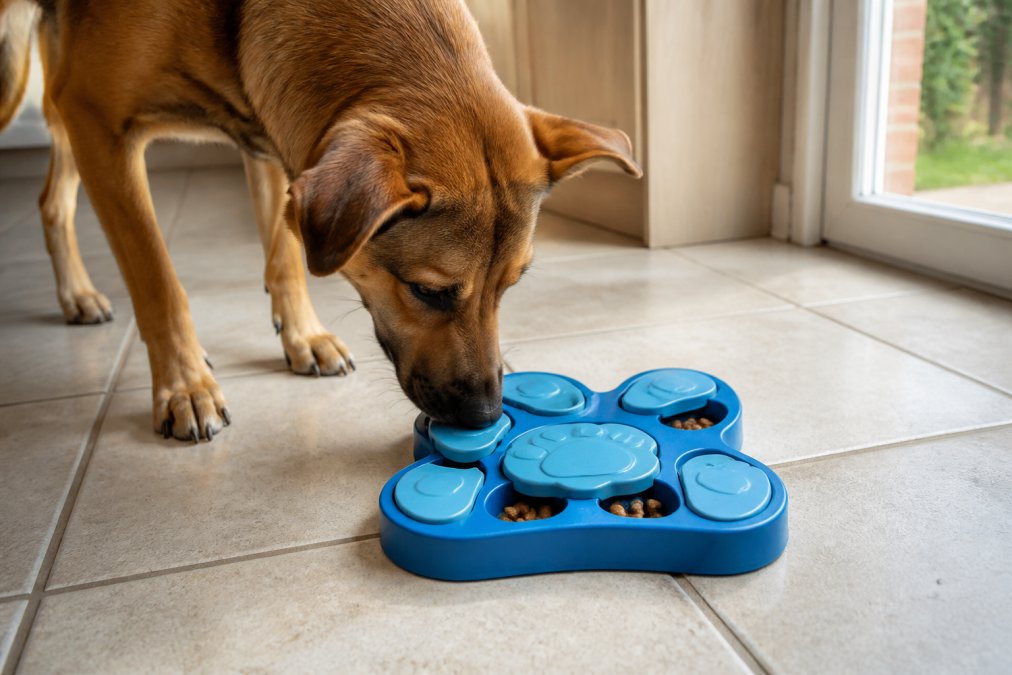
Chewzzle ThinkDisc Puzzle Feeder ($19.99)
The ThinkDisc is the best all-round starter for a fast eater. Kibble goes into recessed compartments hidden by sliding paw-shaped covers and a turning center wheel, so a bowlful that disappeared in seconds takes several minutes. The rubberized base keeps it planted on tile and hardwood. Sized for small and medium dogs, and it works for a curious cat too.
Chewzzle PuzzleFeast Sliding Puzzle ($49.99)
Buy this one if you want a full meal paced out. Each button slides aside to reveal a single treat, so your dog works across the board one reward at a time. Load it with normal kibble and the same food becomes several minutes of thinking. It suits all sizes, but not dogs who chew plastic rather than solve it.
Chewzzle RollFeast Treat Ball ($9.99)
The cheapest entry point, and a good test of whether your dog engages with puzzles at all. It dispenses kibble as your dog rolls or nudges it, pacing delivery during play. Compatible with most dry kibble and treats up to roughly 1.5 by 2.3 centimeters. Best for small and medium dogs, including puppies.
Chewzzle TreatDrop Ball ($14.99)
A textured silicone ball that leaks treats as your dog plays, with a chew-and-clean surface that helps reduce plaque. Built for gentle to moderate chewers, so a determined destroyer needs the SmartPaws instead. Easy to rinse, and a solid pick for daily indoor enrichment.
Chewzzle SnuffleSphere Foraging Ball ($29.99)
Soft fleece and non-toxic TPR make this the gentlest option here. Dogs sniff and root hidden treats out of the folds, which mimics foraging and settles anxious dogs. Lightweight and portable, it travels well and works in a crate. Not a chew toy, and not for dogs who shred fabric.
Chewzzle SmartPaws Interactive Puzzle ($39.99)
Built for the dog who destroys everything else. Durable, non-toxic plastic, scalable difficulty, and a format that redirects chewing and excess energy into problem-solving. Choose it for obedience training and for dogs who need their brain tired out, not just their legs.
Chewzzle MindMaze IQ Puzzle ($29.99)
The MindMaze earns its keep through adjustable difficulty: vary where treats sit and the challenge stays fresh as your dog gets faster. Non-toxic, BPA-free plastic, suitable for all sizes, and simple to clean. Good for clever dogs who solve a fixed puzzle once and lose interest.
How to Introduce a Slow Feeder to a Puppy
Start with the easiest setting and make success almost guaranteed. A puppy who fails on the first attempt may walk away from the feeder entirely, which is hard to undo.
- Begin partly open. Leave covers ajar so your puppy can see and smell the food.
- Use high-value food. A portion of normal kibble works, but a few treats on top speed up the first win.
- Supervise the first sessions. Watch for chewing on plastic rather than solving.
- Keep sessions short. Five to ten minutes is plenty for a young puppy.
- Increase difficulty gradually. Close covers, then rotate placements.
Most food-motivated dogs work out the first cover within minutes.
Transitioning a Picky Eater Without Frustration
Choosing the Right Size, Material, and Design
Size and material matter more than the number of compartments. A feeder your dog cannot comfortably reach goes unused, and a material that fails under daily chewing becomes a hazard.
Sizing: Match the Feeder to the Dog, Not the Bowl
Measure your dog's muzzle width and the distance from nose tip to jaw base. A feeder is correctly sized when your dog can reach every compartment without pressing the muzzle flat against the base. As a working rule:
- Small dogs and cats (under about 20 lb): feeders roughly 8 to 10 inches across with shallow compartments
- Medium dogs (about 20 to 50 lb): feeders roughly 10 to 12 inches across with moderate depth
- Large dogs (over about 50 lb): feeders roughly 12 inches and up, or a ball-style feeder that rolls freely
A feeder that is too small forces the dog to pinch the muzzle, slowing eating for the wrong reason and causing frustration. One that is too large lets a big dog swallow whole compartments without solving anything. Between sizes, size up for a fast eater and down for a picky eater.
Food-Safe Materials, BPA-Free Plastic, and Silicone
The Chewzzle range uses pet-safe plastic, BPA-free plastic, textured silicone, and non-toxic TPR depending on the model. Each material has a trade-off:
- Rigid food-safe plastic: best for puzzle boards and sliding tracks; holds shape, cleans easily, but can crack under a determined chewer
- Silicone: best for chew-friendly balls and lick mats; flexible, freezer-safe, but can retain odors if not washed promptly
- TPR (thermoplastic rubber): best for foraging toys that need to flex; softer than plastic, not a chew toy
- Fleece and fabric: best for snuffle-style feeders; gentle on the nose, but not for dogs who shred fabric
Check that a product is described as food-safe and BPA-free before you buy, and treat "non-toxic" as a claim worth verifying. Look for a manufacturer that names the specific material rather than a generic phrase.
Suction Cups vs. Weighted Non-Slip Bases
Suction cups grip smooth surfaces hard but fail on grout lines and textured floors. Weighted rubberized bases, like the ThinkDisc's, stay put on tile and hardwood without a perfect seal. For most homes a weighted non-slip base is more reliable; suction works best on a smooth, sealed surface in a crate or on a glass door.
Before you commit, press the base on your actual feeding surface and try to slide it with two fingers. If it moves, your dog will move it too. Weighted bases survive better around dogs who paw at the feeder; suction cups suit dogs who lift it with the muzzle.
Design Features Worth Paying For
- Adjustable difficulty: lets the same feeder grow with your dog instead of being outgrown
- Removable or open compartments: makes deep cleaning possible without a bottle brush in every corner
- Dishwasher-safe components: saves time on weekly sanitation
- No small detachable parts: reduces choking risk for strong chewers
Cleaning and Maintenance: Dishwasher-Safe Care That Lasts
Rinse puzzle feeders after every use and wash them thoroughly at least weekly. Dried kibble residue in recessed compartments is the main reason a feeder starts to smell.
- Rinse under warm water immediately after a meal
- Use a bottle brush for sliding tracks and hidden wedges
- Wash with mild dish soap weekly, or follow the manufacturer's dishwasher guidance
- Check sliding parts for cracks, especially with heavy chewers
- Dry fully before refilling
DIY vs. Commercial Slow Feeders
DIY options are cheap and worth trying: a muffin tin with tennis balls over the cups, a snuffle box of crumpled paper, or a scatter feed on a towel all slow eating down. What they lack is durability and predictability. Commercial feeders hold up to daily use, clean more easily, and offer adjustable difficulty. A reasonable path: start with a DIY scatter feed to see whether your dog engages, then buy a commercial puzzle once the behavior is worth investing in.
Which Chewzzle Feeder Should You Add to Cart?
Match the feeder to the problem, not the price. A gulper needs the ThinkDisc or PuzzleFeast. A destructive chewer needs the SmartPaws. An anxious rescue or a puppy does best with the SnuffleSphere or RollFeast.
If unsure, the ThinkDisc at $19.99 is the safest first purchase: moderate difficulty, non-slip base, and it suits dogs and cats. For a full meal paced one treat at a time, the PuzzleFeast is worth the $49.99.
Mealtime is the one routine your dog repeats every day, making it the easiest place to add enrichment without adding time to your schedule. Chewzzle builds interactive slow feeders and puzzle toys that turn that routine into foraging, problem-solving, and calmer eating, using durable, non-toxic materials and non-slip designs that hold up to daily use. Whether you are pacing a fast eater, redirecting a destructive chewer, or helping an anxious rescue settle, there is a Chewzzle feeder sized for the job. Add to cart and give your dog a mealtime worth working for.
Frequently Asked Questions
Are interactive slow feeders worth it for dogs?
For fast eaters, yes. An interactive slow feeder paces kibble out a few pieces at a time, so a meal that vanished in seconds stretches into several minutes of sniffing and problem-solving. That longer mealtime supports digestion and reduces gulping, which is linked to bloating and choking. It also doubles as mental stimulation, which helps high-energy dogs and anxious rescues settle. If your dog already eats calmly and shows no boredom behaviors, the value is lower, but most multi-dog homes find at least one puzzle pays for itself in calmer evenings.
How do I choose the right slow feeder for my dog?
Match the feeder to your dog's size, chewing style, and food motivation. Small and medium dogs do well with the Chewzzle ThinkDisc Puzzle Feeder at $19.99, while determined chewers need sturdier plastic like the Chewzzle PuzzleFeast Sliding Puzzle at $49.99. Ball-style feeders such as the Chewzzle RollFeast Treat Ball at $9.99 suit dogs who prefer chasing to nosing. If your dog gives up easily, start with a shallow design and partly open compartments, then increase difficulty once they succeed.
Can slow feeders help prevent bloat in dogs?
They can reduce one known risk factor. Eating fast pulls in air, and swallowed air is associated with gastric dilatation-volvulus, a life-threatening emergency in deep-chested breeds. A slow feeder forces smaller bites and longer pauses, which limits how much air gets swallowed. It is not a guarantee against bloat, since genetics, breed, and meal timing also play a role. Feed two or three smaller meals instead of one large one, and avoid vigorous exercise right after eating.
What is the difference between a slow feeder bowl and a puzzle toy?
A slow feeder bowl uses ridges or maze walls to make your dog work around obstacles for every bite. A puzzle toy adds problem-solving: sliding covers, turning wheels, or rolling balls that release food only when your dog figures out the mechanism. Puzzle feeders tend to take longer and provide more enrichment, while basic bowls are simpler for dogs who get frustrated. Many owners use a bowl for everyday meals and a puzzle like the Chewzzle MindMaze IQ Puzzle for weekend enrichment sessions.
How do I clean an interactive slow feeder?
Rinse it under warm water right after each meal to stop kibble residue and saliva from hardening in the crevices. Most Chewzzle feeders are dishwasher safe on the top rack, which handles weekly deep cleaning. For sliding-button puzzles, work a soft bottle brush into the button tracks where food packs down. Skip abrasive scouring pads, since they scratch plastic and create rough edges that trap bacteria. Check the manufacturer's care note before the first wash so you do not warp a piece.