

What Happens If Dogs Don't Get Mental Stimulation?
Table of Contents
- What Happens If Dogs Do Not Get Mental Stimulation
- Signs of Boredom in Dogs to Watch For
- Boredom vs. Anxiety, Pain, or a Behavior Problem
- How Much Mental Stimulation Does a Dog Need?
- Dog Mental Stimulation Ideas That Fit Real Life
- Dog Puzzle Toys for Boredom: What to Look For
- Risks of Too Much or Unsuitable Enrichment
- Conclusion
- Frequently Asked Questions
Last Updated: October 17, 2026
What Happens If Dogs Do Not Get Mental Stimulation
A dog without enough mental stimulation doesn't just get bored. That boredom turns into a job. Your dog will find work, and the work it finds is rarely the work you want.
Owners often describe the same pattern: the trash is spread across the kitchen floor, the couch cushion has a new hole, or the barking starts at 6 p.m. and doesn't stop. They blame the dog.
Dog mental stimulation is the mental work a dog's brain needs to stay settled: sniffing, solving, learning, and searching. It is not the same as a walk.
So what happens if dogs do not get mental stimulation? Short version: unwanted behaviors appear, stress builds, and your dog's quality of life drops.
Signs of Boredom in Dogs to Watch For
The classic signs of boredom in dogs are destructive behavior, excessive barking, digging, chewing, pacing, and restlessness. These are not personality flaws. They are signals that your dog has energy and nowhere to put it.
Watch for these patterns:
- Chewing on furniture, shoes, or baseboards, especially when alone
- Digging in the yard or at the sofa cushions
- Excessive barking at nothing in particular
- Pacing between rooms or circling the same spot
- Tail-chasing that repeats for minutes at a time
- Hyperactivity that spikes in the evening
- Frustration behaviors like nipping at the leash or jumping on guests
A common mistake is treating these as training problems first. In practice, most of them shrink when the dog gets real mental work each day.
Boredom vs. Anxiety, Pain, or a Behavior Problem
Boredom looks like anxiety from the outside, and the two get confused constantly. The difference usually comes down to timing, triggers, and whether the behavior responds to an activity offer.
Here is a practical way to sort it out. Use a simple behavior log for three to five days. Note when the behavior happens, what happened right before it, who was present, and whether offering an activity changed it. Patterns usually emerge fast.
Boredom-based behavior tends to:
- Happen when your dog has nothing to do, often in the evening or when the household is quiet
- Improve within minutes when you offer a sniff game, puzzle, or training session
- Show up as destructive chewing, digging, pacing, or barking that has no obvious trigger
- Stay the same regardless of who is home or what the weather is doing
Anxiety-based behavior tends to:
- Cluster around specific triggers: you leaving, storms, fireworks, strangers, or a change in routine
- Persist even when you offer a toy or activity
- Come with other stress signals like lip licking, yawning, tucked tail, or shadowing you
- Worsen over time if the trigger repeats
Pain or medical causes can mimic restlessness in ways owners miss. A dog with arthritis may pace, pant, or struggle to settle because lying down hurts. Dental pain, gastrointestinal discomfort, and thyroid issues can all show up as irritability or night restlessness. Watch for these red flags:
- A sudden change in behavior in an adult or senior dog
- Limping, stiffness, trouble getting up, or reluctance to climb stairs
- Panting at rest, loss of appetite, or weight change
- House-training accidents in a previously reliable dog
- Excessive licking or chewing at one spot on the body
When to call a qualified behavior professional: If the behavior is intense, dangerous (biting, injuring itself, destroying doors or walls), or has not improved after two to three weeks of consistent daily enrichment and routine, ask your veterinarian for a referral to a veterinary behaviorist or a certified applied animal behaviorist. These professionals can separate true anxiety or compulsive disorders from simple under-stimulation, and they can build a plan that fits your dog.
A useful rule of thumb: boredom responds to a job. Anxiety, pain, and compulsive behavior do not. If you offer real mental work and the behavior keeps happening on its own schedule, that is your signal to look deeper.
How Much Mental Stimulation Does a Dog Need?
Most dogs need roughly 15 to 30 minutes of focused mental work per day, split into two short sessions. That is the honest answer, and it's far less than most owners expect. But the number matters less than the fit.
How much mental stimulation does a dog need depends on age, breed traits, energy level, and health. Use the ranges below as a starting point, then adjust based on how your dog settles.
- Puppies (under 6 months): 5 to 10 minutes, several times a day. Keep sessions short and upbeat. Puppies tire quickly and get cranky when overtired.
- Adolescents (6 to 18 months): 15 to 25 minutes total, split into two or three sessions. This is the age when under-stimulation most often shows up as chewing and jumping.
- Adult dogs: 15 to 30 minutes total, split in two. Most healthy adult dogs do well with one puzzle meal and one short training or sniff session.
- High-drive or working breeds: 30 to 45 minutes, mixed with physical exercise. Herding, retrieving, and terrier types often need a job, not just a walk.
- Seniors or dogs with mobility limits: 5 to 10 minutes, low-impact only. Nose work and food puzzles at floor level work well; skip anything that requires jumping or sharp turns.
How to measure progress. Watch how quickly your dog settles after a session. A dog that is genuinely mentally tired will flop down and nap within a few minutes.
Signs you are in the right range:
- Your dog settles within 5 to 10 minutes after a session
- Evening restlessness drops noticeably
- Your dog still gets excited for the next session but is not frantic
- Destructive behavior and nuisance barking decrease over one to two weeks
Signs you have gone too far:
- Your dog gets frustrated, gives up, or walks away from the puzzle
- Behavior gets worse after sessions, not better
- Your dog is overtired, nippy, or unable to settle at all
- A senior dog is stiff or sore the next day
If you are unsure where to start, pick one daily anchor: a puzzle meal in the morning and a 10-minute sniff walk or training session in the evening. That baseline is enough to see whether your dog's behavior changes, and it gives you a clear starting point to build from.
Dog Mental Stimulation Ideas That Fit Real Life
The best dog mental stimulation ideas are the ones you'll actually do on a Tuesday. Forget the elaborate setups you see online. These take minutes.
- Scatter kibble in the grass and let your dog sniff it out. Sniffing is real mental exercise.
- Hide treats around one room and release your dog to search.
- Teach one new trick per week. Learning is problem-solving.
- Swap the food bowl for a slow feeder or puzzle a few meals a week.
- Play "find it" with a favorite toy, hiding it in easy spots first.
- Take a sniff walk. Let your dog lead and stop to smell everything.
Interactive play counts too. A short tug session or a game of hide-and-seek with a family member gives your dog engagement and problem-solving at the same time.
Dog Puzzle Toys for Boredom: What to Look For
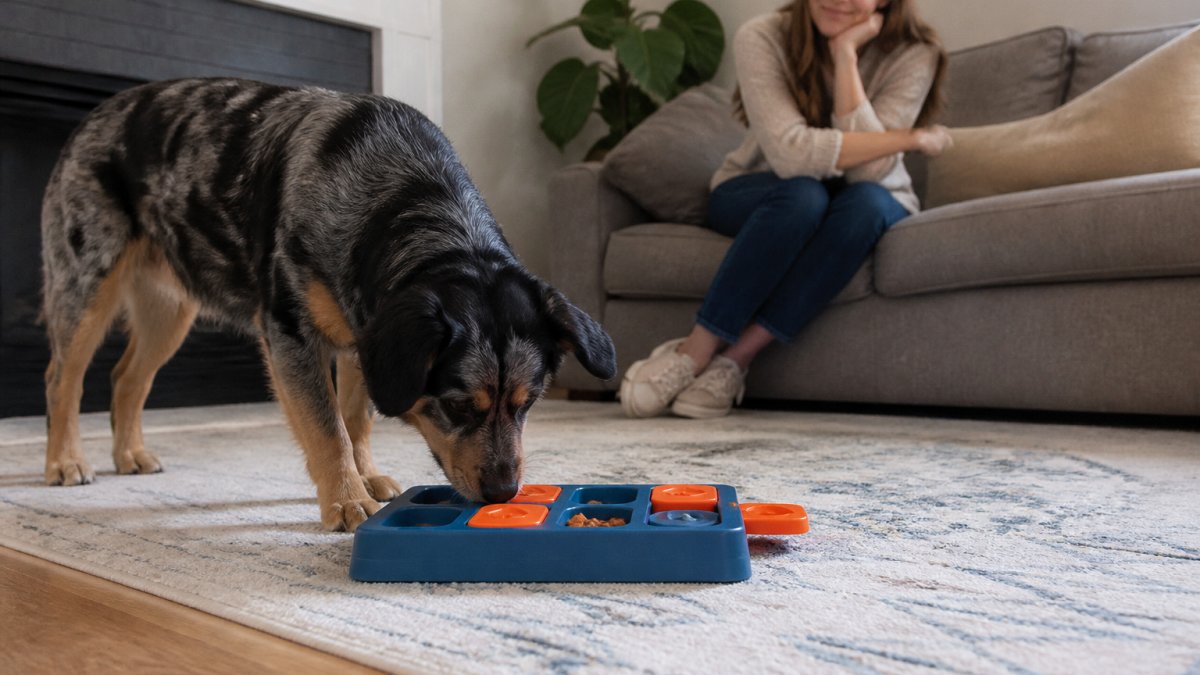
The right dog puzzle toys for boredom share three traits: adjustable difficulty, food motivation, and safe materials. Skip any one of those and the toy ends up in the bottom of the closet.
Look for these features:
- Adjustable difficulty so the challenge grows with your dog
- Non-toxic, BPA-free materials if your dog chews hard
- A non-slip base so the puzzle stays put on tile and hardwood
- Easy cleaning, because a puzzle you dread rinsing won't get used
Our Chewzzle MindMaze IQ Puzzle ($29.99) hits all four. It dispenses treats as your dog unlocks each hidden reward, and you can vary the treat placement to keep it fresh.

If your dog inhales meals in seconds, the Chewzzle PuzzleFeast Sliding Puzzle ($49.99) is built for that.
| Product | Price | Best For |
|---|---|---|
| MindMaze IQ Puzzle | $29.99 | Beginners and all dog sizes |
| SmartPaws Interactive Puzzle | $39.99 | Chew redirecting and training |
| PuzzleFeast Sliding Puzzle | $49.99 | Fast eaters who gulp meals |
| ThinkDisc Puzzle Feeder | $19.99 | Small and medium dogs, cats |
Risks of Too Much or Unsuitable Enrichment
More enrichment is not automatically better. Push too hard and you get the opposite result: a frustrated dog, a guarding habit, or a chewed-up puzzle.
The real risks are these:
- Too much difficulty leads to frustration and a dog that gives up
- Unsupervised chewing on plastic puzzles can mean swallowed pieces
- Food guarding can develop if puzzles are used around other pets
- Overtired puppies get cranky and nippy, just like toddlers
- Mobility strain happens when a stiff senior dog is pushed into floor puzzles
Match the challenge to the dog. Start easy, let your dog win, then add difficulty. And supervise the first few sessions, especially with a determined chewer.
Conclusion
The hard part isn't knowing what to do. It's fitting it into a day that's already full. Start with ten minutes of sniffing or one puzzle at mealtime, and you'll see the difference within a week.
At Chewzzle, we build puzzle toys and slow feeders that turn that ten minutes into real mental work. Our durable, non-toxic products mimic natural foraging, pace fast eaters, and give anxious or high-energy dogs a job to do. Add a puzzle to your dog's routine and watch the restlessness fade. Add to cart and give your dog something to think about.
Frequently Asked Questions
What are the signs that a dog needs more mental stimulation?
Watch for restlessness that doesn't settle after a walk, chewing furniture or shoes, digging at carpets and cushions, excessive barking, pacing, and tail-chasing. Some dogs become clingy or demand constant attention, while others get hyperactive in the evening. These signs of boredom in dogs usually appear when physical exercise is adequate but problem-solving and sniffing time are missing. If the behavior starts suddenly in an older dog, check with your vet first, since pain and illness can look similar to boredom.
Can a lack of mental stimulation make a dog destructive?
Yes. Destructive behavior is one of the most common results of under-stimulation. A dog with nothing to chew, sniff, or solve will often redirect that energy into furniture, baseboards, and shoes. Chewing is normal dog behavior, and it needs an outlet. The fix isn't punishment, it's giving the dog a job. Food puzzles, treat-dispensing toys, and scent games channel that drive into something acceptable. Most owners see less damage within a week or two of adding daily problem-solving sessions.
How much mental stimulation does a dog need each day?
Most dogs do well with 15 to 30 minutes of focused mental work per day, split into two or three short sessions. That can be a puzzle feeder at mealtime, a five-minute training session, or a sniff walk. Puppies and high-energy breeds often need closer to 30 minutes, while seniors may be satisfied with 10. The real measure is behavior: a dog who settles easily and stops the pacing and chewing is getting enough. A dog who is still restless after a full session may need more, or may need a different kind of activity.
Can puzzle toys help with dog boredom?
Yes, and they're one of the easiest fixes because they work with food your dog already gets. A sliding puzzle like the Chewzzle PuzzleFeast ($49.99) releases one treat at a time, so a meal that used to take seconds takes several minutes of sniffing and nudging. The Chewzzle ThinkDisc Puzzle Feeder ($19.99) slows fast eaters the same way, with sliding covers and a turning center wheel. Start easy so your dog gets a win, then increase difficulty. Supervise the first few sessions, especially with dogs who chew plastic rather than solve it.