

7 Steps to Choose the Right Size Dog Toy
Last Updated: November 1, 2026
Quick Summary
To choose the right dog toy size, measure the width across your dog's back molars and pick a toy wider than that gap, then confirm with the two-finger rule. Use weight and breed only as a starting range, and size up when in doubt, since a toy slightly too large is far safer than one too small.
- Small dogs under 25 pounds usually start with toys 1.5 to 2.5 inches in diameter.
- A toy that fits comfortably in your palm is often too small for a medium or large dog.
- Chew toys must be wide enough and long enough that your dog cannot work them past the molars.
- Plan a puppy toy size upgrade roughly every few months during the first year.
- Inspect every toy weekly for cracks, missing chunks, exposed squeakers, and loosened seams.
Table of Contents
- Why the Wrong Dog Toy Size Is a Real Safety Risk
- Step 1: Measure Your Dog's Mouth, Not Just Their Weight
- Step 2: Use a Dog Toy Size Guide by Weight and Breed
- Step 3: Match the Toy Category to Your Dog's Play Style
- Step 4: Pick the Right Material and Durability for Chewing Strength
- Step 5: Choose Safe Dog Toys for Heavy Chewers
- Step 6: Get Puppy Toy Size Right for Growing Mouths
- Step 7: Follow Dog Toy Safety Tips and Know When to Replace
- Frequently Asked Questions
Why the Wrong Dog Toy Size Is a Real Safety Risk
Choosing the right size dog toy is not a style preference. It is a safety decision.
Choking and swallowed toy fragments are a recognised cause of emergency veterinary visits in dogs. The toy aisle rarely warns you about this. Packaging often lists a weight range and little else.
Fit is where toy safety starts. Below, we walk through seven steps for matching toy size to your dog's mouth, body, age, and habits. Each step takes only minutes.
Step 1: Measure Your Dog's Mouth, Not Just Their Weight
Weight alone tells you very little about toy fit. A lean, long-snouted breed and a stocky, short-snouted breed can weigh the same and need very different toy dimensions.
Measure the mouth instead. Open your dog's jaws gently and look at the width across the back molars. That gap is the space a toy must not slip through.
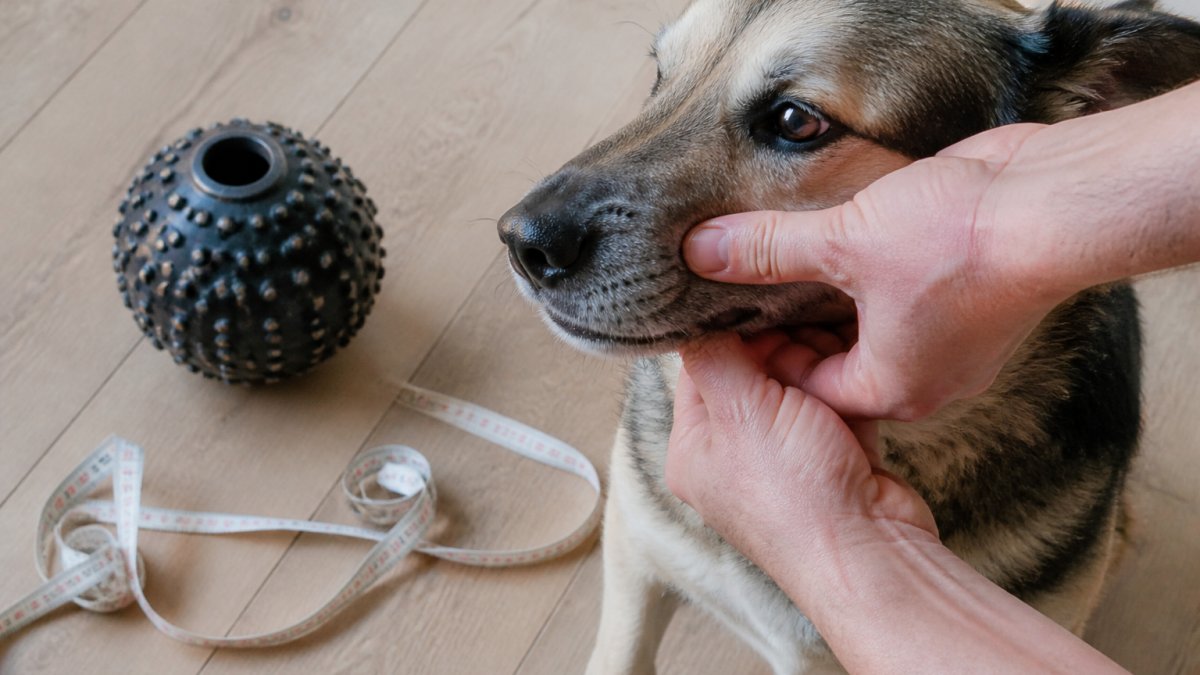
The Two-Finger Rule for Toy Diameter
Here is a quick field test. Hold the toy and place two fingers alongside it, as if the toy were in your dog's mouth.
For most adult dogs, a toy should be at least as wide as two of your fingers side by side.
Watch out: a toy that fits comfortably in your palm is often too small for a medium or large dog. Palm-sized balls are a common choking hazard.
Step 2: Use a Dog Toy Size Guide by Weight and Breed
A dog toy size guide works best when it combines weight with breed shape and a hands-on fit check. Weight gives you a starting range. Breed tells you whether to size up or down.
Small dogs under about 25 pounds usually need toys in the small range. Medium dogs between roughly 25 and 55 pounds fit most medium toys. Large dogs above 55 pounds need large or extra-large options. Breed shape adjusts that range.
Size-by-Weight Chart for Common Breeds
| Dog Size | Weight Range | Example Breeds | Toy Size to Start With |
|---|---|---|---|
| Small | Under 25 lb | Chihuahua, Dachshund, Shih Tzu | Small, 1.5-2.5 in diameter |
| Medium | 25-55 lb | Beagle, Cocker Spaniel, Border Collie | Medium, 2.5-3.5 in diameter |
| Large | 55-90 lb | Labrador, Golden Retriever, German Shepherd | Large, 3.5-5 in diameter |
| Extra Large | Over 90 lb | Great Dane, Mastiff, Rottweiler | XL, 5 in and up |
Treat this chart as a starting point, then confirm with the mouth measurement from Step 1. Two dogs at the same weight can need different toy sizes if one has a wider jaw or a stronger chew drive. A 50-pound Labrador retriever and a 50-pound Pit Bull mix may both fall in the medium row, but the Pit Bull's wider jaw often calls for the large row.
How to Fit-Test a Toy in 30 Seconds
Hold the toy at the widest point and compare it with the back-molar gap you measured in Step 1. The toy should be wider than that gap so it cannot slip past the tongue. Then try the two-finger rule: place two fingers alongside the toy as if it were in your dog's mouth.
A toy that fits comfortably in your palm is often too small for a medium or large dog. Palm-sized balls are a common choking hazard.
Step 3: Match the Toy Category to Your Dog's Play Style
Play style decides which toy category fits best, and the safe size is not the same across categories. A ball, a tug toy, a plush toy, and a chew toy are used differently, so each has its own sizing logic. Most sizing advice treats "dog toy" as one category. It is not.
Fetch Toys, Chew Toys, and Plush Toys Compared
- Fetch toys: Prioritize visibility and weight. A fetch ball must be large enough that it cannot lodge behind the tongue when carried, and light enough to carry without jaw strain. Too small means a swallowed ball; too heavy means a sore mouth. For fetch, the ball should be wider than the back-molar gap and large enough to see in grass. A common mistake is using a tennis ball for a large dog, a standard tennis ball is about 2.6 inches, which is fine for many medium dogs but too small for a 90-pound retriever that can compress it in its jaws.
- Chew toys: Prioritize density and width. The toy must be wider than the back of the mouth and long enough that the dog cannot work it past the molars. Chew toys are held between the paws or against the floor, so length matters as much as diameter. A chew that is wide enough but too short can be flipped and swallowed.
- Tug toys: Prioritize length and handle safety. A tug toy needs enough length that the dog's mouth stays on the toy and not on your hand, and the hardware, ropes, handles, knots, must be sized so it cannot be swallowed if it detaches. Tug toys are a two-player category, so the human end matters too.
- Plush toys: Prioritize supervised play only. Squeakers and stuffing are the first things to go. Plush toys are not sized for chewing; they are sized for carrying and cuddling. A plush toy that is "the right size" for a gentle dog is still a hazard for a chewer because the failure mode is internal parts, not overall dimensions.
- Puzzle and treat toys: Prioritize opening size versus kibble size. A treat ball that is correctly sized for the dog but has an opening larger than the kibble will dump food too fast, while one with an opening too small frustrates the dog. Match the opening to the treat, and the ball to the mouth.
A common mistake is buying one toy for every job. Most dogs do better with a small rotation: one fetch toy, one chew toy, one puzzle toy. Rotating also lets you inspect each toy between sessions, which is when damage is easiest to spot.
Step 4: Pick the Right Material and Durability for Chewing Strength
Material and durability must match chewing strength, or the toy fails early. A soft toy in a strong jaw tears within minutes.
Rubber suits moderate chewers and offers some give. Nylon suits determined chewers but is hard enough to wear down enamel in heavy use.
If you are weighing rubber against nylon for your dog's jaw strength, our guide to rubber vs nylon chew toys breaks down the trade-offs. And before buying anything, it helps to know how to verify a dog toy is BPA free, since "non-toxic" on packaging means little without proof.
Watch out: hard materials can chip teeth in dogs that chew with real force. If your dog has cracked a tooth before, choose a toy with some flex.
Step 5: Choose Safe Dog Toys for Heavy Chewers
Safe dog toys for heavy chewers share three traits: no small parts, no hollow chambers that collapse, and a size that cannot be swallowed even after damage.
Heavy chewers destroy toys by design. They work seams, edges, and squeakers until something gives. The toy must stay safe as it wears, not just when it is new.
For a deeper look at durable options, our guide to durable chew toys for heavy chewers covers what holds up and what fails.
Step 6: Get Puppy Toy Size Right for Growing Mouths
Puppy toy size changes fast. A toy that fits at four months will be too small by eight. Plan for a size upgrade roughly every few months during the first year.
Teething puppies need softer materials and slightly larger toys than their weight suggests.
Our buyer's guide to durable toys for teething puppies covers materials and sizing for each growth stage. Size up before you think you need to.
Step 7: Follow Dog Toy Safety Tips and Know When to Replace
Dog toy safety tips matter most after the purchase. Inspect every toy weekly. Check for cracks, missing chunks, exposed squeakers, and loosened seams.
Replace a toy when it shows damage. A damaged toy can become a hazard.
Supervision is the simplest safety step. No toy replaces a watchful eye, especially with strong chewers and puppies.
A puzzle feeder sized correctly adds daily enrichment. The Chewzzle TreatDrop Ball is priced at $14.99 and is a slow feeder and chew toy that releases food gradually during play. The Chewzzle RollFeast Treat Ball is priced at $9.99 and dispenses treats as your dog rolls it.


For a closer look at dental wear from hard toys, read our guide to signs of dental damage from hard chew toys.
Frequently Asked Questions
How big should a dog toy be?
A toy should be large enough that your dog cannot fit it fully into their mouth or swallow it. As a starting point, the toy's diameter should be wider than the space between your dog's back molars, roughly two fingers' width for small dogs and three to four for large ones. For balls, pick one that cannot pass behind the canine teeth. Always size up when in doubt, and check the toy against your dog's mouth in person rather than relying on the packaging alone.
Can a dog toy be too small?
Yes, and it is the most common choking hazard. A toy small enough to slide past the back of the tongue can lodge in the throat, especially during fetch or tug. Small parts like squeakers, plastic eyes, and stuffing are also swallow risks. If you can push the whole toy into your dog's mouth with room to spare, it is too small. Remove any toy your dog has chewed down to a smaller size, and supervise play with balls that could roll under furniture and get stuck.
Should puppies use smaller dog toys?
Puppies need toys sized for their smaller mouths, but not so small they can swallow them. Choose soft, lightweight toys that fit comfortably between their jaws, and avoid hard materials that could damage baby teeth. Puppy toy size should be reassessed every few weeks because puppies grow fast. Around six to eight months, most puppies need to move up a size. Rotate toys and check them often, since teething puppies chew aggressively and can shred soft toys quickly.
How do I choose a safe chew toy for a heavy chewer?
Look for dense natural rubber or tough nylon rated for power chewers, and skip thin plastic, plush, and anything with glued-on parts. Match the toy's size to your dog's mouth so they cannot swallow it, and choose a shape that is too big to get lodged behind the molars. Test durability by pressing a fingernail into the material: if it dents easily, it will not last. Inspect the toy after every session and replace it at the first sign of cracks, tears, or missing chunks.
Matching toy size to your dog takes ten minutes and prevents injuries that are far harder to treat. At Chewzzle, we design puzzle toys and slow feeders around real chewing habits, with durable, non-toxic materials and interactive challenges that keep dogs engaged. Start with the TreatDrop Ball or RollFeast Treat Ball, measure your dog's mouth first, and add to cart with confidence.
