

How to Keep a Shy Dog Entertained: 7 Low-Pressure Ideas
Table of Contents
- Why Shy Dogs Need Entertainment (And How to Tell If Your Dog Is Anxious)
- Enrichment Activities for Shy Dogs by Confidence Level
- Puzzle Toys for Nervous Dogs: Finding the Right Fit
- How to Play With a Shy Dog Without Overwhelming Them
- Low-Pressure Enrichment for Dogs That Avoid Toys or Play
- A Practical Daily Routine for Different Time Budgets
- Safety and Supervision: What You Should Know
- When to Seek Professional Support
- Frequently Asked Questions
Last Updated: October 19, 2026
Why Shy Dogs Need Entertainment (And How to Tell If Your Dog Is Anxious)
Understanding how to keep a shy dog entertained is essential, since most people assume a quiet dog is a happy dog. A nervous dog sitting alone isn't relaxed, they're often stressed, understimulated, and prone to anxiety spirals.
Mental enrichment isn't a luxury for shy dogs, it's a necessity. Unchecked anxiety worsens over time, making your dog more fearful, not less. Activities matched to your dog's comfort level build confidence while keeping their mind engaged, which is how to keep a shy dog entertained without pushing them into situations that backfire.
Reading Your Dog's Comfort Signals
Before trying any enrichment activity, know what your dog is actually feeling. Comfort and stress signals look different, and confusing them can make anxiety worse.
Comfort signals (your dog is enjoying the activity):
- Soft, relaxed body posture
- Ears in neutral position (not pinned back)
- Tail wagging or held at mid-level
- Seeking out the activity or returning to it
- Playful behavior or engaged sniffing
- Slow blinks directed at you
Stress signals (stop the activity immediately):
- Tucked tail or stiff posture
- Ears pinned back or forward in alert mode
- Lip licking, yawning, or panting excessively
- Avoiding eye contact or turning away
- Freezing or becoming very still
- Whining or trembling
The difference between a shy dog having fun and one getting overwhelmed can be subtle. Watch your dog's whole body, not just their tail, since a stressed dog can wag while showing other tension signals.
How Much Mental Stimulation Does a Dog Need
This depends on your dog's age, energy level, and anxiety baseline. A nervous dog doesn't need hours of activity, they need the right activity, done consistently.
Most dogs benefit from 20-45 minutes of mental enrichment daily. For anxious dogs, shorter 10-15 minute sessions spread throughout the day beat one long session, preventing overstimulation while keeping boredom at bay.
The key is consistency. A shy dog's confidence builds through predictable, low-pressure experiences. Daily enrichment creates a rhythm that reduces overall anxiety.
Enrichment Activities for Shy Dogs by Confidence Level
Not all enrichment works for all dogs. A puzzle toy that excites a confident dog might overwhelm a very anxious one, so match activities to your dog's current confidence level.
Level 1: Very Anxious Dogs (Solo, Low-Pressure Activities)
Very anxious dogs need activities they can do alone, at their own pace, with zero pressure.
Sniffing games in safe spaces: Scatter treats or kibble on a blanket or towel and let your dog search.
Lick mats: Spread wet food, peanut butter, or yogurt on a lick mat and freeze it.
Solo chew time: Give your dog a safe chew in a quiet space. Long-duration chewing releases calming hormones.
Treat-dispensing toys (easy difficulty): Start with toys that release treats with minimal effort. The goal is success and confidence, not frustration.
Level 2: Moderately Shy Dogs (Guided Exploration)
Dogs at this level can handle a little guidance and slightly more challenge.
Guided sniffing walks: Take your dog on a slow walk where they lead and sniff everything, no rushing.
Treat-dispensing toys (medium difficulty): Toys with sliding covers or rotating wheels work here, requiring a little problem-solving with quick success.
Simple hide-and-seek: Hide treats around a single room. Your dog searches at their own pace. Gradually expand to other rooms as confidence grows.
Gentle interactive play: Introduce soft toys and very gentle, low-key games with no sudden movements or loud sounds.
Level 3: Gaining Confidence (Gradual Challenge)
Dogs showing more confidence can handle slightly harder puzzles and more interactive play.
Harder puzzle toys: The Chewzzle MindMaze IQ Puzzle or Chewzzle PuzzleFeast Sliding Puzzle work well here.

Multi-room scavenger hunts: Hide treats throughout your home. Your dog searches independently. This combines sniffing, exploration, and confidence-building.
Tug toys (supervised): Introduce gentle, low-pressure tug games and let your dog "win" often. This builds bonding and confidence.
Indoor obstacle courses: Set up simple, safe obstacles (cushions, tunnels made from blankets). Guide your dog through slowly. No pressure. This builds spatial confidence.
Puzzle Toys for Nervous Dogs: Finding the Right Fit
Puzzle toys are powerful enrichment tools, but only if they're the right fit for your dog.
What Makes a Puzzle Toy Suitable for Anxious Dogs
A good puzzle toy for a nervous dog meets these criteria:
Low initial frustration: Your dog should figure out at least the first reward within a few minutes. Frustration increases anxiety.
Adjustable difficulty: You should be able to make it easier or harder. Start easy, build gradually.
Safe materials: Non-toxic, durable plastic that won't splinter or break into pieces. Your anxious dog might chew harder when stressed.
Appropriate size: Your dog should be able to manipulate it comfortably without straining or feeling crowded.
Quiet operation: Loud clicking or clattering can startle nervous dogs. Look for toys that work smoothly and quietly.
The Chewzzle TreatDrop Ball works well for anxious dogs because it's soft, quiet, and releases treats gradually as your dog plays.

Starting Small and Building Success
Introduce puzzle toys during calm moments, not when your dog is already anxious or overstimulated.
Place the toy where your dog can see it. Let them approach at their own pace. Don't force interaction.
Start with the toy loaded with just a few treats and set to easy mode. Your dog should get rewards quickly.
Gradually increase difficulty over weeks, not days. Your dog's brain is learning that effort pays off, but only if they succeed regularly.
Never leave a frustrated dog alone with a puzzle toy.
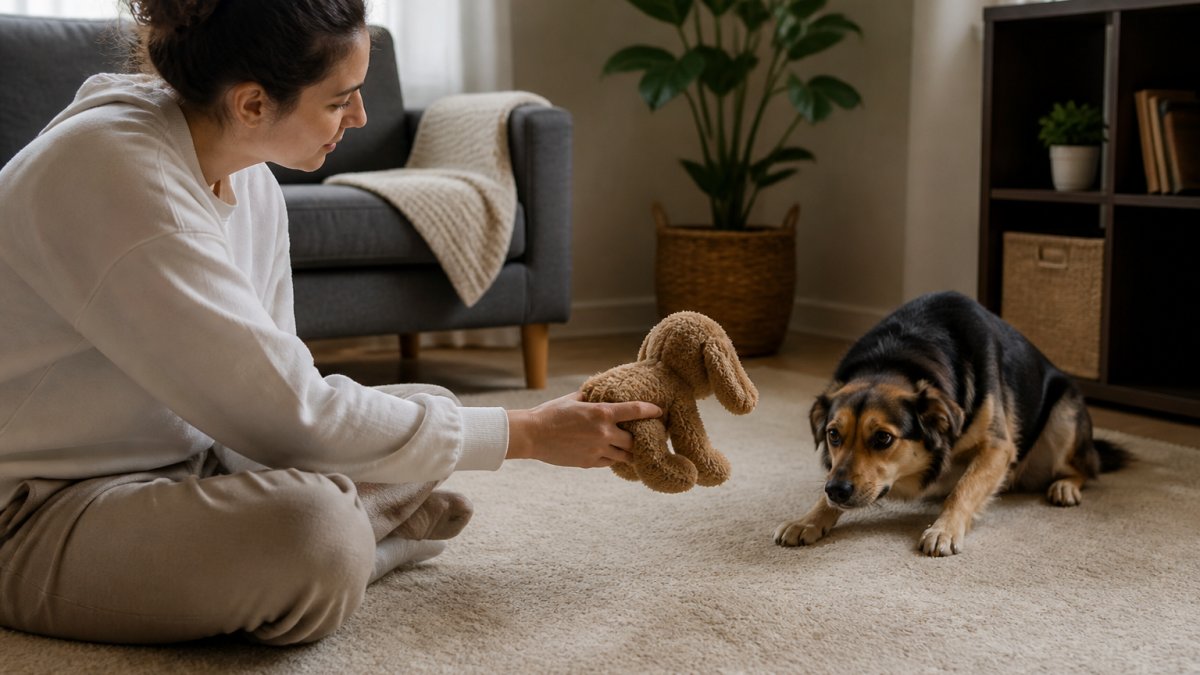
How to Play With a Shy Dog Without Overwhelming Them
Play is enrichment, but for shy dogs, play has to feel safe.
Creating a Calm Play Environment
Set up play in a quiet, familiar space. No other dogs, no kids, no sudden noises.
Use soft toys. Avoid toys with squeakers or crinkly sounds, these startle nervous dogs. Choose plush toys or soft rubber options.
Keep sessions short: 5-10 minutes. Shy dogs tire mentally faster than confident dogs. A short, positive session builds confidence better than a long one that ends in stress.
Play at your dog's pace. If they want to stop, stop. Forcing play creates negative associations.
Indoor Games That Don't Require Confidence
Gentle tug (with rules): Use a soft rope toy. Let your dog initiate. Keep tension light. Let them win often.
Slow chase: In a safe indoor space, slowly walk away from your dog and let them follow.
Treat tosses: Toss treats a short distance. Your dog retrieves them. No pressure to fetch formally, just engaging movement.
Sniffing games: Hide treats in a towel or under a blanket. Your dog searches. Sniffing is inherently calming for anxious dogs.
Gentle hide-and-seek: Hide in another room and call your dog. When they find you, reward heavily.
Low-Pressure Enrichment for Dogs That Avoid Toys or Play
Some shy dogs won't engage with toys at all.
Food-based enrichment: Use their regular meals as enrichment. Use the Chewzzle ThinkDisc Puzzle Feeder to turn mealtime into an activity.

Scent enrichment: Hide treats or food around your home. Your dog searches at their own pace.
Chewing: Provide long-duration chews (bully sticks, yak chews, safe bones).
Environmental enrichment: Rotate toys and objects in your dog's space. Change the furniture layout occasionally.
Supervised outdoor time: Let your dog explore a safe yard or quiet area.
If your dog avoids all enrichment, don't panic. Start with their meals and scent games. Build from there.
A Practical Daily Routine for Different Time Budgets
Consistency matters more than duration. Here's how to structure enrichment based on your schedule.
15-Minute Routine (Busy Days)
This is the minimum for a shy dog's wellbeing.
- Morning: 5-minute sniffing game with scattered kibble
- Midday: 5-minute solo chew time
- Evening: 5-minute gentle play or treat tosses
Total: 15 minutes, spread throughout the day.
30-Minute Routine (Standard Days)
This is ideal for most shy dogs.
- Morning: 10-minute scattering game or puzzle feeder
- Midday: 10-minute solo enrichment (chew, lick mat, or sniffing)
- Evening: 10-minute guided play or interactive time with you
Total: 30 minutes, spread throughout the day.
45-Minute Routine (Enrichment-Focused Days)
Use this on weekends or days when you have more time.
- Morning: 15-minute scattering game or puzzle toy session
- Midday: 15-minute solo enrichment (multiple activities rotated)
- Evening: 15-minute interactive play, training, or guided exploration
Total: 45 minutes, spread throughout the day.
| Time Budget | Morning Activity | Midday Activity | Evening Activity |
|---|---|---|---|
| 15 minutes | Kibble scatter (5 min) | Solo chew (5 min) | Gentle play (5 min) |
| 30 minutes | Puzzle feeder (10 min) | Lick mat or sniffing (10 min) | Interactive time (10 min) |
| 45 minutes | Puzzle toy session (15 min) | Rotated activities (15 min) | Guided play or training (15 min) |
The key is spreading activities throughout the day. This prevents boredom and keeps anxiety manageable.
Safety and Supervision: What You Should Know
Not all enrichment is unsupervised enrichment.
Always supervise puzzle toys during first sessions. Watch your dog's reaction. Is she figuring it out?
Check toys regularly for damage. Anxious dogs sometimes chew harder when stressed.
Know your dog's chewing style. Some dogs solve puzzles; others destroy them.
Don't leave food-based enrichment out too long. Wet food can spoil. Remove lick mats after 20-30 minutes.
Use appropriate portion sizes. Enrichment treats should count toward daily calories.
The Chewzzle products are designed with safety in mind, non-toxic materials, appropriate sizing, and durable construction.
When to Seek Professional Support
Enrichment helps, but it's not a substitute for professional help when anxiety runs deep.
Consider consulting a trainer or behaviorist if your dog shows:
- Severe fear or panic (not just shyness)
- Aggression triggered by anxiety
- Destructive behavior that doesn't improve with enrichment
- Excessive barking, panting, or self-injury
- Inability to settle even in safe spaces
- Signs of learned helplessness (complete shutdown)
A certified professional can assess whether your dog needs behavior modification training, medication, or both. Enrichment is a powerful tool, but it works best alongside professional support when anxiety is severe.
Shy dogs thrive when enrichment matches their confidence level and anxiety needs. Start simple, scatter feeding, gentle sniffing games, and solo chew time build a foundation. As your dog gains confidence, introduce puzzle toys like the Chewzzle MindMaze IQ Puzzle or Chewzzle ThinkDisc Puzzle Feeder to deepen mental engagement.
Frequently Asked Questions
How do you entertain a shy dog at home?
Start with low-pressure activities that don't require social interaction or high energy. Puzzle toys like the Chewzzle MindMaze IQ Puzzle allow your dog to work at their own pace, while sniffing games and food-based enrichment tap into natural behaviors without demanding performance. Keep sessions short (5-10 minutes), offer treats and rewards for trying, and let your dog retreat to their safe space whenever they need a break. The goal is to build confidence gradually, not push them beyond comfort.
What activities help a nervous dog feel more confident?
Confidence-building comes from small wins. Use puzzle toys that start easy so your dog experiences success quickly. Pair enrichment activities with treats and calm praise to create positive associations. Short training sessions with basic cues like 'sit' or 'touch' give shy dogs a sense of control. Gradual exposure to new sounds or spaces in your home, on their schedule, also builds resilience. Avoid forcing interaction; let your dog approach new things at their own pace.
Are puzzle toys good for shy dogs?
Yes, puzzle toys are especially beneficial for shy dogs because they provide mental stimulation without requiring social confidence or high-energy play. Toys like the Chewzzle ThinkDisc Puzzle Feeder and PuzzleFeast Sliding Puzzle let dogs engage independently, reducing anxiety while keeping their mind active. They also slow eating, which benefits nervous dogs prone to gulping from stress. Start with simpler puzzles and supervise early sessions to ensure your dog finds the experience rewarding rather than frustrating.
How much mental stimulation does a shy dog need each day?
Most dogs benefit from 15-30 minutes of mental stimulation daily, though shy dogs may need less frequent but more consistent sessions. Spread activities throughout the day in short bursts (5-10 minutes each) to avoid overwhelming an anxious dog. Mental enrichment through puzzle toys, sniffing games, and gentle training counts just as much as physical exercise. Watch your dog's behavior: if they seem relaxed and content, they're getting enough. If they're destructive or restless indoors, increase enrichment gradually.