

Mental Stimulation for High Energy Puppies: 7 Games
Table of Contents
- Why High Energy Puppies Need Mental Stimulation
- How to Tire Out a Puppy Mentally: A Daily Routine
- 7 Enrichment Activities for Puppies That Work Fast
- Best Puzzle Toys for Puppies: What to Look For
- Safety and Supervision Protocols for Puzzle Play
- Age-Appropriate Stimulation and Breed-Specific Needs
- Budget-Friendly vs. Premium Gear
- Frequently Asked Questions
Last Updated: September 13, 2026
Why High Energy Puppies Need Mental Stimulation
Mental stimulation for high energy puppies is the deliberate use of problem-solving, scent work, and training challenges to tire a puppy's brain rather than just its body. Physical exertion alone often leaves high-drive breeds wound up rather than settled.
A puppy that runs hard for an hour can come home more wired than when it left, because the walk never asked it to think. This guide from Chewzzle covers the warning signs, a sample daily routine, seven fast-working activities, and how to pick gear that survives a determined chewer.
Signs Your Puppy Is Under-Stimulated
Under-stimulated puppies usually show it through behavior, not lethargy. The most common signs are:
- Destructive chewing on furniture, shoes, or baseboards
- Pacing, whining, or an inability to settle even after exercise
- Demand barking or nipping during play
- Hyperactive bursts late in the evening
- Loss of focus during short training sessions
These behaviors often signal a need for cognitive engagement, not more laps around the block. Adding physical exercise when the real deficit is problem-solving is a common mistake.
How to Tire Out a Puppy Mentally: A Daily Routine
A workable routine alternates high-focus activities with calm decompression, so your puppy's nervous system gets both a challenge and a landing. The structure below fits most high-energy puppies and takes roughly 30 to 40 minutes of active engagement across the day, but the exact shape changes with your puppy's developmental window.
Match the Routine to Your Puppy's Age Window
Age is the biggest variable most guides ignore. Attention span and physical durability grow in predictable steps, and pushing past them backfires into frustration, nipping, or a puppy who shuts down.
- 8 to 12 weeks (early socialization window). Focus windows run about 2 to 3 minutes. Run four to six micro-sessions a day rather than one long block. Scent games, scatter feeding, and one-step name recognition are the right difficulty. Skip multi-step puzzles, the motor control isn't there yet.
- 3 to 4 months (peak novelty-seeking). Focus stretches to 5 minutes. Introduce sliding puzzle feeders and simple hide-and-seek. This is the window where most puppies learn to love problem-solving, so keep the win rate high, end every session on a success.
- 4 to 6 months (adolescent onset). Focus reaches 8 to 10 minutes, but impulse control temporarily regresses. Add wait-and-release games, stationing on a mat, and two-step puzzles. Expect the puppy who "knew" a behavior last month to act like it never learned it, that is normal, not defiance.
- 6 to 12 months (adolescent peak). Sessions can run 10 to 15 minutes. Multi-step puzzles, scent discrimination between two scents, and trick chains work well. Physical exercise needs rise in parallel, so mental work alone will not carry the day.
Morning: Sniff Walk and Breakfast Puzzle
Start the day with a scent walk, where your puppy leads and sniffs freely rather than marching at your pace. Ten minutes of sniffing can be as tiring as a much longer brisk walk because dogs devote a far larger share of their brain to processing scent, sniffing is genuine cognitive work, not idle wandering.
Follow the walk with breakfast in a puzzle feeder. Kibble dispensing toys turn a two-minute gulp into a ten-minute problem-solving session and pace fast eaters. For a puppy under 12 weeks, use the easiest setting or a snuffle mat; a puzzle that fails three times in a row teaches nothing but frustration.

Midday: A Five-Minute Reset
If someone is home midday, a five-minute training drill, three reps of a known cue, then one new rep, breaks up the longest stretch of the day and heads off the late-afternoon destruction window. If no one is home, a frozen stuffed toy left at the start of the day covers this slot.
Evening: Training Drills and Decompression
Evening suits obedience drills and impulse control work, when your puppy has energy but you want focus rather than frenzy. Short sessions of five to ten minutes, repeated two or three times, beat one long block. Impulse control games, wait at the door, leave-it, settle on a mat, burn mental energy and build the off-switch high-drive puppies often lack.
Close the day with a lick mat or frozen treat; licking is self-soothing and helps many puppies decompress before settling. Keep the last 30 minutes before bed low-arousal: no fetch, no tug, no wrestling. Arousal hormones take time to clear, and a puppy who peaks at 9 p.m. will not sleep at 10.
A Sample Day at a Glance
| Time | Activity | Duration | Why It Works |
|---|---|---|---|
| Morning | Sniff walk | 10 min | Olfactory processing tires the brain fast |
| Morning | Breakfast in puzzle feeder | 10 min | Converts a gulp into problem-solving |
| Midday | Training drill or frozen toy | 5 min | Breaks the longest alone stretch |
| Evening | Obedience and impulse control | 10-15 min | Builds focus and an off-switch |
| Evening | Lick mat or frozen treat | 10 min | Self-soothing before sleep |
7 Enrichment Activities for Puppies That Work Fast
These seven activities deliver quick results because each forces your puppy to think, not just move. Rotate them so novelty stays high.
- Snuffle mats and scatter feeding. Hide kibble in fabric folds or scatter it across a towel. Foraging mimics instinctual behavior and slows eating.
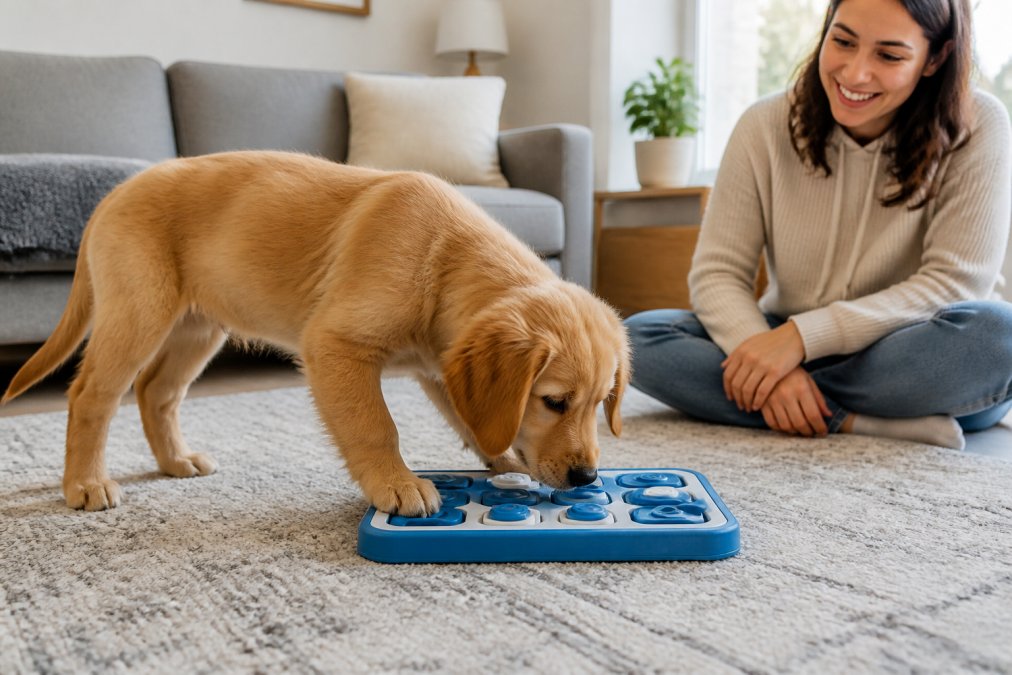
- Sliding puzzle feeders. Treats hide under sliding covers that your puppy must nose or paw aside.
- Scent work games. Hide a treat in one of three cups and let your puppy find it. Increase difficulty by adding cups.
- Hide-and-seek. Have one person hold your puppy while another hides, then release with a "find" cue.
- Frozen stuffed toys. Freeze a portion of your puppy's food inside a durable toy for a long-lasting challenge.
- Trick training. Teach a new behavior each week: spin, roll over, or touch a target.
- Cardboard foraging boxes. Place kibble in a shallow box with paper and let your puppy dig it out under supervision.
Interactive play with a person beats a toy left alone every time. Your puppy is working for a reward and for your attention, which doubles the engagement.
Best Puzzle Toys for Puppies: What to Look For
The best puzzle toys for puppies share four traits: adjustable difficulty, food-safe materials, a size that matches your puppy's mouth, and construction that survives chewing. Difficulty matters most, because a puzzle that's too easy gets solved once and ignored.
| Feature | Why It Matters | What to Avoid |
|---|---|---|
| Adjustable difficulty | Keeps the toy useful as skills grow | One fixed difficulty level |
| Non-toxic materials | Safety during long chew sessions | Unlabeled plastics |
| Size match | Prevents choking and frustration | One-size-fits-all design |
| Durable build | Survives determined chewers | Thin, brittle plastic |
Chewzzle builds its puzzle range around exactly these criteria. The Chewzzle MindMaze IQ Puzzle dispenses treats as your dog unlocks each hidden reward, while the Chewzzle ThinkDisc Puzzle Feeder uses sliding paw-shaped covers and a turning center wheel to hide kibble across multiple compartments. Both are made from durable, non-toxic materials and mimic natural foraging behavior. For puppies who clear a bowl in seconds, the Chewzzle PuzzleFeast Sliding Puzzle uncovers only one treat at a time, which naturally paces a gulper.

Safety and Supervision Protocols for Puzzle Play
No puzzle toy replaces your eyes on your puppy. The risks are real: swallowed pieces, chewed-off covers, and frustration that turns into guarding.
- Check toys for cracks, loose parts, or chewed edges before every session
- Match toy size to your puppy's breed and jaw strength
- Start with the easiest setting and increase difficulty only after success
- Remove the toy once the food is gone, so it stays a game rather than furniture
- Watch for calming signals like lip licking or turning away, which mean your puppy needs a break
A common mistake is leaving a puzzle feeder down all day. That turns a challenge into a chew target and removes the novelty that makes it work.
Age-Appropriate Stimulation and Breed-Specific Needs
Most guides treat "high energy puppy" as one category. It isn't. A 9-week-old Border Collie and a 7-month-old Jack Russell need different mental work at different intensities, and copying a generic activity list is the fastest way to get this wrong. This section breaks stimulation down by age window and by the drive type your puppy was bred for.
Age-Appropriate Stimulation: What Changes and When
The core principle: session length, difficulty, and physical demand should scale with your puppy's developmental stage, not with how much energy they appear to have. A puppy who looks like they could go all day still has a short attention span and soft growth plates.
- 8 to 12 weeks. Two- to three-minute sessions, four to six times daily. Prioritize scent games, scatter feeding, name recognition, and handling desensitization. Avoid stairs, long runs, and multi-step puzzles. The goal is building a positive association with thinking, not testing limits.
- 3 to 4 months. Five-minute sessions, three to four times daily. Introduce sliding puzzle feeders, one-cup scent games, and simple hide-and-seek. This is the window where confidence with novel objects is built, expose your puppy to different textures, sounds, and puzzle mechanisms now.
- 4 to 6 months. Eight- to ten-minute sessions, two to three times daily. Add two-step puzzles, wait-and-release games, and mat stationing. Expect an impulse-control regression; keep criteria low and reward generously.
- 6 to 12 months. Ten- to fifteen-minute sessions, two to three times daily. Multi-step puzzles, scent discrimination, trick chains, and structured nose work all fit here. Physical exercise needs also peak, so pair mental work with age-appropriate cardio, not forced running on hard surfaces.
A common mistake is treating physical maturity as mental maturity. A 6-month-old Labrador may look nearly full-grown but still has the impulse control of an adolescent, and puzzles set too hard produce quitting, not learning.
Breed-Specific Mental Needs: Match the Work to the Drive
Drive type matters more than breed name. Most high-energy puppies fall into one of four working profiles, each satisfied by a different kind of mental challenge.
- Herding breeds (Border Collie, Australian Shepherd, Heeler). Bred to read movement and make split-second decisions. They thrive on pattern games, direction changes, and tasks with a clear job, think "find the hidden object," "herd the ball to a target," or complex multi-step puzzles. A snuffle mat alone will bore them within a week.
- Terriers (Jack Russell, Rat Terrier, Schnauzer). Bred to pursue and problem-solve independently. They excel at digging-style foraging, scent work, and any game with a chase-and-catch payoff. They often prefer short, intense bursts over long, methodical puzzles.
- Retrievers and sporting breeds (Labrador, Golden, Poodle). Bred to retrieve, carry, and work cooperatively with a handler. They respond best to fetch-with-a-twist games, retrieve-and-sort tasks, and training drills with a human partner. They are often the most food-motivated, which makes puzzle feeders easy wins.
- Scent hounds and guardian breeds (Beagle, Coonhound, Great Pyrenees). Bred to track or patrol. Scent work is not optional for these puppies, it is the primary outlet. Nose games, tracking trails, and hide-and-seek with a scent cue will tire them faster than any physical exercise.
Reading Your Individual Puppy
Drive varies more within a breed than between breeds, so treat the profiles above as a starting hypothesis, not a verdict. Watch three signals: what your puppy chooses to do alone, what makes them disengage fastest, and what they repeat without a food reward. Those answers tell you more than any breed chart.
Budget-Friendly vs. Premium Gear
You do not need a shelf full of toys to provide real mental stimulation for high energy puppies. A handful of well-chosen items beats a pile of cheap ones that fall apart.
Budget options work well for variety: cardboard foraging boxes, muffin tins with treats under tennis balls, and towel-wrapped kibble cost almost nothing and deliver genuine problem-solving. Premium gear earns its place when you need durability and adjustable difficulty, the Chewzzle SmartPaws Interactive Puzzle is built to challenge dogs mentally and reduce destructive behaviors through treat-based problem-solving.

The practical split: spend on one or two durable puzzles you'll use daily, and fill the gaps with free DIY enrichment. That keeps your puppy's routine varied without draining your budget.
Frequently Asked Questions
How much mental stimulation does a puppy need daily?
Most puppies need two to three short sessions of mental stimulation per day, about 10 to 15 minutes each. Puppies tire mentally faster than adults, so a 15-minute puzzle session can do more than an hour of running. Split sessions across morning, midday, and evening to match your puppy's natural energy peaks and prevent boredom that leads to destructive behavior.
Can mental stimulation help with puppy destructive chewing?
Yes. Destructive chewing often signals boredom or pent-up energy, not bad behavior. When you give your puppy problem-solving outlets like puzzle toys, lick mats, or sniffing games, the mental fatigue reduces the drive to chew furniture and shoes. Pair mental stimulation with a consistent daily routine and positive reinforcement for the best results.
What are the best puzzle toys for puppies that destroy everything?
Look for toys with durable, non-toxic materials and adjustable difficulty. The Chewzzle SmartPaws Interactive Puzzle ($39.99) is built for determined chewers and encourages problem-solving. The Chewzzle PuzzleFeast Sliding Puzzle ($49.99) reveals only one treat at a time, which slows gulpers and keeps strong chewers engaged longer than flimsy options.
How do I tire out a puppy mentally without overdoing it?
Watch for calming signals like lip licking, yawning, or walking away. These mean your puppy needs a break. Keep sessions short, end on a successful solve, and rotate activities so your puppy stays interested. A sniff walk around the block plus one puzzle session is often enough to tire out a high energy puppy without overwhelming them.
High-energy puppies don't need more miles on the leash. They need problems worth solving, delivered in short, structured sessions that end in calm. Chewzzle makes that easier with puzzle toys and slow feeders designed to boost mental stimulation, promote healthier eating habits, and reduce anxiety, all built from durable, non-toxic materials that mimic natural foraging. Get started with Chewzzle and turn mealtime into the most productive ten minutes of your puppy's day.