

Is a Puzzle Feeder Worth It for Puppies? A 2026 Review
Table of Contents
- The Verdict: When a Puzzle Feeder Is Worth It for Your Puppy
- Interactive Dog Toys for Mental Stimulation: What the Research Says
- Benefits of Slow Feeder Bowls for Puppies: Digestion, Bloat, and Beyond
- How to Introduce Puzzle Toys to a Puppy Without Causing Frustration
- Puzzle Feeder Types and Difficulty Levels: A Practical Comparison
- DIY vs. Store-Bought Puzzle Feeders: Cost and Durability
- Long-Term Behavioral Impact: What to Expect After Months of Use
- Conclusion: Making the Right Choice for Your Puppy
- Frequently Asked Questions
Last Updated: September 14, 2026
The Verdict: When a Puzzle Feeder Is Worth It for Your Puppy
A puzzle feeder is worth it for most puppies, especially fast eaters, high-energy breeds, and dogs left alone during the day. It turns a 90-second meal into several minutes of sniffing, nudging, and problem-solving, exactly the mental work a growing puppy needs.
But it's not worth it for every puppy on day one.
If your puppy is under eight weeks old, recovering from surgery, or so food-obsessed that they smash a toy against a wall to get the kibble out, start with something easier. Frustration is the fastest way to make a puppy hate a toy. Puppies succeed when introduced at the right difficulty level, not given the hardest puzzle first.
So the answer depends less on the toy and more on how you roll it out. Below: the science, digestion benefits, frustration risks, and real cost math.
American Kennel Club's guide to canine enrichment
Interactive Dog Toys for Mental Stimulation: What the Research Says
Interactive dog toys for mental stimulation work because they tap into a dog's natural foraging instinct. Wild canines spend much of their waking hours searching for food; a bowl removes that sequence, and a puzzle feeder puts part of it back.
The Science of Canine Enrichment and Problem-Solving
Canine enrichment gives a dog outlets for natural behaviors, sniffing, foraging, chewing, problem-solving. It's not just "keeping them busy"; it's meeting a biological need.
Veterinary behaviorists generally group enrichment into categories: social, physical, sensory, occupational, and cognitive. Puzzle feeders hit the last two. The puppy has a job, and the job requires thinking. That combination tends to produce calmer, more focused behavior afterward.
What most owners miss is that mental and physical fatigue aren't interchangeable. A puppy can run laps and still chew your baseboards an hour later; ten minutes of real problem-solving often settles them faster.
Benefits of Slow Feeder Bowls for Puppies: Digestion, Bloat, and Beyond
The benefits of slow feeder bowls for puppies come down to pace. When food arrives a few pieces at a time, the puppy swallows less air, chews more, and gives their digestive system a chance to keep up.
Preventing Gulping and Bloat in Fast Eaters
Gulping is the root problem. A puppy who inhales a bowl in under a minute swallows air along with kibble, a known contributor to gastrointestinal discomfort. For deep-chested breeds, fast eating is one factor vets discuss for bloat risk; slow feeding doesn't eliminate that risk, but it addresses the eating-speed piece.
A puzzle feeder also makes the meal last long enough for satiety signals to register. Puppies who eat in 60 seconds often act hungry five minutes later. Puppies who work for their food for eight minutes usually don't.
How to Introduce Puzzle Toys to a Puppy Without Causing Frustration
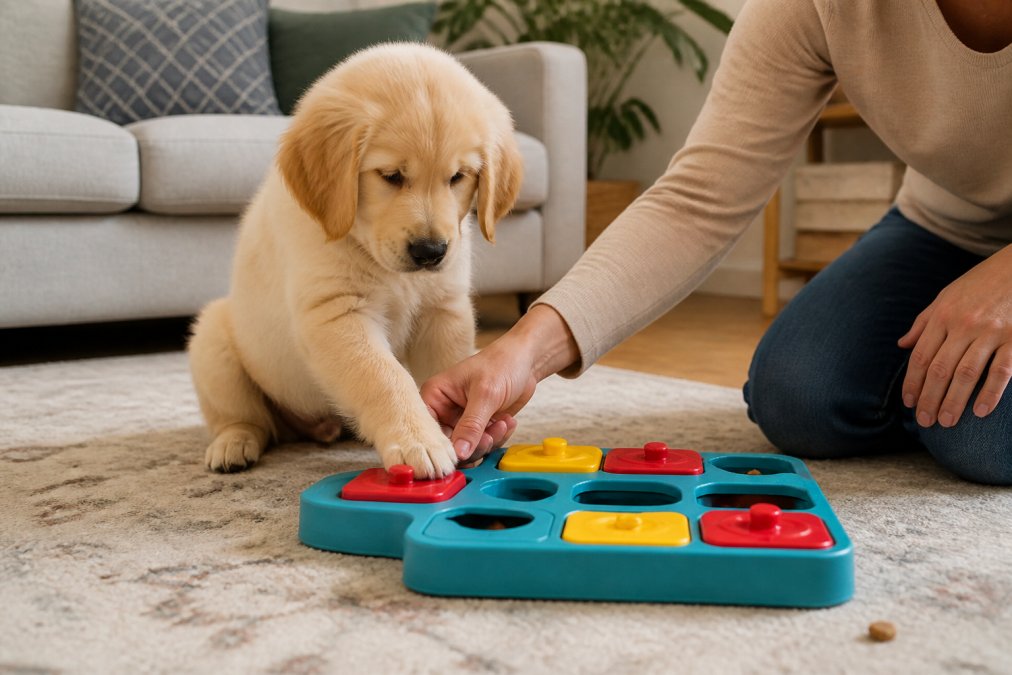
Introduce puzzle toys slowly, with the easiest possible setup and food your puppy can see. The first week's goal is confidence, not challenge. But most guides skip what to do when a puppy gets stuck, and frustration, not boredom, is what kills food puzzles in most homes.

Starting with Success: The First Session
Set the toy down with covers partly open and a few pieces of kibble visible, and let your puppy eat directly from it without solving anything. That's session one.
Then work up:
- Session 1-2: Covers open, food visible, zero problem-solving required
- Session 3-4: Covers half-closed, food still partly visible
- Session 5-6: Covers closed, one compartment at a time
- Week 2 onward: Full puzzle, full meal portion
Keep sessions short, three to five minutes for a young puppy, and always end while they still want more. A puppy who walks away from a finished puzzle will come back to it tomorrow.
Reading Frustration vs. Engagement
Watch the whole body, not just the tail. Engagement looks like a lowered head, forward ears, sniffing, pawing, and a loose, wagging tail. Frustration looks like backing away, whining or barking at the toy, air-pawing, lip-licking, yawning, or shoving it across the floor. A puppy who freezes and stares at the wall is also frustrated, that's a shutdown, not focus.
The fix is almost always the same: reduce difficulty by one step rather than abandoning the toy. Open a cover, scatter a few pieces on top, or hold the toy steady so it stops sliding. Let them win, then stop for the day.
Adjusting Difficulty for High-Drive Puppies
High-drive puppies, herding breeds, terriers, most working lines, present the opposite problem. They don't quit; they bulldoze. A puppy who flips a sliding puzzle, chews the lid off, or body-slams a treat ball isn't solving it, they're defeating it, not enrichment, and a fast track to a destroyed toy.
For these puppies, difficulty isn't about more compartments, it's about more steps. Chain two feeders together: put kibble in a snuffle mat, hide the mat's reward inside a rolling ball, then place the ball inside a box. Three sequential problems burn more mental energy than one harder puzzle and are far less likely to end in frustration.
A useful rule of thumb: if your puppy clears a puzzle in under two minutes, it's too easy. If they walk away before finishing, it's too hard. The sweet spot is a puzzle that takes five to ten minutes and ends with a clear win.
When to Rotate and When to Retire
Rotate toys every few days so no single puzzle becomes memorized, one solved a dozen times stops being enrichment and becomes a bowl with extra steps. Retire a feeder when your puppy stops engaging entirely, or when they defeat it by flipping, chewing, or pawing rather than solving. That signals moving up a difficulty level, not giving up on puzzle feeding.
Puzzle Feeder Types and Difficulty Levels: A Practical Comparison
Puzzle feeders fall into four rough categories, and the right one depends on your puppy's drive and experience level. Here's how the main types stack up.
| Type | Difficulty | Best For | Typical Session |
|---|---|---|---|
| Treat ball / rolling dispenser | Beginner | First-timers, teething puppies | 5-10 min |
| Foraging snuffle ball | Beginner | Anxious puppies, gentle eaters | 5-8 min |
| Sliding-cover board | Intermediate | Food-motivated puppies ready for a challenge | 8-15 min |
| Multi-stage puzzle disc | Advanced | High-drive puppies who clear easier toys fast | 10-20 min |
A good starter set covers at least two difficulty levels so you can rotate as your puppy gets faster. The Chewzzle RollFeast Treat Ball and ChewClean Treat Ball are great for beginners; the ThinkDisc Puzzle Feeder and MindMaze IQ Puzzle offer an intermediate challenge; and the PuzzleFeast Sliding Puzzle and SmartPaws Interactive Puzzle are perfect for puppies who've mastered easier toys.

DIY vs. Store-Bought Puzzle Feeders: Cost and Durability
DIY puzzle feeders cost less upfront; store-bought feeders cost less over time, and that gap widens fast with a determined puppy. Since "worth it" is often a price question, run the actual math.
The Real Cost Math
A muffin tin with tennis balls over the cups is the classic homemade option. So is a cardboard box with kibble scattered inside, or a plastic bottle with holes cut in the sides. All three work for a first session. All three also get shredded, chewed, or ignored within one to three weeks for most puppies, and none is designed to be cleaned properly between uses.
Run the numbers over a puppy's first year:
- DIY route: a muffin tin runs about $8-$12, tennis balls about $5 for a three-pack, and cardboard is free. But most owners replace DIY setups every few weeks, so a realistic annual spend lands around $40-$80, plus the time to build and rebuild them.
- Store-bought route: a single durable treat ball runs about $10-$15 and often lasts the entire puppy year. A multi-stage sliding board runs $30-$50 and typically lasts through adulthood with proper cleaning.
The crossover point is usually around month two. If your puppy engages with food puzzles at all, one $12 treat ball beats a year of shredded cardboard on both cost and safety.
Safety Trade-Offs DIY Guides Skip
Homemade feeders introduce risks that commercial products are designed around:
- Choking and blockage hazards. Cut plastic bottles leave sharp edges and small fragments that a determined chewer can swallow. Tennis balls can be compressed and swallowed by larger puppies.
- Non-food-safe materials. Cardboard boxes are often treated with inks, adhesives, and coatings not intended for mouth contact. Muffin tins may have non-stick coatings that flake under chewing.
- No non-slip base. A tin or box slides across the floor, which adds frustration and teaches a puppy to paw and flip rather than solve.
If you go DIY, stick to food-safe silicone molds, plain cardboard with no printing, and muffin tins with no non-stick coating. Supervise every session, and throw the setup away the moment it starts to break down.
What to Look For in a Store-Bought Feeder
Durability isn't about price, it's about materials and design:
- Non-toxic, BPA-free plastic or food-grade silicone. These are the materials rated for repeated mouth contact and dishwasher cleaning.
- A non-slip base or rubber feet. A toy that stays put lets your puppy focus on solving instead of chasing.
- No removable small parts. Anything a puppy can pop off and swallow is a hazard, no matter how well it's rated.
- Dishwasher-safe construction. Puzzle feeders get slobbery and grow bacteria fast. If you can't clean it thoroughly, it isn't worth keeping.
A Simple Decision Framework
- Puppy under 12 weeks or a first-timer: start with a $10-$15 treat ball. Low risk, high engagement, easy to clean.
- Puppy who clears easy toys in under two minutes: move to a $20-$30 sliding-cover board.
- High-drive puppy who defeats toys by flipping or chewing: skip DIY entirely and invest in a $40-$50 multi-stage puzzle built from thick, non-toxic material.
- Budget-constrained or testing engagement: a food-safe silicone mold or plain cardboard box is fine for a week or two, but plan to upgrade once your puppy shows real interest.
The honest answer to "is it worth it" is that a single durable feeder can often be a more cost-effective and safer long-term solution than repeatedly replacing DIY setups.

Long-Term Behavioral Impact: What to Expect After Months of Use
The long-term payoff shows up in behavior, not just mealtime. Owners who stick with daily enrichment often observe a puppy who settles faster after meals, chews less furniture, and handles alone time with less distress.
That matters for rescue puppies and dogs prone to separation anxiety. A puzzle feeder doesn't cure anxiety or replace training or veterinary guidance; it gives an anxious puppy a predictable, rewarding activity during moments they'd otherwise spend pacing or whining.
The other long-term effect is cognitive: puppies who solve puzzles regularly can develop better focus and problem-solving skills, which can carry into training. A puppy used to working for a reward may be easier to teach.
Where it falls short: puzzle feeders don't replace physical exercise, socialization, or obedience training. They're one tool in a routine, and puppies who only get enrichment at mealtime still need walks and play.
Conclusion: Making the Right Choice for Your Puppy
The hard part isn't deciding whether a puzzle feeder works. It's matching the difficulty to the puppy in front of you, and most owners either start too hard or give up after one frustrating session.
Chewzzle builds feeders across the full range, from a $9.99 treat ball for a first-timer to a $49.99 sliding puzzle for a puppy who clears everything else. Each one is made from durable, non-toxic materials, designed to mimic natural foraging, and built to slow gulping while keeping mealtime engaging.
Start with the difficulty your puppy can win at today. Add to cart, and let the first session be an easy one.
Frequently Asked Questions
At what age can a puppy start using a puzzle feeder?
Most puppies can start with a simple puzzle feeder around 8 to 10 weeks old, once they are comfortably eating solid food. Begin with an easy level, such as a lick mat or a slow feeder bowl with shallow ridges. As your puppy grows and gains confidence, you can introduce more complex puzzles with sliding covers or treat-dispensing balls. Always supervise the first few sessions to ensure your puppy does not become frustrated or try to chew the feeder.
Do puzzle feeders help with puppy teething?
Yes, many puzzle feeders double as teething aids. Soft silicone or natural rubber feeders, like the Chewzzle TreatDrop Ball, provide a textured surface that massages gums and helps relieve teething discomfort. Freezing a treat-dispensing ball with kibble and broth can add a cooling effect. However, always choose durable, non-toxic materials and check for wear, as a determined chewer can damage even tough toys. Puzzle feeders are not a substitute for dedicated chew toys but can complement them.
Can puzzle feeders help with separation anxiety in puppies?
Puzzle feeders can be a useful tool for managing mild separation anxiety by providing a positive distraction when you leave. A food-stuffed toy gives your puppy something enjoyable to focus on, which can reduce stress and prevent destructive chewing. For best results, introduce the puzzle while you are still home, so your puppy associates it with calm, rewarding solo time. For severe anxiety, consult a veterinarian or certified behaviorist, as puzzle feeders alone may not resolve the issue.
What is the best puzzle feeder for a large breed puppy?
Large breed puppies need a puzzle feeder that is sturdy, sized appropriately, and challenging enough to hold their interest. The Chewzzle PuzzleFeast Sliding Puzzle ($49.99) is a good option because its non-slip base and sliding buttons require real problem-solving, and it works for dogs of all sizes. For fast eaters, the Chewzzle ThinkDisc Puzzle Feeder ($19.99) slows down mealtime by hiding kibble under sliding covers. Always match the difficulty to your puppy's age and experience to avoid frustration.
How do I clean a puzzle feeder?
Most Chewzzle puzzle feeders are easy to clean with warm water and mild dish soap. For sticky residue, use a bottle brush to reach crevices. Always check the manufacturer's instructions for specific cleaning guidelines, as some are dishwasher safe on the top rack, while others should be hand-washed. Regular cleaning prevents bacteria buildup and keeps your puppy safe.