

Buy Dog Enrichment Toys Online: A 2026 Guide
Table of Contents
- Interactive Dog Toys for Mental Stimulation: What Works Best
- Best Puzzle Toys for Dogs: Options for Every Chewer
- How to Use Slow Feeders for Enrichment and Digestive Health
- Toy Rotation Strategies to Keep Enrichment Fresh
- Material Safety and Non-Toxic Standards for Dog Toys
- Enrichment for Specific Behavioral Issues
- Frequently Asked Questions
Why Dog Enrichment Toys Matter for Your Pet's Wellbeing
Dog enrichment toys are far more than a way to keep your pet occupied while you're busy. They're essential tools for mental stimulation, behavioral health, and overall wellbeing. At Chewzzle, we've seen firsthand how the right enrichment can transform dogs.
The difference between a mentally stimulated dog and an under-enriched one shows up in behavior. Bored dogs develop destructive habits, excessive chewing, digging, barking, and anxiety-driven behaviors. A dog with proper mental stimulation and cognitive development through interactive play is calmer, more focused, and genuinely happier.
This isn't just about keeping your dog quiet. Enrichment taps into natural canine instincts: problem-solving, foraging, hunting, and play. When you provide outlets for these behaviors through puzzle toys, treat dispensers, and interactive games, you're supporting your dog's psychological needs at a fundamental level. The result is a dog with better behavioral health, reduced anxiety, and improved focus during training.
Consider the common scenario: a high-energy dog left alone for eight hours with no mental challenge. That dog will find entertainment through destructive behavior. Now imagine the same dog with a puzzle feeder that takes 30 minutes to work through, followed by a treat-dispensing toy that requires problem-solving. That dog's brain is engaged. The anxiety drops. The destructive impulses have an appropriate outlet.

Interactive Dog Toys for Mental Stimulation: What Works Best
Interactive puzzle toys are the gold standard for mental stimulation because they combine problem-solving, treat rewards, and extended engagement. Unlike passive toys, puzzle toys require your dog to think, strategize, and work for their reward, exactly what their brains need.
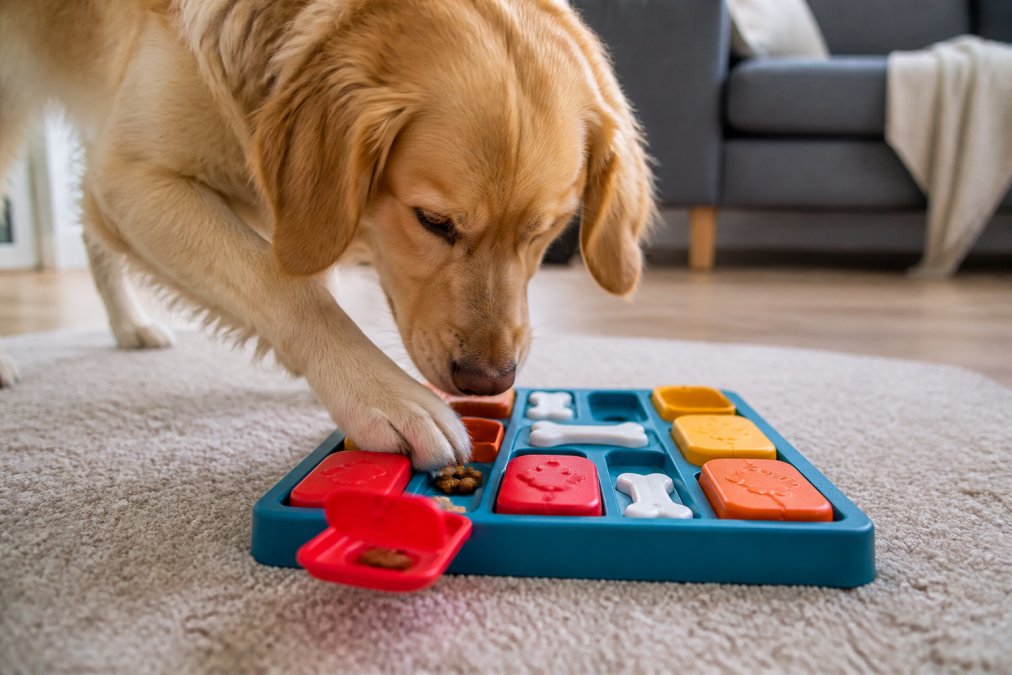
The best interactive toys for mental stimulation share common traits: multiple compartments or levels, varying difficulty, and treat-dispensing mechanics. When a dog has to nudge, paw, flip, or slide components to access treats, their brain is firing on all cylinders. This cognitive engagement can lead to improved focus, reduced anxiety, and fewer destructive behaviors.
Puzzle feeders serve double duty: they slow down fast eaters while providing mental stimulation. The Chewzzle™ ThinkDisc Puzzle Feeder ($19.99) combines sliding paw-shaped covers with a rotating center wheel, creating multiple puzzle layers your dog must solve before accessing kibble. This approach turns mealtime into a brain game, preventing gulping while keeping your dog mentally engaged.
For dogs that need serious cognitive challenge, the Chewzzle™ SmartPaws Interactive Puzzle ($39.99) escalates difficulty with multiple hidden compartments and varied puzzle mechanics. This toy is designed for clever canines and high-energy breeds that solve basic puzzles quickly. The complexity keeps their minds occupied longer.

The key insight most guides miss: difficulty should match your dog's current skill level. A puzzle too easy becomes boring within days. A puzzle too hard creates frustration. Start with moderate difficulty and progress as your dog's problem-solving skills improve. This progression keeps enrichment fresh and maintains engagement over weeks, not days.
Best Puzzle Toys for Dogs: Options for Every Chewer
Puzzle toys aren't one-size-fits-all. Your dog's size, chewing power, and problem-solving ability determine which toy will deliver lasting engagement versus quick destruction.
Small dogs and seniors benefit from simpler puzzle mechanics. Their jaws are weaker, and they tire mentally faster. A basic puzzle with 3-4 compartments and straightforward sliding or flipping mechanics keeps them engaged for 15-20 minutes without frustration. These dogs often excel with treat-dispensing toys that reward quick thinking over sustained problem-solving.
Medium-energy dogs and most adult dogs thrive with mid-level puzzles featuring multiple compartments, rotating sections, and varied hiding spots. The Chewzzle™ MindMaze IQ Puzzle ($29.99) fits this category perfectly. It challenges without overwhelming, maintaining engagement for 20-30 minutes per session. The treat-dispensing mechanics reward successful problem-solving, reinforcing the behavior.

Power chewers and high-energy breeds need industrial-grade durability combined with serious cognitive challenge. These dogs will destroy standard toys within hours. The Chewzzle™ PuzzleFeast Sliding Puzzle ($49.99) addresses this need with a sliding-button mechanism that paces even the fastest eaters. One treat is exposed at a time, forcing your dog to work sequentially through the entire board. The durable construction withstands aggressive chewing and repeated use.
Here's what matters: the toy must match your dog's destructive potential and mental capacity. A puzzle toy that breaks after one session wastes money and frustrates your dog. A toy that's too easy gets ignored. The sweet spot is a toy your dog has to work for, can't destroy, and remains interesting over weeks of use.
How to Use Slow Feeders for Enrichment and Digestive Health
Slow feeders serve a dual purpose: they prevent bloating and gulping while providing enrichment through foraging behavior. Many dog owners overlook this connection, they think slow feeders are purely about digestion. In reality, they're a form of enrichment that mimics natural foraging.
When a dog inhales food in seconds, their stomach expands rapidly, increasing bloating risk and potentially triggering gastric dilatation-volvulus (GDV), a life-threatening condition in large breeds. Beyond physical health, fast eating prevents the natural satisfaction of the eating experience. A dog that works for their food feels more fulfilled than one that swallows without thinking.
Slow feeders transform mealtime into a 10-20 minute engagement session. Your dog's brain is active, their natural foraging instincts are satisfied, and their digestive system processes food at a healthier pace. This is enrichment and health optimization combined.
The Chewzzle™ ThinkDisc Puzzle Feeder ($19.99) exemplifies this approach. Kibble goes into recessed compartments and shallow troughs. Your dog must nudge aside paw-shaped sliding covers and manipulate the rotating center wheel to access each portion. What would normally be a 30-second meal becomes a 15-minute puzzle session.
Implementation matters. Don't switch to a slow feeder cold turkey. Introduce it gradually, starting with easier puzzle mechanics your dog already understands. Place treats in obvious spots initially, then gradually increase difficulty as your dog learns. Most dogs adapt within 3-5 meals and quickly show preference for the enriched feeding experience.
One common mistake: using slow feeders only occasionally. The benefit compounds with consistent use. Daily slow-feeder meals provide ongoing enrichment, digestive health, and behavioral improvement. Occasional use is better than nothing, but daily integration produces measurable results.
Toy Rotation Strategies to Keep Enrichment Fresh
Dogs experience habituation. A toy that captivates for weeks eventually becomes boring. The solution isn't buying new toys constantly, it's strategic rotation. A well-planned toy rotation system keeps the same toys feeling fresh indefinitely.
The rotation principle is simple: cycle toys in and out of active play on a schedule. A dog with four puzzle toys available daily will habituate to all four within 2-3 weeks. The same four toys, rotated so only one or two are available at a time, remain novel and engaging for months.
Here's an effective rotation strategy: divide your dog's toys into three groups. Week one, toys A and B are available. Week two, toys B and C. Week three, toys C and A. By the time a toy returns to active rotation, your dog has forgotten it. The reintroduction feels fresh.
Timing depends on your dog's engagement level. High-energy, toy-motivated dogs habituate faster, rotate every 7-10 days. Moderate dogs can go 2-3 weeks per rotation. Low-interest dogs might need rotation every 4 weeks or less frequently.
The practical benefit: you invest in quality toys once and maintain engagement indefinitely. A single Chewzzle puzzle toy, rotated strategically, provides months of enrichment without replacement.
Storage matters. Keep rotated toys out of sight. If your dog sees toys they can't access, it creates frustration. Store them in a closed closet or container. When rotation day arrives, swap toys completely. Remove the old toy, introduce the "new" one. The novelty is psychological, your dog doesn't know it's the same toy they played with three weeks ago.
Material Safety and Non-Toxic Standards for Dog Toys
Material safety isn't negotiable. Your dog will chew, gnaw, and potentially ingest fragments from any toy you provide. Understanding material standards and safety practices protects your pet from serious harm.
Non-toxic materials are the foundation. This means toys made from rubber, nylon, or food-grade plastics that don't leach harmful chemicals during chewing or digestion. The term "non-toxic" can be vague, so look for specific certifications or manufacturing standards.
Quality manufacturers use materials tested for safety under conditions dogs actually experience, extended chewing, saliva exposure, and potential ingestion of small pieces. Chewzzle products are crafted from durable, non-toxic materials specifically selected to withstand aggressive chewing while remaining safe if fragments are ingested.
Common hazardous materials to avoid: toys with paint or dyes that aren't food-grade, toys with small glued-on pieces that detach easily, toys made from materials that splinter or break into sharp fragments. These pose choking risks, intestinal blockage risks, and chemical toxicity risks.
Check toys regularly for damage. A toy that's safe when new becomes hazardous once pieces start breaking off. Inspect weekly, especially for power chewers. Replace toys showing significant wear before they become dangerous.
The investment in quality, tested toys can help avoid veterinary bills. A $40 Chewzzle puzzle toy that lasts six months can be a valuable investment in your pet's health.
Enrichment for Specific Behavioral Issues
Not all enrichment is generic. Different behavioral problems require targeted enrichment strategies.
Separation anxiety responds to enrichment that occupies your dog's mind while you're absent. A puzzle toy that takes 30-45 minutes to work through provides extended mental engagement during your departure. The focus required for problem-solving can interrupt anxious thought patterns. Pairing this with a consistent departure routine, always leaving after puzzle-toy introduction, can condition your dog to expect your absence and engage with the toy rather than panic.
Destructive chewing driven by boredom requires high-engagement toys that satisfy the chewing impulse. Durable puzzle toys and treat-dispensing toys redirect destructive energy into productive behavior. The key is providing appropriate outlets for the chewing drive, not eliminating it.
Excessive barking and hyperactivity indicate under-stimulated dogs. These dogs need mentally exhausting enrichment, not just physical exercise. A 30-minute run might tire their body but leave their brain spinning. A 20-minute puzzle toy session that requires intense focus can exhaust their mind. Combined, physical exercise plus mental enrichment can lead to calm, satisfied dogs.
Fast eating and gulping in multi-dog households creates competition stress. Slow feeders separate the eating experience, reduce competition anxiety, and allow each dog to eat at their own pace. This simple intervention often reduces tension and resource-guarding behaviors.
Reactive behavior toward other dogs sometimes stems from boredom and lack of mental outlet. Dogs with engaged minds are calmer, more focused, and less reactive. Consistent enrichment can reduce overall anxiety and improve impulse control during encounters with other dogs.
The principle: identify the underlying need driving the behavior, then select enrichment that addresses it. A destructive chewer needs durable toys. An anxious dog needs extended mental engagement. A fast eater needs paced feeding. Matching enrichment to the specific behavioral issue can produce real results.
Enrichment isn't optional, it's fundamental to your dog's mental and physical health. The right toys can transform anxious, destructive, or bored dogs into focused, confident companions. Chewzzle's range of interactive puzzle toys and slow feeders delivers the mental stimulation and enrichment your dog needs at every life stage. Whether you're training a curious puppy, managing a high-energy rescue, or supporting an anxious companion, our durable, non-toxic products provide the engagement your dog deserves. Browse our collection of puzzle feeders and interactive toys today and give your dog the enrichment they need to thrive.
| Enrichment Type | Best For | Duration | Frequency |
|---|---|---|---|
| Interactive Puzzle Toys | Mental stimulation, problem-solving | 20-30 minutes | Daily |
| Slow Feeders | Digestion, fast eaters, foraging | 10-20 minutes | Daily (at meals) |
| Treat Dispensers | Reward-based engagement, training | 15-25 minutes | 3-4 times weekly |
| Durable Chew Toys | Destructive chewing, power chewers | Extended | Daily |
| Toy Rotation | Maintaining novelty, sustained interest | Varies | Weekly rotation |
Frequently Asked Questions
What's the difference between a puzzle toy and a slow feeder?
Puzzle toys require your dog to solve a problem to access treats, engaging their cognitive development and problem-solving skills. Slow feeders pace how quickly your dog eats by spacing out kibble or treats, reducing gulping and bloating. Many dogs benefit from both: puzzle toys for interactive play sessions, and slow feeders at mealtime. The Chewzzle™ ThinkDisc Puzzle Feeder ($19.99) combines both functions, with sliding covers and a rotating wheel that makes eating into a puzzle.
How do I choose the right dog enrichment toy for my dog's size and breed?
Match the toy size to your dog's mouth and paw strength. Smaller breeds need toys they can manipulate with their paws; larger breeds need durable construction that resists power chewing. Consider your dog's food motivation too, highly food-motivated dogs thrive with treat dispensers, while less motivated dogs may prefer toys offering physical challenge. High-energy breeds benefit from mentally exhausting puzzles, while senior dogs need easier options that don't frustrate. Start with one toy type and observe your dog's engagement before investing in others.
Are interactive dog toys safe for unsupervised play?
Most interactive toys are safest with supervision, especially initially. Watch your dog to ensure they're using the toy correctly and not trying to destroy it. Non-toxic materials matter, look for toys made from durable rubber and certified non-toxic components. Chewzzle's products are crafted from durable, non-toxic materials designed for extended play. Remove toys if they show signs of damage, and always follow the manufacturer's guidance on supervision. Rotate toys to maintain interest and reduce wear.
How much mental stimulation does my dog actually need?
Most dogs benefit from 15-30 minutes of active mental enrichment daily, though this varies by age, breed, and energy level. Puppies and high-energy breeds may need more; senior dogs may need less. Signs your dog needs more enrichment include destructive chewing, excessive barking, and separation anxiety. Mental stimulation through puzzle toys, foraging games, and problem-solving activities can significantly reduce these behaviors. Start with one enrichment session daily and adjust based on your dog's response and behavior improvements.