

Dog Puzzle Toys for Separation Anxiety
Table of Contents
- How Puzzle Toys Address Separation Anxiety in Dogs
- Mental Stimulation for Anxious Dogs: Why It Matters
- Safe Toys for Dogs Left Alone: What to Look For
- How to Keep a Dog Busy While at Work
- Gradual Desensitization: Using Puzzle Toys to Build Confidence
- Puzzle Toys for Different Chewing Styles and Anxiety Levels
- Getting Started: Introducing Your Dog to Puzzle Toys
- Frequently Asked Questions
Last Updated: September 4, 2026
Separation anxiety in dogs often surfaces as destructive chewing, pacing, and constant vocalizing the moment you grab your keys. While behavioral training is the long-term fix, the right daily tools can make an immediate difference, and dog puzzle toys for separation anxiety are among the most effective options for redirecting that nervous energy. At Chewzzle, we design enrichment toys that give anxious dogs a focused job to do, which helps break the cycle of stress before it turns into a chewed-up sofa cushion.
The core insight is simple: an anxious dog's brain is stuck in a loop of worry, and mental stimulation is one of the most reliable ways to interrupt that pattern. Below, we will show you exactly how puzzle toys fit into a broader anxiety management plan, what to look for in toys your dog will actually use while you are gone, and how to introduce them so your pup builds confidence rather than frustration.
How Puzzle Toys Address Separation Anxiety in Dogs
Dog puzzle toys for separation anxiety work by shifting your dog's focus from your absence to a rewarding problem-solving task. When a dog is engaged in sniffing, nudging, and manipulating a toy to release food, they cannot simultaneously pace or panic. This is called behavioral modification through enrichment, and it is one of the most practical tools available to pet parents.
The mechanism is straightforward. Puzzle toys trigger a natural foraging instinct that every dog possesses, which produces a calming effect similar to what they would feel sniffing through grass in the wild. For many dogs, the first ten minutes after you leave are the most stressful, and a treat-dispensing toy strategically placed at that moment can carry them through the peak of their anxiety.
What most guides miss is that the toy is not just a distraction. It is a confidence builder. Each successful interaction teaches your dog that being alone can lead to positive outcomes, which gradually reduces separation distress over time.
Mental Stimulation for Anxious Dogs: Why It Matters
Mental stimulation for anxious dogs is not a luxury; it is a core component of canine wellness that directly reduces stress hormones and burns the same energy as a long walk. A tired brain is a calm brain, and puzzle toys deliver cognitive exercise in a compact, indoor-friendly format.
Consider what happens during a typical puzzle session. Your dog must remember where the treat is hidden, figure out how to move a sliding cover, and adjust their approach when the first strategy fails. This sequence engages cognitive function, problem-solving skills, and persistence, all of which build mental resilience. A dog that is mentally exhausted from a fifteen-minute puzzle session is far less likely to engage in destructive behavior during your workday.
For dogs with severe anxiety, mental work also supports the effects of counter-conditioning. When you pair your departure cues, like picking up your keys, with the appearance of a high-value puzzle toy, your dog starts to associate those triggers with something positive rather than threatening.
Safe Toys for Dogs Left Alone: What to Look For
Safe toys for dogs left alone must be durable, non-toxic, and appropriately sized for your dog's chewing intensity. The single biggest mistake owners make is leaving a dog unsupervised with a toy that is too fragile, which creates a choking hazard or leads to the dog ingesting plastic pieces.
Here is what to check before you leave any toy with your dog:
- Material durability: Look for durable rubber or non-toxic, chemical-free plastic that can withstand determined chewing. Soft plastics and thin fabrics will not survive an anxious heavy chewer.
- Size appropriateness: The toy should be too large to swallow entirely but small enough for your dog to manipulate comfortably with their nose or paws.
- Non-toxic certification: Verify that materials are BPA-free and free from harmful chemicals, especially if your dog will be mouthing the toy for extended periods.
- Dishwasher safety: You will be cleaning these toys frequently, so choose options that are easy to rinse or wash thoroughly.
Chewzzle builds its puzzle toys from durable, non-toxic materials specifically to handle solo play sessions. The Chewzzle ChewClean Treat Ball, for example, is made from natural rubber that stands up to aggressive chewers while doubling as a dental cleaning tool. For dogs that tend to chew rather than solve, skip plastic puzzles with removable parts and stick to a single-piece rubber toy filled with treats.
How to Keep a Dog Busy While at Work
Learning how to keep a dog busy while at work starts with timing your dog's enrichment to match their anxiety peak, which is usually in the first thirty minutes after you leave. The goal is to create a positive association with your departure, not just to occupy them until you return.
A practical approach is to reserve a special puzzle toy that your dog only sees when you leave. This makes the toy feel scarce and exciting, which increases its value in your dog's mind. Load it with a portion of your dog's normal kibble or a few high-value treats, then place it in their safe space as you head out the door.
Here is a simple daily structure that works well:
- Give your dog a brisk walk or a few minutes of fetch to burn physical energy.
- Present the puzzle toy loaded with food as you pick up your keys or put on your coat.
- Leave calmly without dramatic goodbyes, which can heighten anxiety.
- When you return, remove the toy so it stays special for the next departure.
For dogs that clear a puzzle in minutes, the Chewzzle PuzzleFeast Sliding Puzzle is particularly effective because it dispenses only one treat at a time. This pacing turns a single meal into a fifteen-minute problem-solving session, which is long enough to carry your dog through the most stressful part of your absence.

Gradual Desensitization: Using Puzzle Toys to Build Confidence
Gradual desensitization is the process of teaching your dog that being alone is safe by exposing them to short, manageable absences that slowly increase in length. Puzzle toys are the perfect anchor for this protocol because they give your dog a positive focus during each practice session.
Start by having your dog work on a puzzle toy while you are in another room for just a few minutes. The goal is for your dog to associate the toy with calm, independent play rather than with your departure. Once your dog is comfortable solving the puzzle without you in the room, begin stepping out the front door for one minute, then two, then five, gradually building up to longer absences.
The key is to move at your dog's pace. If your dog stops engaging with the toy and starts vocalizing or pacing, you have moved too fast. Step back to a shorter duration and build up again. Over several weeks, many dogs learn that your departure reliably leads to a rewarding puzzle session, which is the essence of counter-conditioning.
During this training period, choose puzzle toys that match your dog's skill level. A toy that is too difficult will frustrate an anxious dog and reinforce their distress, while a toy that is too easy will not hold their attention long enough to matter.
Puzzle Toys for Different Chewing Styles and Anxiety Levels
Not all anxious dogs are the same, and puzzle toys for different chewing styles and anxiety levels need to match both your dog's mouth strength and their frustration tolerance. Matching the toy to the dog is the difference between a useful tool and a wasted purchase.
For light chewers and novice puzzle solvers, start with a soft option like the Chewzzle SnuffleSphere Foraging Ball. The plush fleece and gentle TPR material are easy on mouths, and the foraging action taps into natural sniffing instincts without requiring complex problem-solving. This is also an excellent choice for puppies and senior dogs with less jaw strength.

For moderate chewers who are food-motivated, the Chewzzle MindMaze IQ Puzzle or the ThinkDisc Puzzle Feeder provide adjustable difficulty. These toys require your dog to slide covers and rotate sections to find hidden food, which delivers real mental work without demanding heavy chewing.
For heavy chewers and dogs with high anxiety, skip plastic puzzles entirely and reach for durable rubber. The Chewzzle ChewClean Treat Ball is built from natural rubber that survives aggressive chewing, and the textured surface cleans teeth while your dog works to extract the treats stuffed inside. Similarly, the TreatDrop Ball uses textured silicone that is gentler but still durable enough for moderate chewers.
| Dog Profile | Recommended Toy | Price | Why It Works |
|---|---|---|---|
| Light chewer, puppy, or senior | SnuffleSphere Foraging Ball | $29.99 | Soft fleece, natural foraging action, low frustration |
| Moderate chewer, food-motivated | MindMaze IQ Puzzle | $29.99 | Adjustable difficulty, BPA-free plastic, treat dispensing |
| Small or medium dog, fast eater | ThinkDisc Puzzle Feeder | $19.99 | Sliding covers and center wheel pace meals |
| Heavy chewer, high anxiety | ChewClean Treat Ball | $9.99 | Natural rubber, durable, doubles as dental tool |
| All sizes, fast eater | PuzzleFeast Sliding Puzzle | $49.99 | One treat at a time, extends meal duration significantly |
Getting Started: Introducing Your Dog to Puzzle Toys
Introducing a puzzle toy the right way is the difference between a dog that loves it and a dog that ignores it. Start in a calm, quiet environment free from distractions, and never force your dog to interact with the toy. The goal is to make the toy feel like a game, not a test.
Begin by showing your dog the toy and letting them sniff it while it is empty. Then place a few visible treats on top and around the toy so your dog immediately experiences success. Once your dog is confidently eating the visible treats, hide a few treats inside the easiest compartment and let them watch you do it. Most food-motivated dogs will start investigating within a few minutes.
For the first several sessions, stay nearby and offer encouragement. If your dog gets frustrated and walks away, make the puzzle easier by leaving a compartment open so they can see and smell the reward. If your dog solves the puzzle quickly, increase the difficulty by hiding treats in more compartments or using a toy with a higher challenge level.
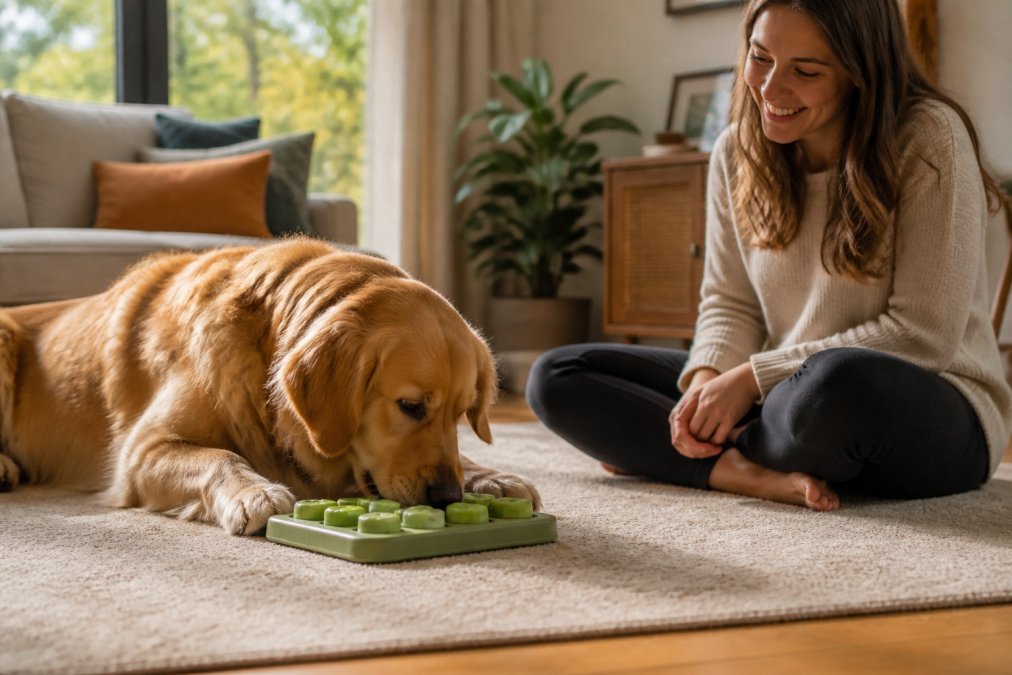
A common mistake is expecting your dog to figure out a puzzle immediately. Most dogs need several short sessions across a few days to understand the mechanics, and that is completely normal. The Chewzzle SmartPaws Interactive Puzzle offers scalable difficulty, which makes it an ideal starting point because you can leave compartments open at first and gradually close them as your dog gains confidence.

Separation anxiety is one of the hardest behavioral challenges a dog owner can face, but you do not have to solve it with training alone. The right enrichment tools, used consistently, can reduce stress, prevent destructive behavior, and give your dog a healthy outlet for their nervous energy. Chewzzle offers a full range of interactive puzzle toys and slow feeders designed to boost mental stimulation, promote healthier eating habits, and reduce anxiety at every stage of your dog's life. Explore our collection of durable, non-toxic puzzle toys and find the right match for your dog's needs today.
Frequently Asked Questions
What is the best toy for a dog with separation anxiety?
The best puzzle toy for separation anxiety combines treat-dispensing features with durability and safety. Look for toys that encourage problem-solving and slow-paced engagement, like the Chewzzle SmartPaws Interactive Puzzle ($39.99) or the SnuffleSphere Foraging Ball ($29.99). These toys redirect anxious energy into mental work, keeping your dog focused on the puzzle rather than your absence. Choose based on your dog's chewing intensity and food motivation level.
How do I choose a safe puzzle toy for a dog left alone?
Select toys made from non-toxic, durable materials that won't break apart if chewed aggressively. Avoid toys with small removable parts that could become choking hazards. The Chewzzle ThinkDisc Puzzle Feeder ($19.99) features a non-slip base and sturdy construction designed for unsupervised play. Always supervise the first few sessions to ensure your dog solves rather than destroys the toy. Start with toys rated for your dog's size and chewing intensity.
Can interactive toys prevent destructive behavior in anxious dogs?
Yes, when used as part of a broader desensitization plan. Puzzle toys redirect destructive impulses by providing mental stimulation and positive reinforcement through treat rewards. Dogs engaged in problem-solving are less likely to pace, vocalize, or chew destructively. However, toys alone won't eliminate separation anxiety. Combine them with gradual desensitization exercises, counterconditioning to your departure cues, and consistent routines for best results.
How long should my dog play with a puzzle toy to reduce stress?
Most dogs benefit from 15-30 minutes of puzzle toy engagement daily, though this varies by individual anxiety level and toy complexity. Start with shorter sessions and observe your dog's focus. Some dogs stay engaged for longer periods with treat-dispensing toys like the PuzzleFeast Sliding Puzzle ($49.99), which paces food delivery and extends playtime naturally. The goal is sustained mental work that tires the brain, not just quick treat consumption.