

How Can You Manage Dog Food Aggression Safely?
Last Updated: October 31, 2026
Quick Summary
You can manage dog food aggression safely by feeding in a quiet, low-traffic spot, setting the bowl down and walking away, and leaving the dog alone while eating. Never take the bowl away to prove you can, since that confirms the dog's fear and makes guarding worse. Rebuild trust slowly with counterconditioning exercises kept below the dog's threshold.
- Dog food aggression is a fear response, not a dominance play, so punishment makes it worse.
- Stiffening when someone approaches the bowl is the signal to act, before a growl appears.
- In multi-dog homes, feed each dog separately using crates, baby gates, or different rooms.
- Advance training stages only after three consecutive calm sessions with no stiffening or growling.
- Get professional help for any bite that breaks skin or guarding aimed at children.
Table of Contents
- Why Dogs Guard Food and What It Means
- Signs of Food Aggression in Dogs: Read the Body Language Early
- How to Feed a Food-Aggressive Dog Without Getting Bitten
- Feeding Multiple Dogs Separately: Crates, Barriers, and Sightlines
- Resource Guarding Training Exercises That Build Trust
- When to Get Professional Help for Dog Food Aggression
- Slow Feeders and Puzzle Toys: Calming Mealtime for Guarders
- Build a Calmer Mealtime Routine with Chewzzle
- Frequently Asked Questions
Why Dogs Guard Food and What It Means
Dog food aggression is a fear response, not a dominance play. When a dog growls over a bowl, they're saying "I feel threatened" in the only language they have.
Resource guarding is the technical term for a dog protecting something they value.
Here's what matters most: the behavior runs on anxiety. A guarding dog isn't trying to be the boss. They're worried the food will disappear.
Resource Guarding vs. Simple Excitement
A dog who spins and barks at dinner time is excited. A dog who freezes over the bowl is guarding. The difference lives in the body.
Excited dogs have loose, wiggly movement. Guarding dogs go still, lower their head over the food, and track you with their eyes. One is joy. The other is a stress response, and it needs a different plan.
Signs of Food Aggression in Dogs: Read the Body Language Early
The signs of food aggression in dogs follow a ladder, and catching the early rungs prevents bites. Most dogs warn before they snap. The problem is that owners often miss the quiet warnings.
Watch for these signals, roughly from mild to serious:
- Stiffening when a person or dog approaches the bowl
- Eating faster when someone walks by
- Freezing with the head lowered over the food
A common mistake is waiting for the growl before taking the behavior seriously. Stiffening is the signal to act. By the time a dog snaps, the fear is already deep.
How to Feed a Food-Aggressive Dog Without Getting Bitten
The safest approach is to stop testing the dog and start managing the environment. Feeding a food-aggressive dog safely means removing the conflict from mealtime entirely, then rebuilding trust slowly.
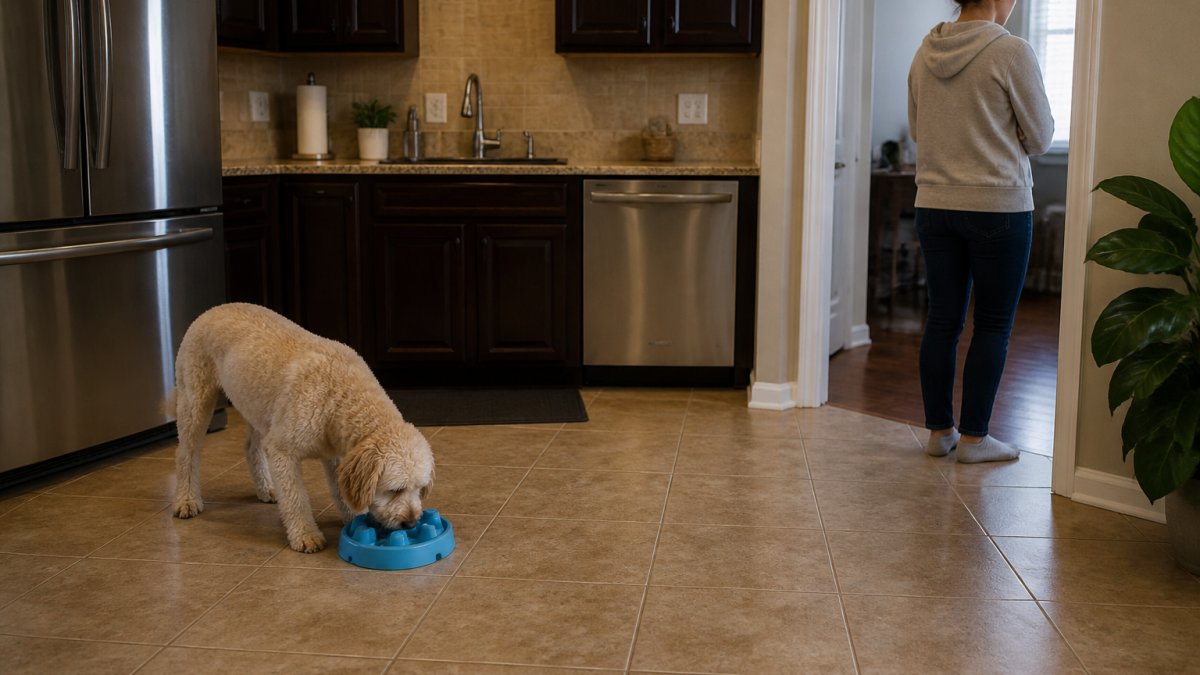
Start with these steps:
- Feed in a quiet, low-traffic spot. A corner away from doorways and walkways lowers stress.
- Set the bowl down and walk away. No hovering, no petting, no hands near the bowl.
- Leave the dog alone while eating. Don't take the bowl away to "prove" you can. That teaches the dog to guard harder.
- Pick up the empty bowl after the dog walks off. Not before.
- Keep kids and visitors clear during meals.
Setting Up a Safe Feeding Zone
A safe feeding zone is a fixed spot where the dog eats undisturbed, every single time. Predictability is the whole point. When the dog knows meals happen in the same calm place with no surprises, the guarding instinct has less to react to.
A mat-stay cue helps here. Teaching your dog to hold a spot before and during meals keeps them calm and fixed in place.
These are the core steps for feeding a food-aggressive dog safely.
| Step | What to do |
|---|---|
| 1 | Feed in a quiet, low-traffic spot |
| 2 | Set the bowl down and walk away |
| 3 | Leave the dog alone while eating |
| 4 | Pick up the empty bowl after the dog walks off |
| 5 | Keep kids and visitors clear during meals |
Feeding Multiple Dogs Separately: Crates, Barriers, and Sightlines
In a multi-dog home, feeding multiple dogs separately is not optional. It's the baseline. Even dogs who get along fine can clash over food, and a fight over a bowl can turn serious in seconds.
Set up separate feeding stations using:
- Crates, one dog per crate, fed inside with the door closed
- Baby gates or barriers to divide a room
- Different rooms if space allows
Watch out: feeding dogs side by side "so they learn to share" often backfires. Competition raises stress, and stress fuels guarding. Separate is safer.
If your dogs eat fast, slowing meals down helps too.
Resource Guarding Training Exercises That Build Trust
Resource guarding training works by changing how the dog feels about people near food. This is counterconditioning: pairing your approach with something the dog loves so the fear fades. Desensitization training is the core method behind this work.
Before you start, set two ground rules. First, every session happens below the dog's threshold, the point where they stiffen, freeze, or growl. Second, if the dog crosses that line, the session is over and you step back a stage.
Stage 1: Baseline and Safe Distance
Pick a time when the dog is eating a meal they value moderately, not their favorite chew. Stand at the distance where the dog notices you but keeps eating with a loose body.
At that distance, toss a high-value treat toward the bowl, then walk away. Do this two or three times per meal. Keep sessions under two minutes.
Stage 2: Close the Gap in Small Steps
Move one to two feet closer only after Stage 1 is solid. At each new distance, toss a treat and retreat. If the dog stiffens, pauses eating, or tracks you with whale eye, you have found the edge, return to the last comfortable distance for two more meals before trying again.
A common pattern is to rush this stage because the dog "seems fine." Watch the body, not the bowl. A dog who keeps eating but goes still is not relaxed.
Stage 3: Approach and Retreat
Once you can stand a few feet away calmly, practice a single step toward the bowl, toss a treat, and step back. Repeat three to five times per session, then end. Do not reach for the bowl yet. The goal is for your approach to predict something good, not a test.
Stage 4: Hand-Feeding and Adding Food
When the dog stays loose through Stage 3, switch some meals to hand-feeding or bowl-top additions. Drop a treat into the bowl as you pass, or hand-feed kibble one piece at a time. This builds the association that hands near food mean more food, not less.
Trade-Up and Drop-It Games
The trade-up game teaches a dog that giving something up pays off:
- Offer a low-value item, like a plain toy.
- Say "trade" and present a high-value treat.
- When the dog drops the item for the treat, praise and return the item.
- Repeat, slowly working toward higher-value items.
The drop it cue follows the same logic. Practice with toys before food, and never rush the ladder. A dog who learns that letting go brings something better has less reason to guard in the first place.
Progression Checklist
Advance a stage only when all three are true:
- The dog keeps eating or holds a loose body at the current distance for three consecutive sessions.
- No stiffening, freezing, whale eye, or growl during the session.
- You can end the session calmly without the dog following or guarding the area.
Pause and step back a stage if any of these appear: the dog stops eating when you approach, the growl returns, or the dog guards the empty bowl after the meal. If guarding escalates despite correct pacing, stop DIY training and see the professional-help section below.
When to Get Professional Help for Dog Food Aggression
Get professional help when the dog has snapped, bitten, or drawn blood, or when guarding extends beyond food to toys, spaces, or people. These cases need a qualified behavior professional, not a DIY plan. The harder question is which professional, and how to tell a humane, evidence-based one from a trainer who will make the problem worse.
Red Flags That Mean Call in Help Now
- Any bite that breaks skin, even a single puncture
- Snapping or air-snapping at a person or another pet
- Guarding aimed at children
A sudden onset in an adult dog is a medical flag as much as a behavioral one. Pain, dental disease, gastrointestinal discomfort, and age-related changes can all make a dog irritable around food. A veterinary assessment is the right first step before any training plan.
Know the Credentials
Titles in this field are not interchangeable. Look for:
- Veterinary behaviorist, a licensed veterinarian with board certification in behavior. This is the highest level of qualification and the right choice for bite cases, sudden-onset guarding, or dogs with medical complexity.
- Certified applied animal behaviorist, a professional with a graduate degree in behavior science and certification through a recognized behavior society.
- Certified professional dog trainer, a trainer who has passed an independent certification exam and commits to continuing education. Useful for general obedience and management support, but not the right lead on a bite history.
Ask directly: What certification do you hold, and through which organization? How many food-guarding cases have you handled in the past year? What is your protocol if the dog bites during a session?
What Humane Help Looks Like
A qualified professional should:
- Use reward-based, force-free methods and explain the learning principle behind each step.
- Refuse to use punishment, dominance handling, or "alpha" techniques around food.
- Start below the dog's threshold and build a written plan with measurable stages.
What to Do Right After a Snap or Bite
If a bite happens, separate the dog from people and pets using a barrier, not your hands. Clean any wound and seek medical attention for a bite that breaks skin. Do not scold or punish the dog after the fact, it will not connect the correction to the bite and will raise the dog's stress around food.
Slow Feeders and Puzzle Toys: Calming Mealtime for Guarders
Puzzle toys and slow feeders change the shape of mealtime, and that helps guarding dogs in two ways. First, they slow eating, which eases the frantic rush that fuels tension. Second, they give the dog a job, which lowers anxiety.
For food puzzles that redirect mealtime focus, the Chewzzle ThinkDisc Puzzle Feeder ($19.99) hides kibble under sliding covers and a turning wheel, so a bowl that vanished in seconds takes several minutes.
A few things to keep in mind with puzzle feeders and guarding dogs:
- Feed puzzles in the safe zone, away from people and other dogs.
- Supervise early sessions, especially with plastic-chewing dogs.
- Start easy so the dog gets a quick win and stays relaxed.
Build a Calmer Mealtime Routine with Chewzzle
Managing dog food aggression comes down to three habits: give the dog space, feed separately, and rebuild trust slowly with positive reinforcement. None of it happens overnight. But consistency beats intensity every time.
Chewzzle puzzle toys and slow feeders turn mealtime into a calm, focused game instead of a race.
Ready to make mealtime calmer? Get started with Chewzzle and give your dog a puzzle that slows the bowl and settles the stress.
Frequently Asked Questions
What are the first signs of food aggression in dogs?
Early signs include stiffening over the bowl, freezing, hard staring, lip licking, and a slow tail wag. As stress rises you may see growling, showing teeth, or snapping when a person or another dog comes near. Watch for these signs of food aggression in dogs before they escalate, and never punish a growl. A growl is a warning that gives you time to back off and change the setup.
Should you take food away from a food-aggressive dog?
No. Reaching into the bowl or snatching food away confirms the dog's fear that people steal food, which makes guarding worse. Instead, add food to the bowl from a distance, toss a high-value treat nearby, and practice trade-up games with low-value items. If you need to remove something dangerous, use a treat toss to move the dog away first, then pick the item up.
Can resource guarding be cured?
It can be managed well in most dogs, but it is rarely cured completely. Many dogs improve steadily with management, counterconditioning, and gradual exposure, yet a history of guarding may return under stress, illness, or change. Keep the safe feeding setup in place long term, track progress, and involve a qualified trainer or veterinary behaviorist for any dog with a bite history.
Can a slow feeder help with food aggression?
A slow feeder helps indirectly. Fast eaters finish in seconds and spend the rest of mealtime anxious and watchful, which fuels guarding. A puzzle feeder like the Chewzzle ThinkDisc ($19.99) or the RollFeast Treat Ball ($9.99) stretches a meal over several minutes of sniffing and problem-solving, so the dog is calmer and more focused on the puzzle than on who is nearby. Pair it with a quiet, separate feeding spot for best results.
