

How to Use Puzzle Feeders to Build Confidence in Shy Dogs
Last Updated: November 3, 2026
Quick Summary
To learn how to use puzzle feeders to build confidence in shy dogs, start with the feeder empty and let the dog investigate at their own pace, then progress through five staged steps, moving on only when the dog meets each readiness criterion. Keep sessions under five minutes, end on a win, and stop immediately if you see stress signals.
- Start with the feeder empty and let the dog sniff it with no food, pressure, or coaxing.
- Move to the next step only after two calm successes in a row at the current level.
- Limit the first week to one or two sessions per day, each under five minutes.
- Place the feeder in a low-traffic corner with a wall behind the dog and other pets out.
- Avoid hand-luring, which teaches the dog to wait for you to start the puzzle.
Table of Contents
- Why Puzzle Feeders Build Confidence in Shy Dogs
- How to Introduce a Puzzle Feeder to a Dog Without Overwhelming Them
- Choosing Puzzle Toys for Fearful Dogs: What to Look For
- Understanding Dog Puzzle Feeder Difficulty Levels
- What to Do When a Dog Is Not Food Motivated
- Spotting Stress, Fear, and Frustration During Puzzle Work
- Troubleshooting Dogs Who Freeze, Avoid, or Abandon the Feeder
- Measuring Confidence Gains and Keeping Sessions Safe
- Frequently Asked Questions
Why Puzzle Feeders Build Confidence in Shy Dogs
A shy dog doesn't need a bigger personality. They need proof that the world is safe.
Here's the core principle: a puzzle feeder gives a nervous dog a job. The dog sniffs, nudges, and solves, and food appears as a direct result of their own actions.
A puzzle feeder is a food-dispensing toy that requires a dog to solve a simple problem, such as sliding a cover or pawing a compartment, before eating. The solving is the point, not the food.
How Foraging Turns Fear Into Focus
Foraging is the act of working for food by sniffing and searching. It's what dogs were built to do. When a shy dog forages, their brain shifts from scanning for threats to tracking a scent. That shift is the confidence engine. American Veterinary Medical Association guidance on behavioral enrichment notes that mentally stimulating activities support a dog's overall behavioral health, and sniffing work is one of the easiest forms to offer at home.
The Confidence Loop: Small Wins, Bigger Challenges
Confidence isn't taught. It's accumulated. We call it the confidence loop:
- Small win: the dog noses a partly open cover and gets kibble
- Repeated success: the same move works every time
- Slight stretch: one cover is a little harder to move
Each pass through the loop raises the dog's baseline. The trick is keeping the stretch small. A dog who fails repeatedly doesn't get braver. They get more convinced the puzzle is a threat.
How to Introduce a Puzzle Feeder to a Dog Without Overwhelming Them
Start with the feeder empty and the dog in the room. Let them sniff it, walk around it, and leave. No food, no pressure, no coaxing. This one step prevents most of the problems people hit later.
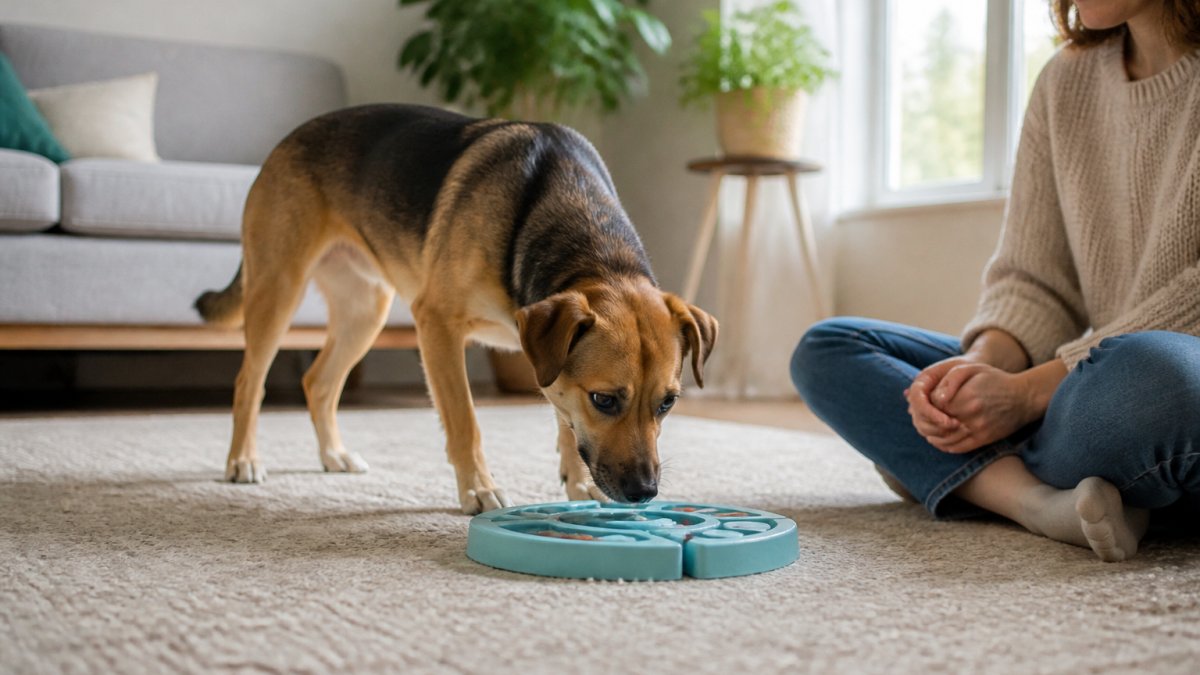
A Five-Step Introduction Plan for Shy Dogs
The plan below for how to use puzzle feeders to build confidence in shy dogs is staged, not scripted. Each step has a readiness criterion you must see before moving on.
- Set the feeder down empty. Let the dog investigate on their own schedule. End the session after a minute or two. Readiness: the dog approaches the feeder voluntarily and sniffs it without backing away.
- Scatter kibble around it. Food on the floor near the toy teaches the dog that the object predicts good things. Readiness: the dog eats the scattered food while standing near the feeder, not while glancing at it from across the room.
- Load one easy compartment and leave the cover off. Let the dog eat and walk away. Readiness: the dog takes food from the open compartment and returns to it for more without prompting.
- Replace the cover, but leave it loose. A single nose touch should move it. Readiness: the dog moves the cover with one deliberate nose or paw touch and eats the revealed food.
- Add one more step of difficulty per session. Only move forward after two calm successes in a row. Readiness: two consecutive sessions where the dog solves the current setup without stress signals and without you pointing or tapping the toy.
Keep sessions to a few minutes and always end on a win. If your dog is brand new to this, our first-time guide to introducing a puzzle feeder walks through the same sequence in more detail.
Setting Up the Room and the Session
Where you place the feeder matters as much as how you load it. Put it in a low-traffic corner with a wall behind the dog so they are not approached from behind.
Limit the first week to one or two sessions per day, each under five minutes. A common pattern is that the dog does well on day one, then avoids the feeder on day two because the first session was too long. If that happens, skip a day and restart at step two.
Watch out: Do not lure the dog to the feeder with a treat in your hand. Hand-luring teaches the dog to wait for you to start the puzzle, which undercuts the whole point of independent problem-solving.
Choosing Puzzle Toys for Fearful Dogs: What to Look For
The best puzzle toy for a fearful dog is one they can win at on the first try.
What matters most:
- Low, stable base. A toy that slides across the floor feels unpredictable. A non-slip bottom keeps the puzzle still.
- Visible food. The dog should be able to see or smell the reward before they commit.
- One simple action. Sliding is easier to learn than lifting or flipping.
For a cautious dog, the Chewzzle ThinkDisc Puzzle Feeder fits this list well. Its paw-shaped covers slide aside, and the non-slip rubber base stays put while a nervous dog pushes at it.

Watch out: Avoid stuffing a fearful dog's first puzzle with high-value treats they've never had. A new food plus a new object is two unknowns at once.
Understanding Dog Puzzle Feeder Difficulty Levels
Puzzle feeders generally fall into three levels: beginner, intermediate, and advanced. Beginner puzzles hide food under loose covers or in open troughs. Intermediate puzzles add sliding, rotating, or multi-step mechanisms. Advanced puzzles combine several actions in sequence.
Matching the Feeder to Your Dog's Current Skill
Match the level to what your dog can already do, not to their age or size.
| Level | What the dog does | Best for | Example |
|---|---|---|---|
| Beginner | Noses loose covers, eats from open troughs | First sessions, highly fearful dogs | ThinkDisc with covers off |
| Intermediate | Slides covers, turns a wheel | Dogs with a few calm wins | ThinkDisc fully loaded |
| Advanced | Works a sequence of buttons | Confident, food-driven dogs | Sliding-button boards |
If you want a product that grows with your dog, the Chewzzle PuzzleFeast Sliding Puzzle starts easy.

A common mistake is buying the hardest puzzle first because it looks impressive. In practice, that's the fastest way to teach a shy dog that puzzles are frustrating.
What to Do When a Dog Is Not Food Motivated
Some dogs won't work for kibble, and that's not a training failure. It's information. Try these swaps before giving up on puzzle work.
- Use a portion of their regular meal. Skip the bowl and put the same food in the feeder.
- Try a wet food smear. A thin layer of wet food in the compartments adds scent.
- Test a toy with a different action. Some dogs ignore covers but love pushing a wheel.
If your dog is on a medically restricted diet, check with your vet before adding any new food to puzzle sessions. Never swap their prescribed food for treats without guidance.
Spotting Stress, Fear, and Frustration During Puzzle Work
Stop the session the moment you see stress signals. A calm dog keeps working. A stressed dog needs an exit.
Watch for these:
- Freezing mid-session, especially with ears back
- Lip licking or yawning when no food is involved
- Turning away from the feeder or leaving the room
Frustration looks different from fear. A frustrated dog usually stays engaged but gets noisy or pushy. That's a sign the puzzle is a step too hard, not a reason to quit. If you're seeing genuine fear signals, our step-by-step guide to calming an anxious rescue dog covers the broader picture.
What to Do in the Moment
Match your response to what you see, not to what you hoped the session would be.
- Freezing: stop moving, do not reach for the toy, and wait ten seconds. If the dog does not unfreeze, end the session by walking away and leaving the feeder in place. Do not pick the dog up or coax them.
- Lip licking or yawning: simplify immediately by removing one cover or scattering a few pieces of food on the floor beside the feeder. If the signal repeats, end the session.
- Turning away or leaving: let them go. Do not call them back. Try again the next day at a lower difficulty.
A useful rule is the ten-second test: if the dog has not re-engaged with the feeder within ten seconds of a pause, the session is over for the day. Ten seconds is long enough for a calm dog to reset and short enough that a stressed dog is not left waiting in a difficult spot.
Measuring Confidence Gains
Confidence shows up in small behaviors, not big ones. Track these over a few weeks:
- The dog approaches the feeder without being called
- Session length grows from one minute to five
- The dog tries a new compartment without backing off
If you see two or more of these, the plan is working. If you see none after several weeks, drop the difficulty and rebuild.
Watch out: Do not treat a dog who finishes a puzzle quickly as ready for the next level. Speed can be confidence, but it can also be a dog who has learned to rush through a setup they find stressful.
Troubleshooting Dogs Who Freeze, Avoid, or Abandon the Feeder
A dog who freezes isn't being stubborn. They're overwhelmed. Drop the difficulty by two steps and start again.
Here's how to handle the three most common stalls:
- Freezing: Remove the covers entirely. Let the dog eat from open compartments for a few sessions.
- Avoiding: Move the feeder to a quiet spot and leave it there with food visible. Walk away. Let the dog approach without an audience.
- Abandoning mid-session: End the session. Try again tomorrow with an easier setup.
Watch out: Don't pick up the feeder and hand the food to your dog when they give up. That teaches them that quitting works better than trying.
Measuring Confidence Gains and Keeping Sessions Safe
Confidence shows up in small behaviors, not big ones. Track these over a few weeks:
- The dog approaches the feeder without being called
- Session length grows from one minute to five
- The dog tries a new compartment without backing off
If you see two or more of these, the plan is working. If you see none after several weeks, drop the difficulty and rebuild.
Safety basics matter as much as progress. Supervise every session, especially with a dog who chews plastic rather than solves it.
For more low-pressure ideas that pair well with puzzle work, our guide to keeping a shy dog entertained has seven options that don't require any training at all.
Frequently Asked Questions
Do puzzle feeders actually help shy or anxious dogs, or will they make things worse?
Foraging gives a nervous dog a job to do, which can shift attention away from whatever is worrying them and onto a solvable problem. The key is pressure. A shy dog needs easy wins first, short sessions, and the option to walk away. If you start with a hard puzzle or hover over your dog, the feeder becomes another source of stress. Begin with food barely hidden, keep sessions to a few minutes, and only add difficulty after your dog is clearly relaxed and eager.
How long should a shy dog use a puzzle feeder at a time?
Start with two to five minutes for a nervous dog, once or twice a day. Watch for relaxed body language: loose posture, easy sniffing, a wagging tail. If your dog freezes, walks away, or starts panting, end the session and try again later with an easier setup. As confidence grows, you can stretch sessions to ten or fifteen minutes and use the feeder for part of a regular meal. Short, frequent sessions build more confidence than one long one.
What if my dog is not food motivated and ignores the puzzle feeder?
Try higher-value food first: small pieces of cooked chicken, cheese, or a favorite treat instead of kibble. You can also use a portion of your dog's regular meal when they are genuinely hungry, and place food where it is partly visible so success is almost guaranteed. If food still does not work, some dogs are more motivated by praise, a favorite toy, or the chance to sniff. A snuffle mat or a simple treat scatter in a towel can be a lower-pressure starting point before moving to a puzzle feeder.
How can I tell whether a puzzle feeder is helping my dog feel more confident?
Look for small, consistent changes rather than a dramatic transformation. Signs of progress include approaching the feeder sooner, sniffing and pawing instead of freezing, staying engaged for longer, recovering faster after a startle, and trying a new compartment without encouragement. Keep a simple log of session length and how quickly your dog engages. If those numbers trend up over a few weeks, the work is paying off. If your dog consistently avoids the feeder, drop back to an easier setup.
Building a shy dog's confidence takes patience, and the right tools make the work easier. At Chewzzle, we build puzzle feeders with non-slip bases, sliding covers, and durable non-toxic materials so a nervous dog can win at their own pace. Start with one easy puzzle, keep sessions short, and let the small wins stack up. Get started with Chewzzle and turn mealtime into a confidence-building routine your dog actually looks forward to.
