

How to Reduce Separation Anxiety in Rescue Dogs
Table of Contents
- Why Rescue Dogs Get Separation Anxiety
- Signs of Separation Anxiety in Dogs vs. Boredom
- The Decompression Phase: What Your Rescue Needs First
- Mental Stimulation for Anxious Dogs: Why It Works
- How Long to Leave a Rescue Dog Alone (and How to Build Up to It)
- Step-by-Step Desensitization and Counterconditioning Protocol
- Medication vs. Training: When to Consult a Veterinary Behaviorist
- Frequently Asked Questions
Last Updated: September 25, 2026
Why Rescue Dogs Get Separation Anxiety
Separation anxiety in rescue dogs is a panic response to being left alone, not disobedience or spite. It develops when a dog forms an intense attachment and then panics at the absence of their person. This guide from Chewzzle walks through a practical, step-by-step plan to reduce separation anxiety in rescue dogs, from the first quiet week at home to a full desensitization protocol.
Rescues arrive with a specific disadvantage: their attachment style forms fast and hard. A dog who has already lost one home can bond intensely with the next person, and every departure then echoes that first loss. You cannot train that away with a stern voice. You have to rebuild the dog's sense of safety, and that takes weeks, not days.
The American Veterinary Medical Association's guidance on behavioral health treats separation anxiety as a diagnosable behavioral condition, not a training gap. That distinction matters: it changes the tools you reach for.
Signs of Separation Anxiety in Dogs vs. Boredom
The core difference is timing and intensity. Separation anxiety symptoms appear within minutes of your departure and include pacing, vocalization, house soiling, and destructive behavior aimed at exits. Boredom-based chewing happens later and is not tied to your leaving.
How to Tell the Difference
A bored dog destroys things because nothing else is available. An anxious dog destroys things because the door is closed and they are trying to get out. Watch for these separation distress markers:
- Pacing in a fixed path, often along the door or window
- Vocalization that starts within 30 minutes of departure
- House soiling by a dog who is otherwise reliably house-trained
- Destructive behavior concentrated at doors, window frames, or crates
- Drooling, trembling, or a stressed body language posture
Set up a camera for one normal workday. The footage tells you more in two hours than a week of guessing.
| Behavior | Anxious Dog | Bored Dog |
|---|---|---|
| Timing | Within 30 minutes of departure | Any time, often later |
| Target | Doors, windows, crates | Anything chewable |
| Body language | Pacing, trembling, drooling | Relaxed, curious |
| Recovery | Still stressed when you return | Greets you normally |
The Decompression Phase: What Your Rescue Needs First
Decompression is the first two to four weeks after adoption, when a rescue dog needs low demands and high predictability. Training a dog in this phase, including separation work, usually backfires because the dog has not yet settled. The mistake most new owners make is treating the first week like a training boot camp. The dog is not being stubborn; their stress hormones are still elevated from the shelter, transport, and the loss of the previous home.
Many trainers describe a "3-3-3" pattern: roughly three days to decompress, three weeks to settle, three months to feel fully at home.
New Arrival Stress vs. Chronic Separation Anxiety
This is the distinction most guides skip, and it changes your entire plan. New arrival stress is situational: the dog is unsettled because everything is unfamiliar. Chronic separation anxiety is a panic response that persists after the dog has settled and bonded. The two look similar in week one and require different responses.
| Signal | New Arrival Stress | Chronic Separation Anxiety |
|---|---|---|
| Onset | First days to two weeks | After the dog has bonded, often 3+ weeks in |
| Trigger | Novelty, noise, unfamiliar people | Your departure specifically |
| Alone at home | May sleep or shut down | Paces, vocalizes, targets exits |
| Response to routine | Improves steadily | Plateaus or worsens without behavior modification |
A Week-by-Week Decompression Schedule
Week 1, Zero demands. No training sessions, no separation practice, no visitors if you can avoid them. Feed at the same times, walk the same short route, and let the dog choose where to rest. Hand-feed a few meals to build a positive association with you without asking for obedience.
Building a Predictable Routine
A predictable routine lowers cortisol levels by removing uncertainty. Feed, walk, and rest at the same times daily. Keep arrivals and departures low-key. For a dog who needs to burn nervous energy, a American Kennel Club overview of canine enrichment is a useful starting point for structured activity.
Mental Stimulation for Anxious Dogs: Why It Works
Mental stimulation for anxious dogs works because it redirects nervous energy into problem-solving, which lowers arousal rather than raising it. A dog working a puzzle is not rehearsing the door.
Chewzzle SmartPaws Interactive Puzzle →
How Long to Leave a Rescue Dog Alone (and How to Build Up to It)
How long to leave a rescue dog alone depends on the individual dog, but a common approach is to start with absences measured in seconds and add time only when the dog stays calm. Never jump from ten minutes to four hours.
Step-by-Step Desensitization and Counterconditioning Protocol
Desensitization and counterconditioning means exposing your dog to departure cues in tiny doses while pairing them with something good. The goal is to change what the cues mean. Most guides give you a bulleted list and stop there. What follows is a structured, week-by-week protocol with session lengths, threshold criteria, and a way to measure whether it is working.
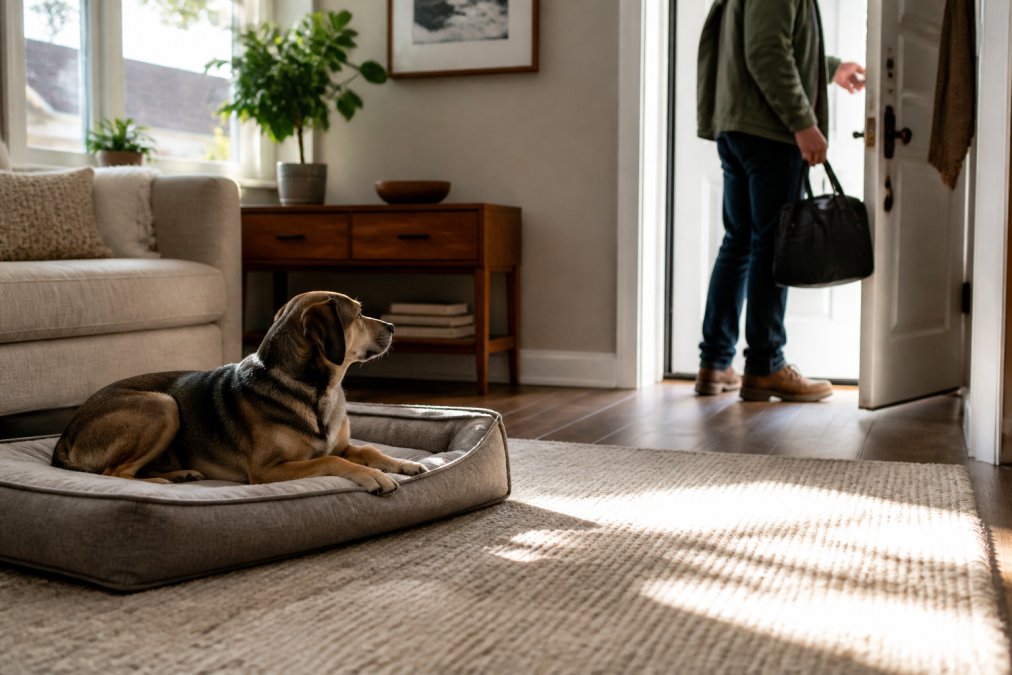
Before You Start: Set Your Baseline
Pick a cue list and rank it from mildest to strongest. A typical order runs: picking up keys, putting on shoes, putting on a coat, picking up a bag, walking to the door, touching the doorknob, opening the door, stepping outside, starting the car. Your dog's list may differ. Write yours down and keep it visible.
The Four-Week Protocol
Week 1, Cue desensitization only, no departures. Pick the mildest cue. Pick up the keys, then immediately give a stuffed food toy or a puzzle loaded with part of the dog's kibble. Put the keys down. Repeat 10 to 15 times per session, two sessions per day, each under five minutes. Move to the next cue only when the dog shows no reaction, meaning no head turn, no whine, no rise from the resting position, for two consecutive sessions.
How to Know It Is Working
Track three numbers in a notebook or a notes app: the longest absence the dog tolerated calmly, the number of seconds before the first stress signal on camera, and the number of sessions per week. Progress looks like a rising first number and a rising second number. If the first number is flat for two weeks, you are either moving too fast or the dog needs veterinary support.
Managing Departure Cues and Triggers
Calm departures matter more than long ones. Do not make a production of leaving or returning. No long goodbyes, no excited greetings. Trigger stacking, where several stressors pile up in one day, is what pushes many anxious dogs over the edge, so keep the rest of the day quiet on training days. Skip the dog park, the grooming appointment, and the house full of guests on the same day you run a duration session.
Medication vs. Training: When to Consult a Veterinary Behaviorist
Medication and training are not competing options; for severe cases they work together. A veterinary behaviorist can assess whether anxiety medication should support your behavior modification plan.
Frequently Asked Questions
How long does it take for a rescue dog to get over separation anxiety?
There is no fixed timeline. Some rescue dogs settle within a few weeks of a predictable routine and decompression, while others need months of gradual desensitization. Progress depends on the dog's history, the severity of the anxiety, and how consistently you practice calm departures. Track small wins, like a dog staying relaxed for 10 minutes instead of 2, rather than waiting for a single breakthrough moment.
Can interactive toys help reduce separation anxiety in dogs?
Interactive puzzle toys give anxious dogs a constructive outlet during alone time. Food-dispensing puzzles like the Chewzzle ThinkDisc Puzzle Feeder or MindMaze IQ Puzzle turn a portion of kibble into several minutes of sniffing and problem-solving, which redirects focus away from pacing and vocalization. Use them as part of a broader behavior modification plan, not as a standalone fix, and introduce them while you are still home so the toy feels positive.
Should I crate train a rescue dog with separation anxiety?
It depends on the dog. Some rescues find a crate calming, while others with confinement-related trauma panic inside one. Watch your dog's body language: if crating leads to heavy drooling, destructive behavior, or house soiling, the crate is adding stress rather than reducing it. A safe space can be a crate, an exercise pen, or a gated room, as long as your dog can settle there calmly before you leave.
What is the difference between boredom and separation anxiety in dogs?
Boredom-related destruction tends to happen anytime your dog is under-stimulated, even when you are home, and the mess is usually scattered and playful. Separation anxiety is tied specifically to your absence: pacing, vocalization, and destructive behavior start within minutes of your departure and often focus on exits like doors or windows. A camera recording your dog's alone time is the fastest way to tell which one you are dealing with.